

Brown University Students Fled After Handwritten Final Put AI-Era High Marks to the Test
Following a campus tragedy, Serrano initially offered take-home assessments, causing enrollment to skyrocket to 86 students

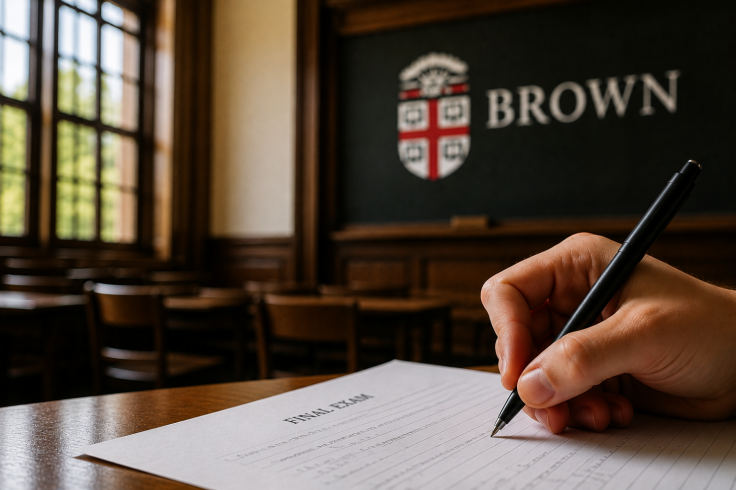
When an Ivy League economics professor suspected his class was outsourcing their coursework to artificial intelligence, he decided to pull the plug on digital testing. Returning to traditional pen-and-paper exams for the final assessment at Rhode Island's prestigious Brown University completely transformed the playing field.
What followed was an unprecedented collapse in grades that has sparked a major debate over academic integrity in the age of ChatGPT.
Attending an Ivy League institution implies a high level of natural intelligence, meaning these students are more than capable of mastering their coursework without relying on generative AI.
Yet the reality of navigating a fiercely competitive, high-pressure environment with an overloaded schedule makes artificial intelligence a tempting shortcut, allowing students to reclaim time for activities a chatbot simply cannot handle. Faced with that intense pressure, it raises the question of which path they ultimately choose.
The answer is starting to emerge at Brown University, where a fresh academic scandal suggests a staggering number of students are willing to cut corners.
El profesor Roberto Serrano, de la universidad de Brown, permitió a sus alumnos un examen parcial desde casa después de que los estudiantes expresaran ansiedad tras un tiroteo en. La mayoría obtuvieron calificaciones casi perfectas o perfectas.
— Antonio Ortiz (@antonello) July 9, 2026
Decidió realizar los exámenes… pic.twitter.com/QajDGff6JG
At Princeton, a recent poll indicated that nearly 30 per cent of the student body admitted to using artificial intelligence to cheat on an assignment or test. However, the current fallout at Brown University offers a clearer picture of how this misconduct manifests within a specific classroom — and the extent to which technology is replacing genuine comprehension.
The details of this incident have come to light because Roberto Serrano, the visually impaired economics professor at the centre of the controversy, refuses to let the matter drop.
Professor's Decision After Campus Tragedy
Over the past week alone, Serrano, a native of Spain, has shared his experience with two news organisations, both of which have published extensive reports on the controversy. His account traces back to December 2025, when a gunman opened fire on the Brown campus and claimed two lives, including a woman who had only recently introduced herself to him.
Deeply affected by the tragedy, Serrano chose to alter the format of his notoriously challenging spring 2026 ECON 1170 course, opting for take-home assessments for both major exams. Following this decision, the class experienced a sudden and massive surge in enrolment.
Record Enrolment Raises Questions
This notoriously demanding module has historically drawn a tiny, elite cohort; class sizes rarely exceed 30 and have occasionally fallen to just eight. That track record was shattered this term when 86 candidates flooded the course, lured by the relaxed take-home format. When the 5 March midterm results were released, the figures were genuinely unprecedented: the class average reached a staggering 96 out of 100, driven by 40 perfect scores.
"The problem with this technology is that the cost of cheating has basically gone down to zero," said Brown University professor Roberto Serrano. "It's very easy for students to succumb to the temptation." https://t.co/HYY92ntVbY
— Insider (@thisisinsider) July 9, 2026
The results marked a dramatic departure from normal performance. In a recent interview with Inside Higher Ed, Serrano explained: 'Historically the average grade in the midterm of this course has ranged between 65 and 80 [percent], and this exam was harder than the exams I wrote in the past, because... take-home is an opportunity to challenge the class a little bit more, given that you're giving the students unlimited time.'
ChatGPT Responses Trigger Alarm Bells
Aside from the suspicious results, the actual wording of the responses raised immediate red flags, reading as unnatural even when the data was accurate. According to Serrano, the submissions favoured a 'very convoluted style', a suspicion that was confirmed when he and his graduate assistants fed the identical prompts into ChatGPT and generated matching outputs.
Driven by growing suspicion, Serrano decided to return the upcoming final assessment to a traditional, invigilated format to determine whether his cohort could replicate their previous success. In a direct message to the class, he issued a clear ultimatum: 'I am not declaring [the midterm] void for now. I am going to give the class a chance to prove me wrong. That is, if the distribution of the final exam is roughly similar to the distribution of the midterm, I will count the midterm. Otherwise, which is of course what I expect to happen, I will declare the midterm void and reweigh the final accordingly.'
Final Exam Exposes Dramatic Score Collapse
The announcement triggered an immediate exodus. Eighteen students immediately abandoned the module, while a further nine failed to show up for the final exam. Regarding this group of 27 dropouts, El País noted: '22 had scored a perfect 100 in the midterm exam.'
🚨 Professor Roberto Serrano uncovered this massive AI cheating scandal in his Welfare Economics and Social Choice Theory course at Brown University.
— SunDeep Mehra (@SundeepMehra7) July 10, 2026
He suspected AI cheating after a take-home midterm averaged 96/100 with dozens of perfect scores.
He switched the final exam to… pic.twitter.com/jjSSmx7wl7
For the remaining candidates who sat the paper, the final results suffered a catastrophic collapse, with the average grade plunging from 96 to just 48.
© Copyright IBTimes 2026. All rights reserved.