

Company Behind AI Companion Robots for Intimacy Enters Us Schools With Humanoid Classroom Teacher
The pilot brings a humanoid classroom assistant from a companion robot for intimacy maker into a US public high school.

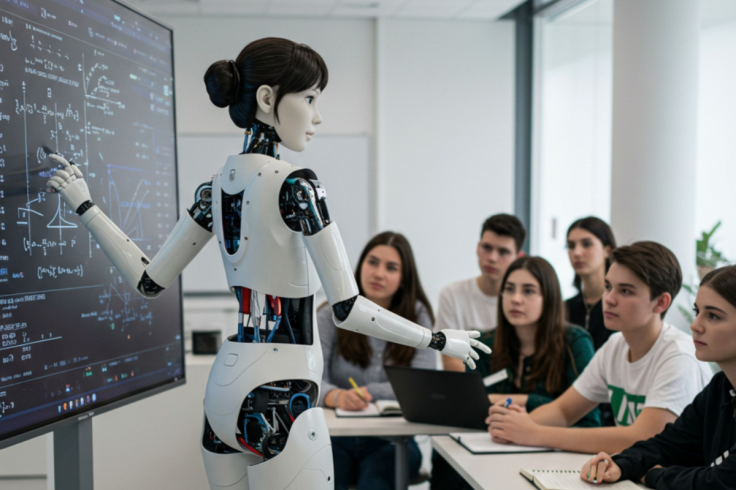
The first humanoid robot set to help teach students at a New York public school this autumn is coming from a company better known for AI-powered companion robots for intimacy.
Realbotix, the robotics firm behind AI-driven companion robots, will deploy its humanoid assistant 'Sally' at Salamanca High School in western New York, where it will help teachers deliver coding, robotics and artificial intelligence lessons.
The pilot makes Salamanca City Central School District one of the first public school districts in the United States to introduce a humanoid classroom assistant. District officials say the robot is intended to support teachers rather than replace them, even as its manufacturer is more closely associated with consumer companion robots than educational technology.
Companion Robot Maker Moves Into the Classroom
'Sally' is scheduled to begin working with Year 11 and Year 12 students when the new school year starts in September.
Unlike fully mobile humanoid robots, Sally remains seated at the front of the classroom. It can move its arms, hands and facial features but cannot walk around the room.
Students will log into the system using school credentials, allowing the robot to remember previous classroom interactions and personalise future lessons. It will assist with coding, robotics and AI courses developed through Woz Ed, the education company founded by Apple co-founder Steve Wozniak.
The district will also provide students with access to Optio, Realbotix's digital AI teaching assistant, through school computers.
School District Stresses Teachers Come First
Salamanca City Central School District has repeatedly said that the project is designed to support classroom teaching rather than automate it.
In announcing the programme, the district said, 'The Realbotix educational robot will never replace teachers, staff members, or meaningful human interaction. Instead, it serves as another instructional tool that supports educators by enhancing student engagement and providing personalised learning opportunities.'
Superintendent Dr Mark Beehler described the initiative as both exciting and unfamiliar, comparing it with earlier waves of technology that schools initially approached with caution before integrating them into everyday teaching.
The district said Sally has been built as a closed educational system rather than a general-purpose chatbot. Unlike publicly available AI tools, it cannot freely browse the internet or generate unrestricted responses. School-approved curriculum, local historical material and classroom content have been loaded into the system instead.
Officials also said the robot does not record classroom conversations or transmit student data back to Realbotix.
Company Shifts From Companion Robots to Classrooms
The classroom pilot represents a notable shift for Realbotix.
The Nevada-based company has built its reputation developing lifelike humanoid robots and AI systems for companionship, including adult-oriented products capable of holding conversations, recognising returning users and maintaining long-term interactions.
In recent months, however, the company has increasingly promoted its technology for healthcare, customer service and education as organisations explore practical uses for embodied artificial intelligence.
Chief Executive Andrew Kiguel described the Salamanca deployment as 'a landmark moment' for bringing physical AI assistants into classrooms.
Small School Trial With Wider AI Questions
The initial programme will involve only a limited number of senior students, although the district has said the project could expand if the trial proves successful.
Salamanca serves roughly 1,400 students and has one of New York state's largest Native American student populations, with more than 30% of pupils identifying as members of the Seneca Nation.
The deployment also comes as schools across the United States continue experimenting with generative AI while trying to balance educational benefits against concerns over privacy, accuracy and student dependence on automated tools.
Unlike most recent classroom AI initiatives, which have focused on software such as ChatGPT-style assistants, Salamanca's pilot places a physical humanoid robot inside the classroom, making the technology visible as well as interactive.
© Copyright IBTimes 2026. All rights reserved.