

What Is the Riemann Hypothesis? Mathematician Claims to Have Solved 167-Year-Old Maths Mystery Using AI
Levent Alpöge says he formalised the proposed argument in Lean, while mathematicians have yet to assess whether it establishes the long-unsolved result
On Friday, 20 November 2026, mathematician Levent Alpöge claimed he had discovered a proof of the Riemann Hypothesis with Anthropic's Claude AI. His announcement concerns a mathematical problem first proposed by German mathematician Bernhard Riemann in 1859, which has remained unsolved for 167 years. The proposed proof has not been independently verified.
To recall, the Riemann Hypothesis concerns the distribution of prime numbers, whole numbers greater than one divisible only by one and themselves. Alpöge described it as a central problem in number theory, with connections reaching into physics. For mathematicians, the challenge is not finding individual primes but understanding how their distribution behaves.
In his published statement, Alpöge wrote, 'I believe I have, working with Claude, discovered a proof of the Riemann Hypothesis.' He also claimed the method resolves the Generalized Riemann Hypothesis, which concerns a wider family of mathematical functions. These are claims made by Alpöge, not independently accepted results.
Holy shit. Levent Alpöge from Anthropic just claimed Claude has resolved the General Reimann Hypothesis!!!
— Deedy (@deedydas) November 20, 2026
Proof is 250,000+ pages long. Lean is released.
GRH is the 2nd of 6 Millenium prizes solved by AI, after Navier-Stokes. This may be the biggest AI math result of all time. pic.twitter.com/SqENWU7rU7
What the Riemann Hypothesis Actually Says
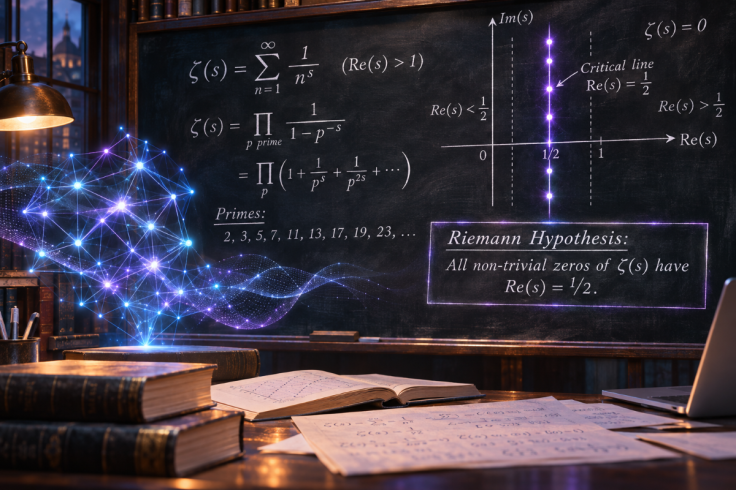
The hypothesis concerns the Riemann zeta function, a mathematical object closely linked to prime numbers. It states that every non-trivial zero of that function has a real part equal to one-half. If proved, it would sharpen mathematicians' understanding of how closely estimates can describe the distribution of primes.
That is more specific than a search for the next prime number. A proof must account for all the relevant zeros, not merely demonstrate that the statement works in a collection of examples. The distinction explains why a lengthy computer-assisted argument still demands careful examination.
Alpöge says he and Claude formalised their arguments without assumptions. His statement points to downloadable files written for Lean, software that helps check whether formal mathematical arguments follow from their stated foundations. The existence of the files alone does not show that they express and prove the intended mathematical claim.
He acknowledged that his argument remains extraordinarily long. Rather than release a conventional written exposition immediately, he opted to share the Lean material and said he intends to explain the reasoning properly. That leaves specialists with technical material to inspect, but not yet the kind of readable paper usually used to evaluate a substantial mathematical result.
How Claude AI Contributed to Alpöge's Work
Alpöge described months of work with Claude and provided a timeline of mathematical steps spanning October and November. The list includes determinants, theta lifts and calculations involving divisibility. Its final entry, dated 16 November, reads 'GRH', an abbreviation for Generalized Riemann Hypothesis.
One specific contribution he attributes to Claude concerns a chain of theta lifts. He wrote that the AI suggested setting its length to the square root of X within the proposed argument. The method's significance cannot be judged from that single detail alone.
'Claude far outpaced me near the finish line,' Alpöge wrote. He also acknowledged limited mastery of some mathematics used in the proposed proof, particularly higher-rank automorphic forms. His account gives Claude an important mathematical role rather than describing it merely as an editing assistant.
The next question for specialists is whether the formal files capture the standard hypotheses and establish the results Alpöge claims. His statement offers a proposed argument and a plan for fuller explanation. Independent scrutiny will determine what, if anything, has been proved.
© Copyright IBTimes 2026. All rights reserved.