

NASA Sent a Golden Record Message to Aliens on Voyager 1: Here Is What the 55-Language Disc Says
The Voyager 1 Golden Record carries greetings in 55 languages, music, natural sounds and 115 images intended to introduce Earth to a possible future discoverer
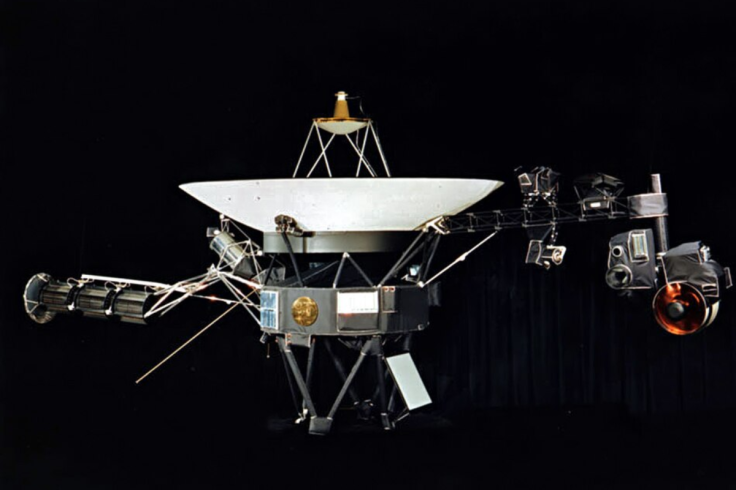
NASA's Voyager 1 spacecraft officially reached a historic distance of one light-day from Earth on Wednesday, 18 November 2026, standing 25.9 billion kilometres away in interstellar space.
Nearly five decades after lifting off in 1977, the veteran probe has become the first human-made object to cross a threshold where light and radio signals from Earth require a full 24 hours to reach the spacecraft.
Having exited the Sun's protective heliosphere in 2012, Voyager 1 continues transmitting valuable scientific data back to mission controllers, even as two-way communication now takes 48 hours.
Bolted to its exterior is the famous 12-inch gold-plated copper Golden Record, a cultural time capsule bearing the inscription 'To the makers of music, all worlds, all time'.
Curated to introduce Earth to any future extraterrestrial discoverer, the disc preserves spoken greetings in 55 languages, including Hindi, Marathi, and Punjabi, alongside Bach, Beethoven, Chuck Berry, and Surshri Kesar Bai Kerkar's classical raga 'Jaat Kahan Ho'.
What NASA Put on the Golden Record
The 12-inch gold-plated copper disc was placed aboard both Voyager 1 and Voyager 2 before their launches in 1977. NASA describes it as a time capsule, designed to communicate something of Earth's life and culture to extraterrestrials.
Its contents range well beyond spoken greetings. NASA says the record includes natural sounds, music from different cultures and eras, and greetings in 55 languages. The images present aspects of human life and the natural world, offering a visual introduction to the planet. They range from human anatomy and DNA to families, animals, landscapes and buildings.
The spoken messages are brief, but they do not all say the same thing. The Hindi greeting reads, 'Greetings from the inhabitants of this world.' The Marathi message sends the good wishes of Earth's people. The Punjabi recording says, 'Welcome home. It is a pleasure to receive you.'
Other greetings appear in Bengali, Gujarati, Kannada, Nepali, Rajasthani, Telugu and Urdu, among other languages. The selection makes the record more than a technical introduction. It preserves a range of voices from a planet whose inhabitants do not speak with one voice.
The music is just as varied. NASA's track list includes Bach, Beethoven and Mozart, alongside traditional music from Java, Senegal, Mexico, China and India. Chuck Berry's 'Johnny B. Goode' is there too, a reminder that the record was not limited to classical compositions.
India's musical contribution includes 'Jaat Kahan Ho', a raga performed by vocalist Surshri Kesar Bai Kerkar.
How NASA Made the Record Understandable
The Golden Record was not a message beamed towards a known planet. Voyager 1 and Voyager 2 are travelling along their own trajectories.
The record's cover carries diagrams intended to help a finder play it. They show how to position the stylus, read the signals as images and use the hydrogen atom's transition as a basic unit of time. A pulsar map identifies the Sun's position relative to 14 pulsars, offering a cosmic reference for locating Earth.
NASA's diagrams go further. The cover shows the stylus in its correct starting position and indicates that the disc should be played from the outside in. It also gives the time for one rotation as 3.6 seconds and explains how to reconstruct images from recorded signals.
Finally, an ultra-pure electroplated sample of radioactive uranium-238 affixed to the cover functions as a cosmic clock, allowing a future finder to measure its decay products and calculate how long the spacecraft has travelled through space.
© Copyright IBTimes 2026. All rights reserved.