

'He Doesn't Understand Social Cues Very Well Anymore': Psychologist Questions Trump's Hug With Xi Jinping
John Paul Garrison offered an interpretation of Trump's movements, while experts and diplomatic context suggest the embrace may have reflected a ceremonial exchange
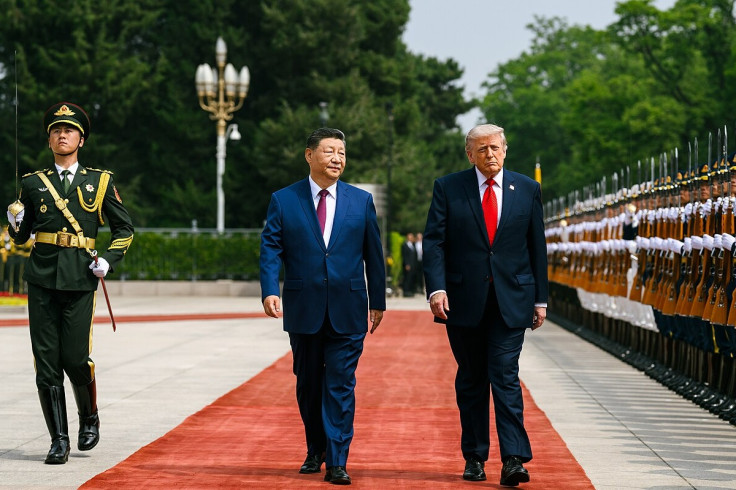
A hug between Donald Trump and Xi Jinping at Shenzhen Bao'an International Airport has prompted a psychologist to question whether the US president recognised the social cues involved. The brief embrace took place as Xi welcomed Trump to China on Wednesday, November 18, 2026.
Clinical and forensic psychologist John Paul Garrison analysed footage of the greeting, suggesting Trump struggled to recognise social cues. His comments were an interpretation of the clip, not a clinical assessment.
Xi personally welcomed Trump beside Air Force One ahead of the Asia-Pacific Economic Cooperation (APEC) summit. The two leaders shook hands and briefly hugged before walking along a red carpet.
The encounter came before Thursday's talks with Russian President Vladimir Putin, where the leaders discussed nuclear risks and international security.
Psychologist Questions Trump's Social Cues
Garrison, who uses the name Dr G, examined Trump's movements as he descended the aircraft stairs in a YouTube video. He drew attention to the president's leg movements, which he interpreted as a possible sign of anxiety.
'I think this goes to the social disinhibition I've talked about with Trump,' Garrison said.
'He doesn't understand social cues very well anymore. He doesn't understand what's appropriate.'
Garrison suggested Trump might have been caught up in the excitement of Xi's elaborate reception. Performers waving Chinese and American flags lined the red carpet, giving the welcome a markedly ceremonial feel.
'He just knows he's feeling very excited, maybe even euphoric, being there,' Garrison said.
Garrison interpreted the hug as a possible failure to restrain an impulse, connecting that view to neurological concerns he had raised previously. But the brief footage cannot establish an emotional reaction or neurological impairment. Nor do the available accounts conclusively identify which leader initiated the embrace.
Not every movement struck Garrison as unusual. He described Trump placing a hand on Xi's back as an ordinary gesture, and said leaning towards someone to speak in a noisy setting could be perfectly normal.
He also interpreted Trump touching Xi's arm as an attempt to convey friendliness and build rapport. He acknowledged that the gesture could reflect a warm diplomatic exchange rather than inappropriate behaviour.
The clip captures only a short part of the leaders' meeting. It shows their greeting, but does not reveal what either man intended by the gestures, or how they interpreted the exchange.
Xi's Unusual Welcome Offers Another Explanation
Xi's presence at the airport was itself significant. According to ABC News, it was the first time in decades that China's paramount leader had personally welcomed a foreign counterpart on arrival. The gesture contrasted with the reception given to Putin, who was met by senior Chinese official Cai Qi.
Xi's welcome also reciprocated Trump's decision to greet him at Joint Base Andrews during his visit to the United States in September, departing from customary American presidential protocol.
In an account carried by China's state-run Xinhua news agency, Xi described the airport reception as a response to the welcome he received in America, citing a tradition of reciprocal courtesy.
Ryan Hass, director of the John L. Thornton China Center at the Brookings Institution, told AFP that Xi was seeking to extend courtesy and respect to Trump while preserving stability in relations between Washington and Beijing.
That diplomatic context offers another way to understand the embrace, beyond the body language examined by Garrison. The footage confirms a brief, friendly-looking greeting between the two presidents, but cannot establish either man's intentions.
Garrison's comments should be understood as his interpretation of the footage, not a diagnosis of Trump's psychological or neurological health.
© Copyright IBTimes 2026. All rights reserved.