

Oil Prices Surge Past $100 a Barrel as Dow Futures Crash 900 Points — What It Means for Your Grocery Bill, Petrol, and Savings
Rising fuel costs are expected to push grocery prices higher in the coming weeks, hitting middle-income households the hardest
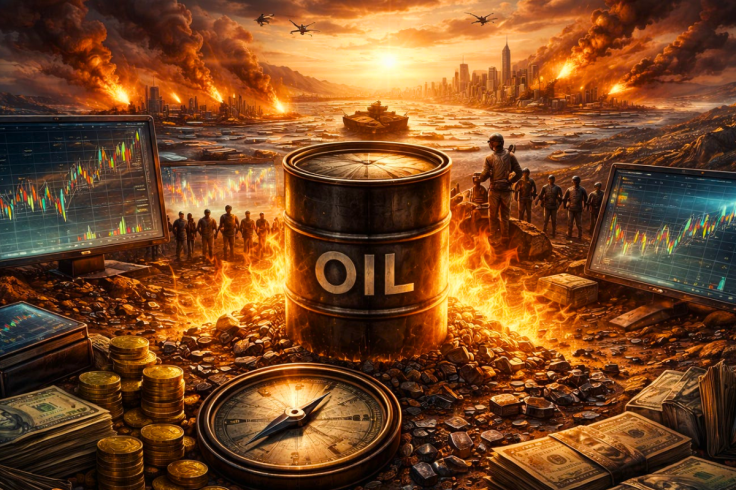
The price you pay to fill your tank, heat your home, and stock your fridge is about to climb.
Oil blasted past $100 (£75.15) a barrel on Sunday evening for the first time since 2022. US benchmark West Texas Intermediate crude jumped roughly 18% to above $107 (£80.44) a barrel, while Brent crude rose about 17% to above $108 (£81.19), according to Yahoo Finance. The 35% weekly gain marks the largest in futures trading history, dating back to 1983.
Stock markets reacted fast. Dow futures crashed around 900 points, or 1.9%. S&P 500 futures fell 1.9%, and Nasdaq 100 futures dropped roughly 2.3%.
But here's what most headlines aren't telling you: the real story isn't Wall Street. It's your wallet.
Your Petrol Bill Is the First Domino
The Strait of Hormuz, where roughly 20% of global oil passes daily, remains effectively shut. Kuwait has confirmed production cuts. Iraq's output has plunged about 70%. These aren't abstract market figures. They translate directly to higher prices at American gas stations and British forecourts alike.
Patrick De Haan, head of petroleum analysis at GasBuddy, posted on X that he now sees an 80% chance that US gas will hit $4 (£3.01) a gallon within a month. He also estimates an 85% chance that diesel reaches $5 (£3.76) a gallon within a week.
US retail gas prices have already jumped to a national average of $3.45 (£2.59) a gallon, up 47 cents from a week ago, according to AAA.
UK drivers are feeling it as well. Petrol currently averages around 136p per litre, with diesel at approximately 146p. Both have risen 3-5p per litre over the past month alone.
Heating Costs Have Already Exploded
While pump prices are climbing, heating oil has already spiked on both sides of the Atlantic. In the UK, energy comparison service BoilerJuice reported prices have surged about 117% in recent days. The End Fuel Poverty Coalition found that 1,000 litres now costs nearly £985 ($1,310), compared to £670 ($891) in January. That's a 47% jump in two months.
One Suffolk resident told BBC Radio Suffolk her 500-litre delivery jumped from £350 ($465) to around £620 ($825) within a single week. For the 1.5 million UK households relying on heating oil rather than mains gas, this isn't a market story. It's a budget crisis.
In the US, diesel prices have risen about 83 cents per gallon in just one week, according to AAA. That hits trucking costs, which means higher prices for everything that moves by road.
Groceries Will Follow in Weeks
Here's where it gets worse for households everywhere. When fuel costs rise, so does the price of moving food from farms to warehouses to supermarket shelves. The lag is typically two to three weeks.
UK food inflation stood at around 3.6% in January, according to the Office for National Statistics and British Retail Consortium (BRC). In the US, food prices rose about 3% year-over-year in late 2025, according to USDA data. Energy-driven price increases could push those numbers higher just as families thought inflation was cooling.
Middle-income households will feel this hardest. Wage growth in the US stands at around 3.8% annually, according to the Bureau of Labor Statistics. That can't keep pace with sudden energy spikes, and budgets already stretched by years of inflation have little room left.
Could Oil Hit $150 a Barrel?
Analysts at Kpler warned that oil could reach $150 (£113) a barrel by the end of March if the Strait of Hormuz remains closed, CNN reported. Energy expert Daniel Yergin described the current situation as potentially 'the biggest disruption in oil production in history.'
The global picture is alarming. European natural gas prices have jumped about 50% since the conflict began. Asian spot prices for liquefied natural gas have nearly doubled as Qatar, one of the largest LNG exporters in the world, was forced to throttle production after military strikes hit two of its facilities.
President Donald Trump posted on Truth Social that 'short term oil prices' are 'a very small price to pay' for addressing Iran's nuclear threat. Energy Secretary Chris Wright told CNN he expects US gas prices to fall back under $3 (£2.26) a gallon 'before too long'.
But for American families spending more on gas and groceries, and UK households already devoting over 10% of income to energy, 'before too long' doesn't pay this month's bills.
Every driver filling their tank, every family heating their home, every shopper buying groceries will feel this oil shock. The question isn't whether prices will rise. It's how much you can afford when they do.
© Copyright IBTimes 2026. All rights reserved.