UK 'On Brink' Of Recession — 250,000 People Could Lose Jobs By Mid-2027 Due To Iran War
A quarter of a million people could lose jobs by mid-2027 as EY Item Club warns of potential recession amid soaring energy costs.

Close to 250,000 people could lose their jobs by mid-2027 as the UK economy teeters on the edge of recession, battered by surging energy costs and shattered supply chains tied to the Iran conflict, according to a report published on Sunday by the EY Item Club.
The forecasting group, which uses the Treasury's own model of the British economy, said GDP growth will halve to 0.7 per cent in 2026, down from 1.4 per cent last year. The economy is expected to flatline across the second and third quarters, bringing Britain to the edge of a technical recession, defined as two consecutive quarters of falling output, Sky News reported.
Unemployment is forecast to climb to 5.8 per cent by mid-2027, pushing the total number of jobseekers past two million. The Item Club described the deterioration as the 'biggest hit since the pandemic' for the UK labour market.
Matt Swannell, chief economic adviser to the Item Club, said: 'Spiralling energy costs and disruption to supply chains will push the UK to the brink of a technical recession in the middle of this year.'
IMF Hands UK Largest Growth Downgrade Among G7 Nations
The Item Club report landed days after the International Monetary Fund issued its own bleak assessment. The IMF cut its UK growth forecast to 0.8 per cent for 2026, down sharply from the 1.3 per cent it had predicted in January. That represented the largest downgrade of any G7 economy, per the Guardian.

The IMF warned the international outlook had 'abruptly darkened' as a result of the conflict and said a prolonged escalation could push the world close to a global recession. Its chief economist, Pierre-Olivier Gourinchas, pointed to both the war and weaker UK performance in the second half of 2025 as factors behind the downgrade.
Chancellor Rachel Reeves, speaking at the IMF-World Bank spring meeting in Washington, acknowledged the cost. 'The war in Iran is not our war, but it will come at a cost to the UK,' she said. 'These are not costs I wanted, but they are costs we will have to respond to.'
We didn’t start this war. We didn’t want it. And working families in a cost of living crisis shouldn’t have to pay the price for it.
— Rachel Reeves (@RachelReevesMP) April 15, 2026
That’s why this government is focused on de-escalation and keeping energy bills down.https://t.co/nmbENDRLby
Reeves has since summoned executives from Barclays, HSBC, Lloyds, NatWest, Santander UK, and Nationwide for a meeting on Wednesday to discuss the economic fallout and how banks can support affected customers, City A.M. wrote.
Inflation Set To Nearly Double Bank Of England Target
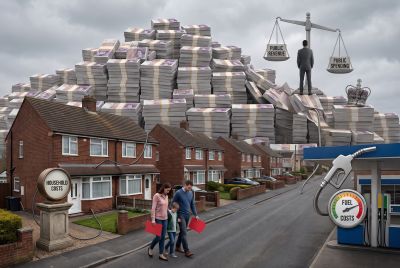
The oil shock driving the downturn stems from the closure of the Strait of Hormuz, through which roughly a fifth of the world's oil supply passes. The International Energy Agency has called it the largest supply disruption in global oil market history. Petrol prices in the UK have already risen by 25.1 pence per litre since the conflict began, with diesel climbing by 48.6 pence per litre.
GDP grew 0.5% in the three months to February 2026. Services ( 0.5%) and production ( 1.2%) both increased, but construction (-2.0%) fell.
— Office for National Statistics (ONS) (@ONS) April 16, 2026
Read the article ➡️ https://t.co/0o1qetyWNv pic.twitter.com/7gVtSckUfx
The Item Club forecasts inflation will surge to nearly 4 per cent in the second half of 2026 - almost double the Bank of England's 2 per cent target. Despite that, the group expects the Monetary Policy Committee to hold rates steady throughout the year rather than repeat the aggressive hikes it deployed during the post-Ukraine energy crisis in 2022.
Swannell told Sky News: 'We don't expect the Bank of England to repeat the 2022 playbook and hike interest rates as energy prices rise. This time policy is already restrictive, and a more fragile economy means that businesses will find it harder to pass on higher costs to the consumer.'
The Item Club instead pencilled in two further rate cuts by mid-2027, once inflation begins to fall back.
February's GDP figures, published last week, showed growth of 0.5 per cent month-on-month - the strongest monthly reading since January 2024. The data suggested the economy carried more momentum than expected before the full weight of the Iran conflict hit.
Growth in 2027 is forecast at 0.9 per cent, still below the pre-conflict trajectory. Unemployment is not expected to fall back to 4.75 per cent until 2029.
© Copyright IBTimes 2026. All rights reserved.
- Recommended For You