

Sarah Ferguson 'Slept' and Was 'Madly In Love' With Jeffrey Epstein, Royal Expert Claims
Freshly published Epstein documents and new allegations from author Andrew Lownie have reignited scrutiny of Sarah Ferguson's relationship with Jeffrey Epstein.
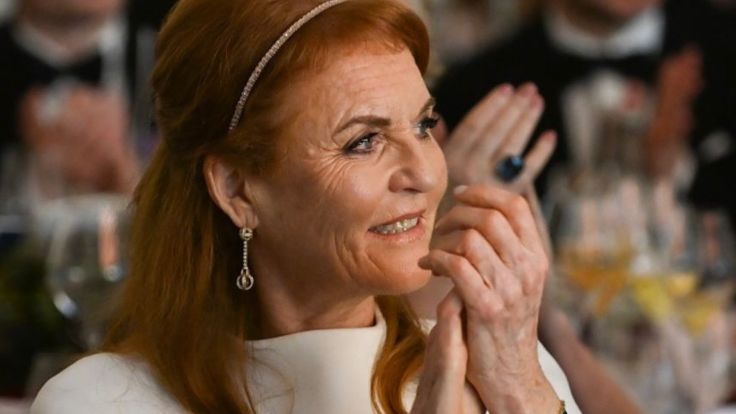
A handful of blunt, slightly bruised emails rarely change how you see the British royal family. These ones might.
When the latest tranche of Jeffrey Epstein documents landed, they did not simply revive the familiar gloom around Prince Andrew's long-shadowed friendship with the disgraced financier.
They also dragged Sarah, Duchess of York—forever 'Fergie' in the public imagination—back into a story she has spent years trying to outpace. And in the process, they offered something that feels almost more uncomfortable than scandal: a glimpse of neediness, leverage, and the strange currency of proximity.
At the centre are messages attributed to Ferguson, including one in September 2011 congratulating Epstein on having a 'baby boy,' followed minutes later by a furious, wounded follow-up accusing him of only staying close to her 'to get to Andrew.'

Another exchange, from 2009, shows her signing off with lavish gratitude—'You are a legend'—and the line that now ricochets around headlines: 'Just marry me.' Taken together, they read less like a confident social operator and more like someone trying, anxiously, to keep a door open.

And then came a claim that turns awkward correspondence into something far darker.
Sarah Ferguson Jeffrey Epstein Claims: The Lownie Allegation
Royal author Andrew Lownie has gone further than the documents themselves, alleging a sexual relationship between Ferguson and Epstein and describing her as 'madly in love' with him. Speaking on his Substack podcast, he said he had heard that 'Epstein and Sarah were sleeping together,' adding that it 'doesn't surprise' him.
He also painted what he called a 'complicated psychosexual network' overlapping with money and influence—suggesting Prince Andrew and Ghislaine Maxwell had their own intimate history, while implying rivalry and jealousy between Maxwell and Ferguson.
These are explosive assertions, and it matters that they are presented as Lownie's claims rather than proven fact. But they have traction for an obvious reason: the released emails already show a relationship that looks emotionally charged, not merely social, and one that sits uncomfortably alongside the long-documented web of Epstein's relationships with rich, famous, and powerful figures.
Lownie's comments also tap into a broader, more corrosive question: how did so many people convince themselves they could orbit Epstein without being stained?
In one email exchange reported by the BBC, Epstein allegedly floated a line—'Fergie can say, I am not a pedo'—as part of a reputational strategy involving his publicist, with Ferguson apparently writing back that she 'did' and 'would not' label him as such, while also referencing the need to 'protect my own brand.' That is not a legal finding; it is, however, the sort of detail that lingers in the reader's mind.
Fergie said Beatrice was aware of Epstein’s sexual offenses by 2011 bc she was part of the discussions ab how to deal with Fergie calling him a pedo
— montecito royals (@house_of_sussex) February 6, 2026
Fergie discussed w/ Beatrice the fact that he had “done his penance” for those convictions. Beatrice knewhttps://t.co/tL11lkS7v2 pic.twitter.com/eHraE6jMJz
Sarah Ferguson Jeffrey Epstein Emails: What The Messages Suggest
Strip away the royal titles and the tabloid familiarity and the messages read like a messy private conversation—except the man on the receiving end was Epstein, already convicted in 2008, and later dead in custody amid allegations of trafficking and abuse. That context changes everything.
The 'baby boy' email is particularly bizarre because Epstein's fatherhood has never been publicly established, making the congratulations feel both intimate and oddly uninformed—Ferguson says she heard it from 'The Duke,' a reference widely taken to mean Prince Andrew.
What makes the exchange striking is not only its content but its emotional whiplash: affection, then resentment, in the space of eight minutes. If you were trying to script a cleaner, more dignified royal distance from Epstein, you would not start here.
There is also the lingering matter of money. The Mirror reports that Epstein financially supported Ferguson over a period of years, feeding the impression of a relationship in which affection, access and financial assistance became entangled in ways that are hard to defend and harder still to explain away as naïveté.

It leaves the duchess, once marketed as a bright, chaotic counterpoint to royal stiffness, looking instead like someone who drifted too close to a predator's orbit—and stayed there.
The fallout, inevitably, is not confined to one person. For Ferguson's daughters, Princesses Beatrice and Eugenie, the embarrassment is public and renewed; the BBC notes that one email suggested Epstein wanted the young women to 'say hello' during a London visit in 2010, when they were 21 and 20.
Even without any allegation against them, it underscores how Epstein's reach threaded into family life.
What cannot be ignored is the slow drip effect. The Epstein files do not arrive as one clean revelation; they arrive as a nagging accumulation, a reminder that reputations—especially royal ones—are often less about single events than about patterns people chose not to notice.
© Copyright IBTimes 2026. All rights reserved.