

Tidal To Block up to 85,000 Songs Daily After AI Music Accounts for More Than 43% of Its Recent Uploads
The streaming service expects to reject up to 85,000 new AI-generated submissions daily, while AI-assisted recordings will remain allowed
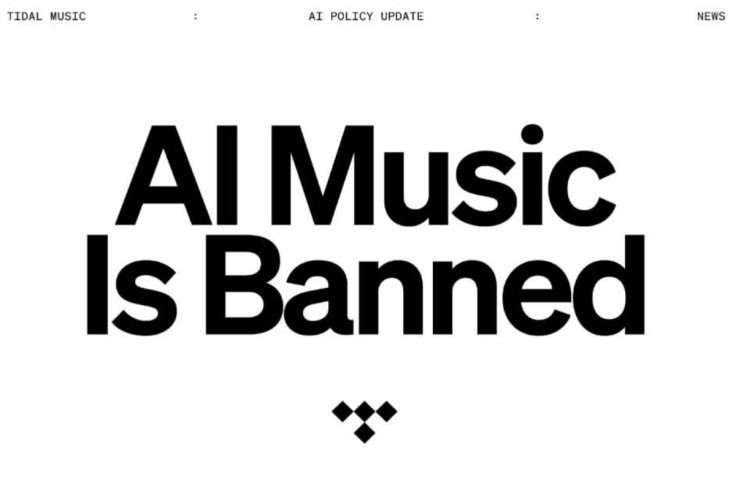
Tidal will begin removing wholly AI-generated music from its catalogue on 9 December, after the streaming service found that 43 per cent of tracks delivered to it over the past 90 days were fully AI-generated. About 29 million songs are expected to be removed, with the clean-up due to finish by early 2027.
A Tidal executive said the service expects to reject between 80,000 and 85,000 new submissions every day once the ban is in place. The figure covers future uploads, not songs already on the service.
The move goes further than the policy Tidal published on 29 June 2026. Under those rules, recordings found to be wholly AI-generated immediately lost their eligibility for royalties, and from 15 July they carried an 'AI' badge but could remain on the platform.
In its 24 November announcement, Tidal said distributors would no longer be allowed to deliver wholly AI-generated tracks. Any submission whose metadata says it was made entirely with generative AI tools will be rejected.
Tidal said about 27 million tracks in its catalogue already carry an AI label, equal to 6.3 per cent of its music. Of those, 96 per cent drew no streams in the previous three months. Tidal has not explained the difference between the 27 million labelled tracks and its estimate of 29 million removals.
What Tidal's AI Music Ban Covers
The ban does not cover every track made with AI. Tidal says tracks that were assisted by AI tools, but were not solely produced by them, will still be allowed on the platform.
Tidal has named Ircam Amplify, the commercial arm of the French music research institute IRCAM, as its detection partner. Its audio analysis will work alongside metadata checks to identify fully synthetic recordings. Tidal's support pages also set out an appeal process for artists who believe their work has been wrongly labelled.
Tidal named Suno and Google's Lyria among the AI tools behind the music it has flagged, and reports said 94 per cent of its AI-badged tracks were traced to Suno. On 6 November alone, more than 60 per cent of deliveries were wholly AI-generated. Tidal has also taken down more than 65,000 AI tracks flagged for suspected artist-name impersonation.
How Tidal's Ban Compares With Other Streaming Platforms
Tidal says that, at this scale, the authentic music its subscribers want to discover gets buried. It added that AI tracks impersonating artists divert streams and royalties away from them and confuse fans.
Rival services have taken softer approaches. Spotify allows artists to disclose AI involvement through industry-standard song credits. It also displays AI Persona badges on artist profiles whose identities appear to be AI-generated, and keeps music from those profiles out of editorial and algorithmic recommendations by default.
YouTube Music began rolling out labels on 14 October 2026 for songs created primarily with generative AI. The labels appear on the player page, but listeners cannot use them to hide AI tracks.
Deezer, which labels detected AI tracks and excludes them from editorial and algorithmic recommendations, said in July that fully AI-generated music had surpassed half of its daily uploads at peak levels in June, compared with 44 per cent in April.
The December rollout will test whether a streaming service can clear wholly AI-generated music from its catalogue without catching human artists whose work is wrongly flagged.
© Copyright IBTimes 2026. All rights reserved.