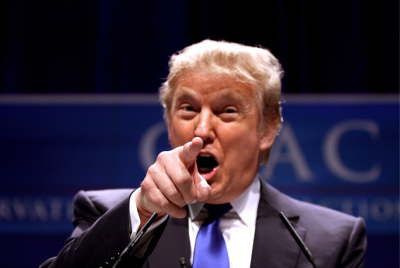
'Dictatorship Unlocked': Trump's Statement He Will Get Out of Office in '8 or 9 Years' Receives Mixed Responses
Donald Trump's recent comments on extending his presidency beyond legal limits stir controversy and highlight constitutional boundaries

Donald Trump sparked debate about constitutional term limits after suggesting at a White House business summit that his tenure could extend to eight or nine years. The remark, made to an audience of small business owners on Monday, drew criticism and support on social media.
Trump hosted the gathering as part of National Small Business Week, with more than 130 business leaders joining him at the White House. During his address, he referenced the summit's theme to make the remark about his own time in office.
Trump Sparks Controversy With '8 or 9 Years' Leadership Claim
'When I get out of office in, let's say, eight or nine years from now, I'll be able to use it. I'll be able to use it myself,' Trump said.
The audience at the summit laughed and clapped. However, reactions on social media were largely critical.
The audience at the summit laughed and clapped, seemingly cheering him on. However, the reactions on social media are largely critical.
One observer characterised the comment as 'Dictatorship unlocked,' predicting that 'Trump will soon declare himself president for life.' Others criticised Trump for what they described as an attack on democratic norms and expressed concern at the audience's reaction.
Conversely, some supporters embraced the remark, with one commenter noting 'I love the transparency.' Another suggested the idea 'sounds fair,' arguing they preferred Trump over any other potential candidate.
JUST IN: 🇺🇸 President Trump says he will get out of office "eight or nine years from now." pic.twitter.com/rVGA5uoCDM
— Remarks (@remarks) May 4, 2026
Dictatorship unlocked, Trump will soon declare himself president for life.
— LEAD🇳🇬 🇺🇸. (@Greatmindshub1) May 4, 2026
A full blown third world behavior.
I'm not shocked that he is saying it but im mindblown that people are cheering for it. I swear only a whiteman could do this😂 they will probably never let this dude out of office especially right now. only a younger white blonde republican man would rally them like this again.
— 7KEN7NARD7 (@P_karti777) May 4, 2026
I’m not too crazy about it but it sounds fair. I still like our chances better with him than the rest of the field.
— Troll Patrol (@troll_on_patrol) May 4, 2026
I love the transparency
— Im half and half - in terms of tea with sugar (@BrattanySummer) May 4, 2026
The 22nd Amendment and the Legal Barriers to a Third Term
Despite Trump's remarks, the United States' legal framework provides a clear barrier to serving more than two terms in the presidency. The 22nd Amendment of the Constitution states that 'No person shall be elected to the office of the President more than twice.' This legislation was ratified in 1951 to ensure that no leader could hold power indefinitely, following Franklin D. Roosevelt's four-term presidency.
Constitutional experts maintain that the Amendment's language is absolute and does not allow extensions based on personal preference or popular acclaim. For Trump to serve eight or nine years, a constitutional amendment would be required, a process that necessitates a two-thirds majority in both chambers of Congress and ratification by three-quarters of individual states.
The legal reality contradicts the rhetoric heard at the summit. While some view the comments as a joke or rhetorical flourish, others see them as a challenge to the rule of law.
Rather bold of him to assume he can legally run for a 3rd term
— DesertPunk Tiger (@Desertpunk88274) May 4, 2026
A Historical Return and the Finality of the Current Presidency
Donald Trump's journey to the highest office began when he was first elected in 2016, defeating Hillary Clinton. After serving his initial four-year term, he left office in 2021 following the 2020 election. His return to power in the 2024 election makes him only the second president in history to serve non-consecutive terms.
Because he has now been elected to the presidency twice, his current term beginning in 2025 is legally mandated to be his last. Under the current constitutional structure, he is ineligible to run for the presidency again once this term concludes in early 2029.
The debate surrounding his potential longevity in office continues to reflect the country's broader anxieties about the future of its governing systems. Whether these statements are mere hyperbole or a sign of future conflict, the constitutional limits remain firmly in place.
© Copyright IBTimes 2026. All rights reserved.
- Recommended For You