

Trump Receives Backlash After Quick Pivot From Dead Soldiers Killed In His 'Illegal War' to 'Bragging' About New Ballroom
President Trump criticised for focusing on White House renovations during a solemn ceremony for fallen soldiers.

President Donald Trump drew fierce public condemnation on Monday after veering into an extended endorsement of his White House ballroom project during a Medal of Honour ceremony intended to mark the deaths of American service members killed in an unauthorised military campaign against Iran.
The joint US-Israeli operation, codenamed 'Epic Fury,' launched in the early hours of Saturday, 28 February 2026, without a formal declaration of war from Congress, a constitutional requirement that critics say the president has flagrantly ignored. As the death toll of American soldiers climbed to six by Monday, Trump's remarks about drapes, doors, and a 'beautiful' building struck many observers as a profound failure of presidential decorum.
'I Picked Those Drapes:' The Remarks That Ignited a Firestorm
The moment that set social media ablaze came during Sunday's Medal of Honour ceremony, an occasion traditionally reserved for solemn reflection on military sacrifice. With at least four American soldiers dead at the time, the figure later revised upward to six. Trump turned from the subject of war casualties to the construction site visible just beyond the White House grounds.
'See that nice drape?' Trump said, gesturing toward the ongoing construction. 'When that comes down right now, you're gonna see a very, very deep hole, but in about a year and a half, you're gonna see a very, very beautiful building.' He continued, 'I picked those drapes. I always liked gold. I believe it will be the most beautiful ballroom anywhere in the world.' He then joked about awarding himself the Medal of Honour.
Susan Glasser of The New Yorker described it as 'one of the most politically tone deaf things I've ever seen from a POTUS.' Journalist John Harwood wrote that Trump 'demonstrat[ed] his mental disfigurement by bragging about his ballroom and chuckling immediately after claiming that 'we grieve' for four US soldiers killed in the war he just initiated,' adding, 'Trump does not possess empathy and does not grieve for any other person's misfortune.'
Bragging about his "beautiful ballroom" while he's supposed to be explaining the somber decision to go to war.
— Susan Glasser (@sbg1) March 2, 2026
It's one of the most politically tone deaf things I've ever seen from a POTUS, including this one...
Democratic candidate Fred Wellman put it plainly: 'We have sent thousands of our sons and daughters to war on this man's whim without Congressional authorisation or any idea of an end goal or plan... and he's talking about decorating. Just absolutely pitiful.'
We have sent thousands of our sons and daughters to war on this man’s whim without Congressional authorization or any idea of an end goal or plan…and he’s talking about decorating. Just absolutely pitiful. https://t.co/jnSPFyJAr4
— Fred Wellman (@FPWellman) March 2, 2026
An 'Illegal War' With a Rising Body Count
The military operation that provided the grim backdrop to Trump's remarks is itself deeply contested on legal grounds. Senator Tim Kaine (D-Va.), the lead sponsor of a Senate War Powers Resolution, was unambiguous in his characterisation on Fox News Sunday: 'This is an illegal war.
The Constitution says no declaration of war without Congress. The president not only did not come to Congress to seek a debate or vote, he acted without even notification to the vast majority of us.'
Republican lawmakers including Reps. Pat Harrigan (N.C.) and Mike Lawler (N.Y.) countered that the War Powers Resolution permits the president to act for up to 60 days without prior congressional approval, but Kaine rejected that framing, arguing that no statute can override the Constitution's plain language on the matter.

US Central Command (CENTCOM) confirmed on Monday that six American service members had been killed since the operation began, with the troops identified as ground-based forces stationed in Kuwait. General Dan Caine, chair of the Joint Chiefs of Staff, warned publicly that further losses were expected. Trump himself, in a phone interview with NBC News on Sunday, acknowledged the deaths without apology: 'We expect casualties with something like this. We have three, but we expect casualties, but in the end it's going to be a great deal for the world.'
The human cost extends far beyond US forces. Iran's Red Crescent Society placed the Iranian death toll at roughly 555 in an initial tally reported Monday. Iranian officials separately said more than 168 schoolgirls were killed when a strike hit a girls' elementary school, an allegation that Israel denied, saying it was not aware of its forces operating in that area. US Central Command told NPR it was 'looking into' reports of civilian harm.
Sen. Mark Warner (D-Va.), the top Democrat on the Senate Intelligence Committee, said on Sunday he had seen 'no intelligence' suggesting Iran was planning a preemptive strike on the US, directly contradicting the Trump administration's stated justification for the operation. PBS News fact-checked Trump's central public rationale, finding that his claim Iran could 'soon' deliver nuclear warheads capable of reaching the United States is contradicted by a 2025 federal government assessment that places Iran years away from that capability.
A £310 Million ($400 Million) Vanity Project Under Legal Fire
The ballroom that consumed Trump's attention on Sunday is itself mired in controversy. Announced via a White House press release on 31 July 2025, the project involves the demolition of the historic East Wing, built in its current form in 1942 under Franklin D. Roosevelt, to make way for a roughly 90,000-square-foot neoclassical structure. The project was initially estimated at £155 million ($200 million); by December 2025, that figure had ballooned to £310 million ($400 million) with experts describing the administration's projected completion timeline as 'optimistic.'
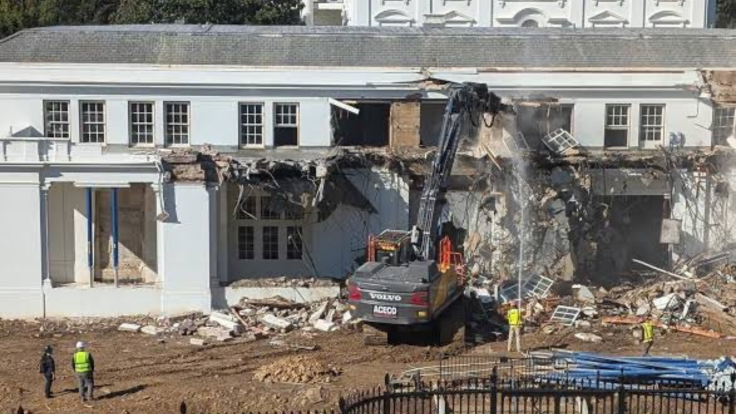
The demolition itself proceeded with little public notice. The East Wing was razed in four days beginning 20 October 2025, despite Trump's earlier assurances that the project 'won't interfere with the current building.' The Washington Post reported in August 2025 that the project had not been submitted for review to the National Capital Planning Commission (NCPC) as required by federal law, a process that typically takes years. The administration claimed a 1964 executive order allowed it to bypass the Commission, though it later acknowledged the Commission would 'be a part of that process at the appropriate time.'
The controversy lands against a backdrop of Trump's repeated claims to have ended multiple wars globally, claims that have not always held up to scrutiny. His Congo-Rwanda peace deal, celebrated with a signing ceremony at the former US Institute of Peace on 4 December 2025, saw fighting resume within hours of the ink drying.
Human Rights Watch documented 141 civilian deaths in eastern Congo in July 2025 alone, after the initial peace framework had already been signed. Even Secretary of State Marco Rubio acknowledged that subsequent violations constituted 'a clear violation' of the ceasefire Trump had brokered.
Now, with American families awaiting word on soldiers killed in a war Congress never authorised, the image of the president admiring gold drapes may prove harder to shake than any of his previous controversies.
© Copyright IBTimes 2026. All rights reserved.