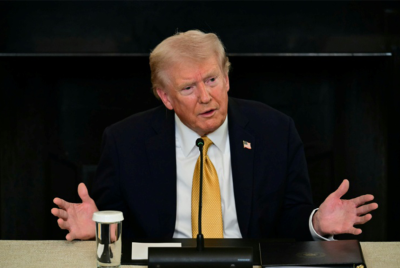
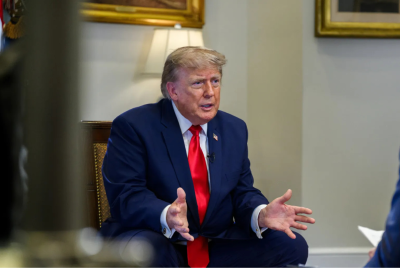
'Ineffective Leader' Donald Trump Accused Of 'Losing The Plot' After Claiming Credit For Opening Strait He Helped Close
William Becker warns of 'irreparable damage' to American democracy while Trump faces a fresh geopolitical firestorm over his Middle East legacy

Donald Trump is facing backlash after taking credit for reopening the Straight of Hormuz amid scathing calls for his immediate resignation.
In a move that has left geopolitical analysts baffled, the president claimed his personal diplomacy resolved the recent shipping crisis in the Middle East. However, a searing new op-ed has accused him of 'losing the plot' and causing 'decay, division, and disgrace' throughout his political tenure.
Policy expert William Becker, writing in The Hill, argued that the voting public has given Trump ample opportunity for redemption, only for him to make the national situation worse.
The Donald Trump Strait of Hormuz controversy has now become a flashpoint for critics who say his foreign policy record is a narrative of manufactured crises.
With the global energy market on edge, news of the Strait of Hormuz blockade continues to dominate headlines as the Pentagon remains silent on the former leader's claims of a 'secret deal'.
Resignation Demands Amidst Trump Middle East Foreign Policy Failures
The demand for Trump to step down has reached a fever pitch following Becker's assessment of his fitness for office. Becker insisted that Trump should resign immediately, citing health reasons, to spare the country further 'irreparable damage'.
The Donald Trump resignation calls are not merely coming from his usual political opponents but are increasingly being echoed by constitutional scholars. Becker noted that if the former president refuses to step down, the burden of redeeming the office passes to Congress to perform its duty.
This internal political pressure coincides with a messy Trump Middle East foreign policy legacy that many say helped close the waterway in the first place. By withdrawing from historic agreements and escalating rhetoric, critics argue that Trump created the very volatility he now claims to have cured.
The Strait of Hormuz reopening claims have been met with derision in Tehran, with Iranian officials dismissing the idea that Trump played any constructive role in the recent maritime de-escalation.
👏Policy expert William Becker published an op-ed in The Hill arguing that Trump has one final opportunity to redeem his legacy by resigning on health grounds.
— Sumner (@renmusb1) April 20, 2026
Becker detailed the admin's controversies, incl constitutional violations, conflicts of interest, pardon abuse,… pic.twitter.com/9U8ya7i4SG
Alleged Constitutional Violations And Abuse Of Power
Beyond the geopolitical theatre, the critique of Trump's domestic conduct remains equally severe. The op-ed detailed a long list of Trump constitutional violations, including the alleged deployment of military forces against civilians and the withholding of federal funds from states that did not support him.
Becker argued that these actions constitute a fundamental abuse of the pardon power and a disregard for citizens' rights. These Trump misinformation claims are particularly sensitive as the 2026 election cycle approaches.
The president is accused of using legal threats and federal funding to extort private corporations into compliance with his personal agenda.
For many observers, the Trump losing the plot narrative is supported by a pattern of behaviour that prioritises personal loyalty over constitutional law.
The United States' legal framework has been pushed to its limit, according to the report, leaving the government on the brink of systemic collapse.
Commentary: U.S. President Donald Trump may try to use war with Iran and escalating crises as a pretext to cancel or overturn elections, invoking emergency powers or even staging a false flag operation to remain in power. https://t.co/qoDgoM2HND
— The Japan Times (@japantimes) April 21, 2026
Historical Judgement And The Strait Of Hormuz Geopolitical Impact
The energy sector remains the most volatile casualty of this ongoing political warfare. Because the Strait serves as the world's most critical oil artery, the Strait of Hormuz's geopolitical impact cannot be overstated.
Any suggestion that a single political figure can open or close this chokepoint through social media posts is viewed as dangerous by market traders. Becker warned that when the plaques are eventually placed on Trump's monuments, they will explain how the government nearly allowed democracy to slip away.
"Resignation is Trump’s last chance at redemption" (@TheHillOpinion) https://t.co/q9AMOrvBhO
— The Hill (@thehill) April 20, 2026
Analysts tracking US-Iran tensions suggest that the current regional stability is fragile and unrelated to Trump's public assertions.
The reality of regional security involves complex naval manoeuvres and multilateral diplomacy that bypasses the president's rhetoric.
As the debate continues, the focus remains on whether the American political system can survive another round of what Becker describes as 'degeneration and disgrace'. The next legal steps regarding these executive overreaches are expected to be debated in the coming weeks.
© Copyright IBTimes 2026. All rights reserved.
- Recommended For You