

Trump Reportedly Billed Taxpayers $400K to Fly Just 59 White South Africans to US on Nearly Empty Jet
Donald Trump's rushed refugee airlift for 59 white South Africans left a US‑funded jet largely empty and deepened a fierce dispute with South Africa over claims of 'white genocide.'
Donald Trump's administration quietly spent an estimated $400,000 of public money to fly just 59 white South Africans to the United States on a largely empty charter jet from Johannesburg to Washington, D.C., in May, according to former US officials and aviation cost estimates.
The flight was part of a fast‑tracked resettlement programme created for white Afrikaners, whom Trump has repeatedly portrayed as victims of racial persecution and even 'genocide' in post‑apartheid South Africa, a narrative the South African government and several local experts have consistently rejected.
The operation, which bypassed the usual, slower refugee vetting processes, followed an executive order and a series of public claims by Trump that white farmers and Afrikaners faced state‑backed discrimination and violence, including land seizures and racially motivated attacks.
It can be recalled that the first group of white South Africans admitted under the programme arrived in the US on a charter flight in May 2025, landing at Dulles Airport before continuing on to Texas and other states.
Trump Refugee Flight Leaves Most Seats Empty
The nearly empty flight at the centre of the latest row was chartered from US carrier Omni Air International, which typically operates Boeing 767‑300 aircraft configured to carry between roughly 290 and 440 passengers.
According to former officials, the Trump White House was so eager to push through the resettlement of white South Africans that staff were effectively trying to get people on a plane within 24 hours, a pace that left them scrambling to find enough passengers.
One source described the group as having been 'carved out of nowhere' and admitted they 'didn't get close to filling the plane,' exposing how thinly supported the urgent narrative of a refugee emergency really was.
Aviation cost estimates cited in US coverage suggest chartering a Boeing 767‑300 on the Johannesburg–Washington route would typically cost between $16,000 and $21,000 per flight hour, putting the bill for the long‑haul trip at up to about $400,000 before additional charges.

Those extra costs, including positioning flights, landing fees, handling charges, crew accommodation, catering and taxes, would push the overall price higher still, potentially by tens of thousands of dollars.
That means US taxpayers paid for hundreds of empty seats on an operation designed to showcase Trump's commitment to white South African refugees, not a carefully planned humanitarian airlift.
South Africa Challenges Trump's Persecution Narrative
The news came after months of increasingly sharp exchanges between Washington and Pretoria over Trump's repeated references to alleged 'white genocide' and what he called 'recent increases in the incitement of racially motivated violence' against Afrikaners.
In official statements, South Africa's department of international relations has insisted there is no credible evidence of systematic persecution of white Afrikaners, stressing that violent attacks on farms affect Black farmers and farmworkers as well as whites and are largely driven by crime, not race.
The government has also pointed out that some of those who left under the American refugee programme have since chosen to return home, behaviour it argues is inconsistent with claims of an existential threat. Government spokesperson Chrispin Phiri told the Associated Press that the assertion of a 'white genocide' in South Africa is 'widely discredited and lacks reliable evidence,' a direct challenge to Trump's framing of the issue.
He further noted that individuals who had taken up the preferential immigration offer from the US had later decided to come back, reinforcing the view in Pretoria that the programme is driven more by politics than genuine humanitarian necessity.
IBTimes UK could not independently verify all of the claims made by US and South African officials about the level of risk faced by Afrikaners, so readers should take everything lightly and recognise that much of the debate rests on contested interpretations rather than clear data.
Trump, for his part, has repeatedly linked his refugee push to South Africa's affirmative action and land reform policies, arguing that efforts to redress apartheid‑era inequalities amount to discrimination against white citizens.
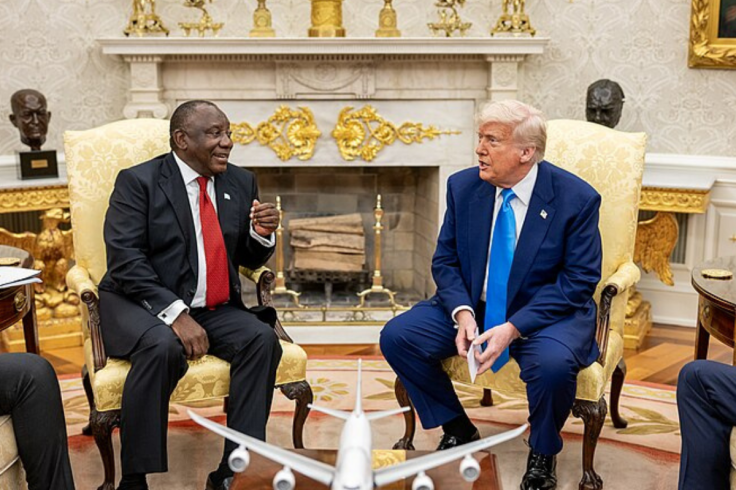
In an executive order, he claimed Afrikaners, descendants of Dutch, German and French settlers who dominated the apartheid regime, are victims of racial violence at the hands of the government, citing attacks on white farmers as key evidence.
South African President Cyril Ramaphosa has publicly rejected that framing, saying Afrikaners were 'enticed' to the US even though they face no persecution of the kind Trump describes, and branding the refugee programme 'politically motivated.'
Trump's White South African Refugee Cap Rises
The controversial charter flight sits within a broader policy shift that has quietly re‑engineered parts of the US refugee system around race. In May, the Trump administration announced that it would raise the annual cap specifically for white South African refugees by 10,000 people, increasing the total limit to 17,500, with the increase applying only to white residents of South Africa.
The US State Department previously reported receiving around 8,000 inquiries from white South Africans seeking resettlement, while Trump officials have suggested that as many as several thousand Afrikaners could be admitted in a single year. Critics in South Africa and abroad argue that granting a dedicated quota to one racial group from a country that is not experiencing war or state collapse is mad policy, particularly when those beneficiaries are members of a historically privileged minority.
Afrikaners make up a small share of South Africa's population but still hold a disproportionate share of private farmland and wealth, a legacy of apartheid that land reform and affirmative action are designed to address.
Trump's programme, they say, risks hardening a narrative in parts of the US and Europe that white South Africans are the real victims of post‑apartheid change, while the majority who suffered under minority rule are treated as secondary characters in their own story.
At the same time, not all Afrikaner organisations buy into Trump's most extreme language. The advocacy group AfriForum, for example, has raised concerns about crime and farm attacks but said it does not categorise the killings of white farmers as 'genocide,' putting it at odds with the president's rhetoric even as it criticises the South African government.
Nothing is confirmed yet so everything should be taken with a grain of salt when it comes to future flights and the full financial footprint of Trump's white South African refugee project, but the image of a half‑empty wide‑body jet leaving Johannesburg on the public dime, carrying a hand‑picked group of 59 people, is likely to linger in both South African and American politics for some time.
© Copyright IBTimes 2026. All rights reserved.