

'I'm Iran's No. 1 Target': Trump Ditches New $400M Air Force One, Flies Older Jet Home
$400M Qatari jet lacks missile defences fitted to ageing Presidential fleet
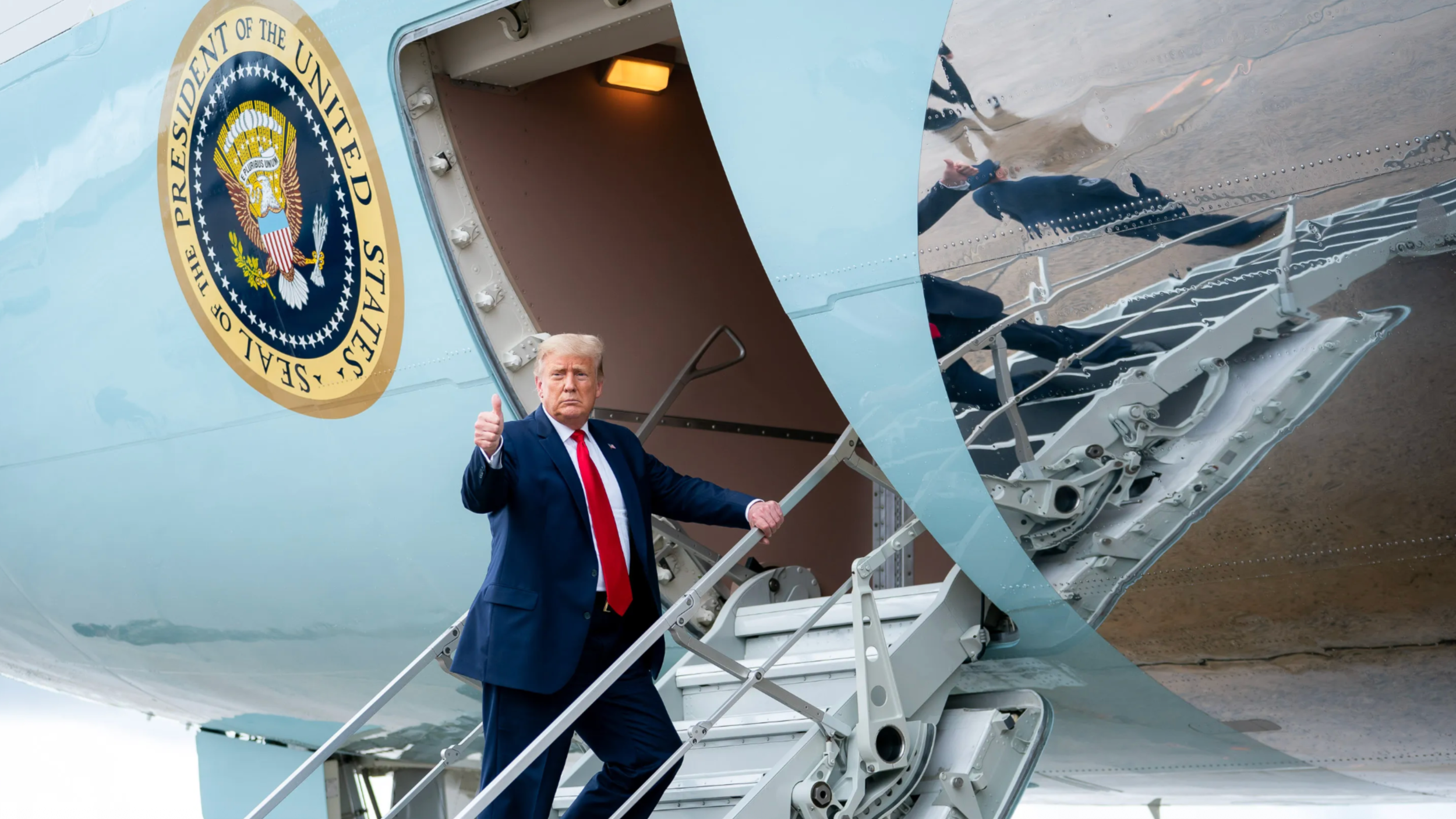
President Donald Trump flew home from a NATO summit in Turkey this week aboard a decades-old Air Force One, leaving behind the gleaming $400M (£302M) jet he had shown off only a day earlier and telling reporters he made the switch because he sits at the top of Iran's assassination list.
The move came as the United States and Iran again traded strikes, less than a day after American forces hit Iranian targets in retaliation for attacks on merchant shipping. It also renewed questions over an aircraft whose real cost has been disputed from the start.
At a news conference in Ankara before he left the summit, Trump was pressed on why he was not taking the newer plane. He gave no direct security answer. Instead, he kept returning to the claim that he was Iran's 'No. 1 target'.
'I'm No. 1 on the kill list for Iran,' the US President was quoted as saying.
'I don't really care because I'm doing my job.' He joked that he would rather be 'No. 1 on TikTok,' before adding, 'But I'm No. 1 on the list for killing.'
The president said the newer jet would instead route through Britain so American troops could see it at RAF Mildenhall, a change Trump first revealed in a social media post. Both jets made the unscheduled stop at the base.
Counting the Cost of the $400M Air Force One
The plane Trump passed over is a Boeing 747-8, an unconditional gift from Qatar's royal family valued at about $400M (£302M). The Pentagon accepted it last year and had contractor L3Harris rebuild it in roughly 10 months, a job that normally takes years. Trump unveiled the result last month and called it a 'bridge' aircraft, meant to cover the gap until Boeing delivers two purpose-built replacements.
What the conversion actually cost is where the numbers split. The Air Force has put the security retrofit at under $400M (£302M). Democratic lawmakers and independent analysts say the true figure is closer to $934M (£705M), with part of the money diverted from the Sentinel programme that funds America's new nuclear missiles. A group of 13 Democratic senators wrote to the Air Force and L3Harris this month seeking a full account, accusing the administration of stonewalling.
Boeing's own troubles explain why a stopgap was needed at all. The company signed a $3.9B (£2.9B) fixed-price contract in 2018 to build the next two Air Force One jets and was due to deliver them in 2024. That date has slipped to 2028, and Boeing has absorbed heavy losses on the deal.
The gift from Qatar itself remains legally contested. Administration lawyers cleared it on the understanding that the jet will pass to Trump's presidential library foundation by the start of 2029; Democrats argue that taking a plane of such value from a foreign state breaches the Constitution's emoluments clause.
Before this, the jet had made just one flight, to North Dakota last week.
The Security Gap in Trump's New Air Force One
At the centre of the security question is what the rushed conversion left out. Images of the jet taken since its unveiling show it lacks some of the missile detection and countermeasure systems fitted to the older presidential planes. Those legacy aircraft were built near the end of the Cold War, hardened against a nuclear blast, and equipped with anti-missile defences, an onboard operating room, and air-to-air refuelling, which defence analysts say the interim jet cannot match.
The US Air Force, which runs the presidential fleet, has said the rapid conversion was carried out 'without accepting any risk regarding security, safety, or secure communications,' while conceding that some complex engineering work for the final aircraft was still outstanding.
The White House rejected any suggestion the swap exposed a weakness. 'The new Air Force One is a state-of-the-art aircraft that has been fitted with high-level security protocols that ensure the safety of the President and his staff,' spokesman Steven Cheung said, adding that the administration leans on 'distraction and misdirection' among its tools against threats.
Geography sharpened the calculation. Iran and Turkey share a border, and Iran holds drones and ballistic missiles with the range to cross it, among them its Shahed drones and Shahab missiles. According to the Center for Strategic and International Studies, Iran has no weapon able to reach England, roughly 2,500 miles away.
Other signs pointed to a heightened alert. The older jet's transponder went dark shortly after take-off, a step usually reserved for war zones rather than a friendly NATO host. Flights carrying leaders from Germany and Britain stayed trackable. Passengers were asked to keep their blinds down, which Trump put down to the 'sleazebags over here', an apparent reference to Iran.
© Copyright IBTimes 2026. All rights reserved.