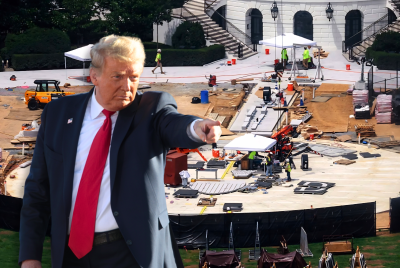
Trump's Health Fears Grow as White House Builds Underground Hospital Inside $400m Ballroom
Court filing reveals underground medical facilities in Trump's White House ballroom project, intensifying scrutiny over his health

Donald Trump's already contested $400 million (£315 million) White House ballroom project has taken a striking new turn after a court filing confirmed it will include an underground hospital and medical facilities for the ageing president. This disclosure that has intensified public scrutiny over the 79-year-old's physical condition. The revelation arrived in a filing submitted by Acting Attorney General Todd Blanche, which described the so-called 'Military Top Secret Ballroom' as essential to the safety and health of the president and all future occupants of the office.
The timing has not gone unnoticed. Trump is scheduled to undergo his annual physical and dental examination at Walter Reed National Military Medical Center in Bethesda, Maryland, on 26 May — his fourth publicised visit to medical professionals since returning to office. A Washington Post/ABC News/Ipsos poll conducted between 24 and 28 April found that 55 per cent of Americans do not believe Trump is in good enough physical health to serve effectively as president.
'Fully Designed to Protect the President'
Blanche's court document, filed late Thursday, described the underground project in expansive terms. 'The Project, which includes a state-of-the-art hospital and medical facilities, Top Secret military installations, bomb shelters, structures, and equipment, protective partitioning, and other features — is fully designed to protect the President,' he wrote. The filing also praised the ballroom itself as a 'gift to the People of the United States,' while accusing the National Trust for Historic Preservation of obstructing it due to what Blanche called 'Trump Derangement Syndrome.'
The National Trust filed a lawsuit in December after the East Wing of the White House — a structure that had stood since 1902 — was demolished without congressional approval to clear the way for the 90,000-square-foot project. A federal judge subsequently blocked above-ground construction, though that order has been stayed while an appeals court panel reviews the matter. Oral arguments are now scheduled for 5 June.
From Party Venue to Underground Complex
The ballroom's stated purpose has shifted considerably since Trump first announced it in July 2025 as a privately funded entertainment venue for hosting foreign dignitaries. Trump himself confirmed the scale of the underground works on 29 March 2026, telling reporters aboard Air Force One: 'The military is building a massive complex under the ballroom, and that's under construction and we're doing very well.'
What was billed as a gift to the nation, funded entirely by private donors, has also grown in cost and public funding exposure. The Secret Service is now seeking $1 billion (£787 million) in federal funding for security-related work, with $220 million (£173 million) of that earmarked specifically for the ballroom project, covering 'bulletproof glass, drone detection technologies, chemical and other threat filtration and detection systems.' A further $175 million (£138 million) has been requested for Secret Service agent training, and another $175 million (£138 million) for protectee security enhancements.
Health Questions Refuse to Go Away
Photographs taken during Trump's recent state visit to China showed visible bruising and discolouration on his hands. The photographs drew wide attention on social media. White House Press Secretary Karoline Leavitt previously attributed the bruising to 'minor soft tissue irritation from frequent handshaking and the use of aspirin,' though no new formal medical explanation has been released on the record in response to the most recent photographs.
Trump rants that his ballroom will feature "Bomb Shelters, a State of the Art Hospital and Medical Facilities, Protective Partitioning, Top Secret Military Installations, Structures, and Equipment, Protective Missile Resistant Steel, Columns, Roofs, and Beams, Drone Proof… pic.twitter.com/5lIGzzGdrW
— Aaron Rupar (@atrupar) April 16, 2026
Dr Jonathan Reiner, a cardiologist and CNN medical analyst, wrote on social media after Trump's unscheduled visit to a Florida dentist on 3 May that 'there's been such lack of candour about the health of the president that even a visit to the dentist raises questions.' Trump, who turns 80 in June and holds the record as the oldest person inaugurated as US president, has repeatedly dismissed concerns. At an Oval Office event on 11 May, he said: 'I feel literally the same' as he did 50 years ago.
The construction of an underground medical facility inside a White House ballroom represents a significant and unprecedented escalation in how the executive branch is preparing for presidential continuity of care. Historically, presidents have relied on Walter Reed Medical Center, White House on-site medical staff, and surgical suites aboard Air Force One — a system long considered sufficient. The decision to embed hospital-grade facilities directly beneath the White House raises legitimate questions about what scenarios the administration is preparing for, and why that need is being framed, legally and publicly, as urgent.
© Copyright IBTimes 2026. All rights reserved.
- Recommended For You