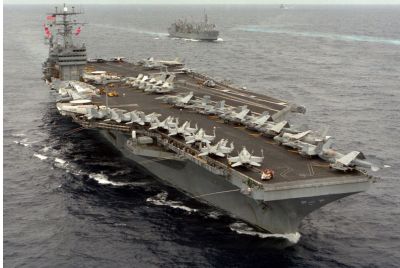
US Navy Releases Photos Refuting 'Sailor's Small, Poor Meals' as USS Lincoln and Tripoli Serve Full Meals Daily
Navy officials assert that sailors aboard USS Abraham Lincoln and USS Tripoli receive adequate meals, countering viral claims

The United States Navy has moved to counter claims that sailors aboard the USS Abraham Lincoln and USS Tripoli are being served 'small, poor meals', stating that both vessels continue to deliver full, regularly prepared meals without disruption. The circulating narrative — fuelled by selective images and online speculation — does not reflect daily operations at sea, officials said.
According to the Navy's latest update, sailors aboard both ships are receiving balanced, sufficient meals aligned with operational nutritional standards, with logistics systems remaining operational during extended deployments.
Fresh meals. Full service. Mission ready.
— U.S. Navy (@USNavy) April 18, 2026
Sailors aboard USS Abraham Lincoln and USS Tripoli continue to receive regularly prepared meals at sea—no interruptions, no shortages. pic.twitter.com/1ZprkBkmjR
'Fresh Meals, Full Service': Images Reinforce Navy's Position
In a public-facing response, the Navy paired its message — 'Fresh meals. Full service. Mission ready.' — with images showing well-prepared food trays, stocked serving lines, and active galley operations aboard both vessels, directly countering the perception that sailors were facing inadequate portions.
Naval officials stressed that food service is a core component of operational readiness, requiring precise planning to sustain thousands of personnel at sea. Representatives from the Office of the Chief of Naval Operations reiterated that claims of 'small, poor meals' are inaccurate, adding that what may appear as limited portions in isolated photos often reflects standard menu variation rather than rationing or supply issues.
Statement on Claims of Food Shortages aboard the USS Abraham Lincoln and USS Tripoli:
— Office of the Chief of Naval Operations (@USNavyCNO) April 17, 2026
Recent reports alleging food shortages and poor quality aboard our deployed ships are false.
Viral Images and the Rise of a Misleading Narrative
The controversy originated from widely shared images depicting seemingly minimal meal portions — such as a tortilla with shredded meat or trays with sparse vegetables and processed items. These snapshots quickly gained traction online, prompting concerns about sailor welfare and fuelling a broader narrative of declining conditions aboard deployed ships.
>📸 U.S. sailors on the USS Abraham Lincoln aircraf carrier are reporting poor-quality food and small portions during a long deployment near Iran.
— Clash Report (@clashreport) April 16, 2026
Because of extended operations and strained supply lines, crews are relying on limited resupply at sea, leading to rationing and… pic.twitter.com/xri3TI9DbM📸 U.S. sailors on the USS Abraham Lincoln aircraf carrier are reporting poor-quality food and small portions during a long deployment near Iran.
— Clash Report (@clashreport) April 16, 2026
Because of extended operations and strained supply lines, crews are relying on limited resupply at sea, leading to rationing and… pic.twitter.com/xri3TI9DbM
Families of deployed sailors and some lawmakers questioned whether personnel were receiving adequate nutrition during demanding missions. Naval officials cautioned against drawing broad conclusions from isolated visuals, arguing that a single meal snapshot does not represent the full daily food cycle, which includes multiple meal options, varied menus, and caloric planning tailored to sustain physically demanding duties.
Political Reactions Highlight Divide
California Representative Mike Levin criticised the reported conditions as 'completely unacceptable', calling for further scrutiny and suggesting a possible breakdown in supply chains.
This is completely unacceptable and Congress must investigate.
— Rep. Mike Levin (@RepMikeLevin) April 17, 2026
Service members aboard the USS Tripoli and USS Abraham Lincoln are rationing food and going without fresh produce.
Their families, worried that their loved ones are going hungry, are assembling care packages… https://t.co/LxB1656mSC
Defence Secretary Pete Hegseth dismissed the controversy as 'more fake news', citing internal assessments indicating that both ships maintained over 30 days of Class I supplies — the military designation for food reserves. 'Our sailors deserve — and receive — the best,' he stated.
The @USNavy is correct. More FAKE NEWS from the Pharisee Press.
— Pete Hegseth (@PeteHegseth) April 18, 2026
My team confirmed the logistics stats for the Lincoln & Tripoli. Both have 30 days of Class I supplies (food) on board. NavCent monitors this everyday, for every ship.
Our sailors deserve — and receive — the best. https://t.co/XekXU6oHOo
Inside the Navy's Logistics System
The Navy highlighted the complexity of sustaining food supply chains across vast oceanic distances. Warships like the USS Abraham Lincoln and USS Tripoli rely on coordinated logistics involving replenishment vessels, inventory forecasting, and strict ration management protocols.
Naval officials acknowledged that temporary adjustments — such as menu substitutions or delayed delivery of specific items — can occur during high-tempo operations. These are standard practices designed to optimise endurance and resource allocation, not indicators of scarcity.
The Navy confirmed on 17 April that a temporary hold on sending mail into the theatre, imposed due to combat operations, has been lifted. However, the US Postal Service and Military Postal Service Agency have separately suspended all deliveries to more than 27 military ZIP codes in the Middle East until further notice, citing airspace closures linked to the ongoing conflict. Mike Levin has called for a congressional investigation into food provision aboard both vessels; the Navy has not responded publicly to his specific request.
© Copyright IBTimes 2026. All rights reserved.
- Recommended For You