'They're Hungry All the Time': US Sailors' Poor, Small Meals Near Iran Reveal a Crisis
Naval warships near Iran experience severe food rationing and halted mail services, impacting morale.

Families of US military personnel deployed near Iran are raising alarms over severe food rationing aboard naval warships. Photographs from vessels like the USS Tripoli reveal nearly empty dinner trays featuring small portions of shredded meat, folded tortillas, and processed food.
While relatives attempt to send supplies to the Middle East, a sudden halt in postal services has left critical care packages stranded. The ongoing conflict involving the US, Israel, and Iran has put an indefinite pause on mail delivery to 27 military ZIP codes, cutting off what is essentially a vital lifeline.
How Airspace Closures Halted Military Mail Deliveries
The United States Postal Service (USPS) temporarily suspended deliveries to several overseas military addresses at the beginning of April following recent attacks in the region. Major Travis Shaw, an Army spokesperson, said there is currently no scheduled end date for the disruption, despite a recent ceasefire.
'Resumption of mail service is contingent upon the reopening of airspace by civil authorities, and the area commander's evaluation of regional transportation and distribution stability,' Shaw explained. He noted that mail already in transit is being held in secure facilities and will not be returned to senders.
David Coleman, a USPS spokesperson, said families can monitor temporary suspensions online through official USPS service alerts. The Pentagon has not responded to requests for comment regarding the stoppage or reported food shortages.
Why Meagre Rations Are Crushing Crew Morale
Dan F., a 63-year-old Marine veteran, expressed outrage after his daughter shared a photograph of her lunch aboard the USS Tripoli. The image showed a severely depleted meal, coinciding with her reports of missing fresh produce and dwindling hygiene products.
'We have the strongest military in the world. You shouldn't be running out of food, and you shouldn't not be able to get mail on the ship,' Dan said. He promptly dispatched boxes filled with vitamins and toiletries, which remain undelivered.
A Texas mother shared similar fears for her son, a Navy sailor on the same ship, after spending £1,600 ($2,000) on undelivered packages. In a message sent on 11 March, her son warned that supplies were plummeting and stated, 'Morale is going to be at an all-time low.'
How Prolonged Deployments Impact Warship Conditions
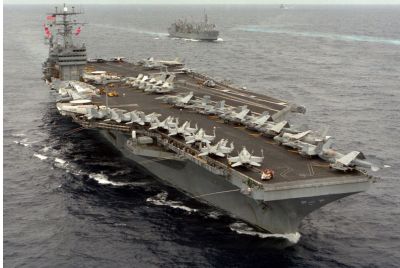
The crisis extends to the USS Abraham Lincoln, where a mid-April dinner reportedly consisted of a dry meat patty and boiled carrots. Karen Erskine-Valentine, a West Virginia pastor, helped ship 22 boxes to the crew, spending £432 ($540) on postage.
'The food is tasteless and there's not nearly enough and they're hungry all the time,' Erskine-Valentine remarked. Six of her parcels reached Tokyo on 14 April, but they remain stuck in transit caught in the postal disruption.
The situation is worsened by record-breaking deployments. On 15 April, the USS Gerald R. Ford set the mark for the longest aircraft carrier deployment since the Cold War. The vessel previously retreated to Crete on 23 March for maintenance following a laundry fire.
📸 U.S. sailors on the USS Abraham Lincoln aircraf carrier are reporting poor-quality food and small portions during a long deployment near Iran.
— Clash Report (@clashreport) April 16, 2026
Because of extended operations and strained supply lines, crews are relying on limited resupply at sea, leading to rationing and… pic.twitter.com/xri3TI9DbM
Why Undelivered Care Packages Remain Stranded at Home
Communities are struggling to support their deployed relatives amid the logistical blockade. Karen Turgeon, a Massachusetts organiser, now delivers flowers directly to local military families instead of shipping unavailable goods.
In Maryland, Dawn Penrod collected £80 ($100) from an American Legion Auxiliary chapter and £40 ($50) from a client to supply her nephew in Bahrain. Postal workers rejected her package outright, refusing to process the required customs forms.
Historians note that supply networks frequently collapse during wartime, mirroring mail backlogs seen after the 1944 D-Day invasion. For relatives staring at unsent boxes, historical precedent offers little comfort.
© Copyright IBTimes 2026. All rights reserved.
- Recommended For You