

Brazil's Christ the Redeemer Appears To Float Above a Sea of Clouds, Leaving Viewers Questioning Reality
Brazil's Christ the Redeemer appears to float above a sea of clouds in viral footage, but a natural weather phenomenon explains the extraordinary sight
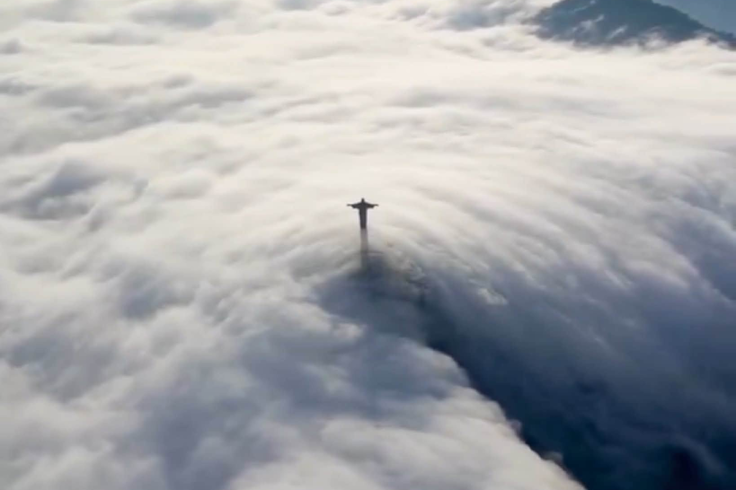
Brazil's Christ the Redeemer appeared to float above Rio de Janeiro on Saturday, 21 November, as clouds concealed much of Corcovado Mountain beneath it. Footage of the scene spread across social media, where users questioned whether the images were genuine or had been created using artificial intelligence (AI).
The scene was recorded in the early hours, as a thick layer of cloud moved across the mountain. The statue remained visible while clouds appeared to spill down the slopes below it, creating the impression of a waterfall beneath its outstretched arms.
Christ the Redeemer Footage Prompts AI Questions
Brazilian filmmaker and photographer Márcio Amaro filmed the scene on his mobile phone from the Santa Teresa neighbourhood. Photographer Humberto Baddini also captured it using a drone, according to a report by NTN24 on 26 November.
The recordings show different views of the same weather event. From Amaro's vantage point, cloud appears to pour down the mountainside. Baddini's aerial footage shows the monument above a blanket of cloud, with much of the surrounding land obscured.
The Times of India reported on 25 November that social media users had questioned whether the images were real. The landmark's appearance, seemingly separated from the ground, also prompted speculation about possible AI involvement.
Amaro said his recording was genuine and had not been generated using AI, according to Euronews. He also said he had never seen Corcovado look quite like this before.
His statement concerned his own recording, rather than every version of the imagery shared online. The footage and reports cited do not establish whether other images circulating online were altered or generated.
Why Christ the Redeemer Appears To Float Above the Clouds
Rio's coastal geography helps explain the scene. Corcovado rises to about 710 metres above sea level and can intercept moist winds arriving from the Atlantic Ocean.
When wind pushes moist air uphill, the air encounters lower atmospheric pressure, expands and cools. If it cools enough, water vapour condenses into tiny droplets, forming clouds. Meteorologists call the upward movement of air caused by terrain orographic lift.
The World Meteorological Organization explains that mountains can affect cloud formation at different elevations. Depending on the atmospheric conditions, clouds may form below a summit, around it or higher above it.
Wind can also carry cloud over a ridge and down a slope, producing what looks like a waterfall. As air descends, it generally warms, which can cause cloud droplets to evaporate and the cloud to dissipate.
The height and movement of the cloud layer determine whether the statue and the land below it remain visible. In this footage, much of Corcovado was hidden, making it difficult to distinguish the ground beneath the monument, particularly from a distance.
Euronews reported that similar scenes were photographed in August 2026. Those images showed fog settled in the valleys, rather than clouds cascading down the hillside.
Completed in 1931, Christ the Redeemer stands within Tijuca National Park. New7Wonders gives the concrete and soapstone figure's height as 30 metres, excluding its eight-metre pedestal, and its arm span as 28 metres.
The monument overlooks Rio de Janeiro and Guanabara Bay and is recognised as one of the New Seven Wonders of the World. On 21 November, cloud obscured much of the landscape around it, leaving the statue visible above the slopes.
© Copyright IBTimes 2026. All rights reserved.