

Choctaw Nation Buys Oklahoma Warehouse ICE Had Moved To Acquire For Immigration Operations
Tribal acquisition ends speculation over potential ICE detention site in Durant.
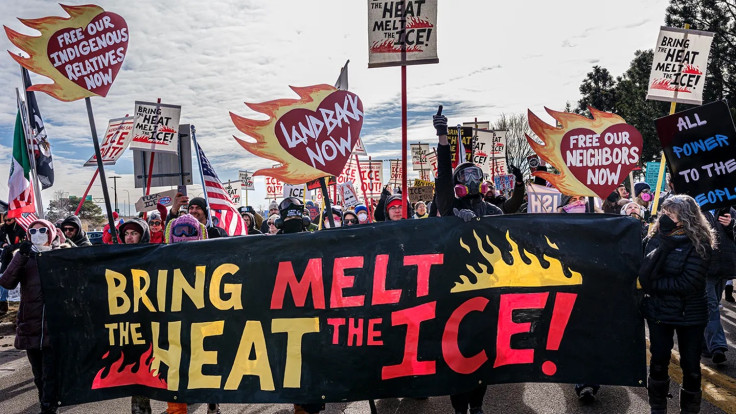
The Choctaw Nation of Oklahoma has bought a vacant warehouse that federal immigration authorities had been quietly manoeuvring to acquire, settling in a single transaction a dispute that had drawn protesters, tribal resolutions, and an emergency city ordinance.
The tribe announced the purchase of the former Big Lots distribution centre at 2306 Enterprise Drive in Durant, a 1.24-million-square-foot facility that had been under informal consideration by US Immigration and Customs Enforcement as a potential detention site.
Chief Gary Batton's official statement described the acquisition as part of an effort to support operational growth adjacent to the tribe's existing headquarters campus. No purchase price was disclosed, and no deed records were immediately available from the Bryan County Assessor's office.
A Warehouse, a Rumour, and Four Months of Resistance
The distribution centre opened in 2004 and served as a regional hub for Big Lots stores across 16 states before the retailer's 2024 bankruptcy forced its closure, eliminating roughly 330 local jobs. By late 2025, the vacant building had become the subject of intense speculation in Durant.
In December 2025, the City of Durant acknowledged publicly that officials had 'reason to believe' the site was being considered for ICE detention use. Mayor Martin Tucker told the Durant Democrat that no federal representative had contacted the city. 'No one from the federal government or from any other entity involved with or associated with any kind of detention facility has talked to the city,' Tucker said.
By January 2026, those rumours had hardened into coordinated action. The Choctaw Nation's tribal council voted unanimously on a resolution opposing any ICE detention facility at the site, citing its proximity to tribal facilities. Tribal Council member Regina Mabray told the council the proposed location was 'unacceptably close to the nation's governmental headquarters' and noted that the site sits approximately 1,073 feet from the Choctaw Nation Child Development Centre.
The Inter-Tribal Council of the Five Tribes, representing the Cherokee, Chickasaw, Choctaw, Muscogee, and Seminole nations, also voted unanimously on a resolution opposing any ICE detention facility in the area.
Their resolution additionally called on the Department of Homeland Security to engage in formal government-to-government consultation with tribal nations before siting detention facilities on or near tribal lands. That request went unanswered by federal authorities.
On 13 January 2026, in front of an overflowing crowd, the Durant City Council voted unanimously to pass an ordinance requiring a conditional-use permit for any detention centre operating within city limits. The council applied an emergency clause, bringing the measure into immediate effect. City Attorney Doug Elliott said the move was a direct response to reports that federal parties were 'making inroads' toward the Big Lots site.
The Broker Connection and the Federal Acquisition Pipeline
As local opposition mounted, investigative reporting revealed a direct corporate thread running through the Durant property and similar warehouse acquisitions across Oklahoma. Newmark Robinson Park, a local arm of the billion-dollar real estate group Newmark, was listed as the broker for the Durant warehouse.
A February 2026 investigation by The Lever, published in Jacobin, identified Newmark Robinson Park as the broker on at least two Oklahoma properties under consideration for ICE detention use, including the Durant site. Until his appointment as US Secretary of Commerce, Howard Lutnick served as chairman of Newmark's board and chief executive of its parent company, Cantor Fitzgerald.
Lutnick divested his Newmark holdings upon entering government, and his son Kyle Lutnick subsequently became a director at Newmark Group. Robinson Park's chief executive, Mark Beffort, holds the role of vice chair at the Oklahoma City Chamber of Commerce, which works in partnership with local governments on economic development projects. Newmark Robinson Park did not respond to multiple requests for comment from The Lever.

The Durant property was not an isolated case. ICE's Detention Reengineering Initiative, details of which emerged through New Hampshire state government filings in February 2026, is built around the purchase and retrofitting of commercial warehouses at scale. Six processing centres acquired since January 2026 are each designed to hold between 1,000 and 1,500 people for up to one week. Four additional 'mega centres,' intended to hold up to 10,000 people for up to 60 days, have also been acquired in that period.
The Durant property was not the only Oklahoma warehouse that ICE pursued and lost. In Oklahoma City, the Department of Homeland Security had outlined plans to convert a warehouse near the Western Heights School District into a detention centre capable of holding 1,500 people. After weeks of community opposition and city council pressure on the brokerage, Mayor David Holt announced on 29 January 2026 that the owners had confirmed they were 'no longer engaged with the Department of Homeland Security' about the property.
The Purchase and Its Projected Cost to the Federal Government
The Choctaw Nation's acquisition removes the property from the federal market permanently. The tribe has not disclosed what it paid, nor announced a specific use for the building. In his official statement, Chief Batton said: 'We are evaluating how to use this adjoining property as part of our efforts to support operational growth and exploring a variety of potential uses that align with our strategic vision.'
The headquarters campus of the Choctaw Nation, the third-largest tribal nation in the United States by enrolment with more than 230,000 members, already spans 500,000 square feet on the same stretch of Enterprise Boulevard.
Jessica Scott of Oklahomans Against ICE, a coalition that had tracked and opposed the property's potential federal acquisition, said the Choctaw Nation's move reflected the cumulative effect of sustained local pressure. 'While Oklahoma is often seen as one of the reddest states in the country, this moment shows what's possible when people come together to stand up for their communities,' Scott said.
A tribal nation that was forcibly relocated to Oklahoma nearly 200 years ago along the Trail of Tears has now used its economic power to prevent the federal government from turning its neighbour's warehouse into a mass detention facility, and federal authorities have said nothing publicly about what comes next.
© Copyright IBTimes 2026. All rights reserved.