Cuba's President Fires Back at NBC Anchor Who Asked If He Would Resign: 'Do You Ask That Question to Trump?'
Diaz-Canel's Interview with NBC Highlights Tensions with the US

Cuban President Miguel Diaz-Canel told NBC News' Kristen Welker he would not step down during his country's worst energy crisis in decades, then turned the question back on her with a challenge that cut straight to the heart of US-Cuba geopolitics.
In what NBC News described as his first interview with a US broadcast network, Diaz-Canel sat down with 'Meet the Press' moderator Kristen Welker in Havana on 9 April 2026.
Welker asked the Cuban leader directly whether he would be 'willing to step down to save your country,' a question the Trump administration has effectively been pressing in public for months. Diaz-Canel responded with visible irritation, firing back: 'Is that a question from you, or is that coming from the State Department of the US government?'
The Welker Interview: What Diaz-Canel Said and What He Refused to Say
Welker's resignation question was the most charged moment in the interview, but it was not the only substantive exchange. Diaz-Canel insisted that Cuban leadership derives its legitimacy from the Cuban people, not from Washington. 'In Cuba, the people who are in leadership positions are not elected by the US government, and they don't have a mandate from the US government,' he said.
'We have a free sovereign state. We have self-determination and independence, and we are not subjected to the designs of the United States.'
He added a conditional disclaimer that some observers found difficult to reconcile with the island's political reality. 'If the Cuban people understand that I am not fit for office, that I have no reason to be here, then I should not be holding this position of president, I will respond to them,' he said.
Cuba operates a single-party system under the Communist Party; candidates to the National Assembly are chosen through local elections, but no opposition party is permitted and all candidates must hold party membership.
Diaz-Canel's broader message was one of readiness for dialogue, but on Cuban terms. 'I believe the most important thing would be for them to understand and take this critical position, a sincere position, and recognise how much it has cost the Cuban people, and how much they have deprived the American people from a normal relationship with the Cuban people,' he told Welker. The full interview was scheduled to air in extended form on Sunday's broadcast of 'Meet the Press.'
Cuba's Energy Collapse and the US Blockade Behind It
The backdrop to the interview is dire. Cuba produces only around 40% of the fuel it consumes and relies heavily on imported oil, historically sourced from Venezuela. In early January 2026, the United States intervened in Venezuela and arrested then-President Nicolas Maduro, disrupting those critical shipments. On 29 January 2026, Trump signed Executive Order 14380, authorising additional tariffs on imports from any country that directly or indirectly supplies oil to Cuba.
The consequences have been severe. In late March, a Russian tanker carrying 730,000 barrels of crude oil arrived in Havana, marking the island's first oil shipment in three months, according to AP reporting published by ABC News.
Russia said it was preparing a second tanker. Trump said he had 'no problem' with the first delivery, noting he did not believe it would meaningfully sustain the Cuban government. 'Cuba's finished,' he told reporters.
On the ground, the shortages have pushed Cuba's electricity grid past breaking point. On 16 March 2026, the island suffered a nationwide blackout. Juanita Goebertus, Americas director at Human Rights Watch, told CNN that 'the humanitarian situation in Cuba was already extremely fragile, but the electricity crisis is pushing many essential services to the limit. People don't have reliable access to drinking water, hospitals can't operate safely, basic goods are becoming increasingly difficult to obtain, and garbage is piling up in the streets.'
Washington's Regime-Change Rhetoric and the State of Talks
The Trump administration has made no effort to disguise its objective. Secretary of State Marco Rubio, whose parents left Cuba in the 1950s before Fidel Castro's communist revolution, called Cuba 'a disaster' last month, saying its 'economic system doesn't work.' 'Cubans can only be successful if they leave the country,' Rubio said. 'That has to change, and for that to change, you have to change the people in charge.'
Rubio also disputed Havana's characterisation of the US energy restrictions as a blockade. On 27 March 2026, he said publicly: 'There is no naval blockade around Cuba,' adding that the reason Cuba lacks fuel 'is because it wants it for free and people don't give away oil and fuel for free unless it was the Soviet Union subsidising them or Maduro subsidising them.'
Deputy Foreign Minister Josefina Vidal, who helped broker the 2014 Obama-era diplomatic thaw with the United States, told Agence France-Presse this week that any US-Cuba talks to de-escalate tensions remain at a 'very preliminary' stage.
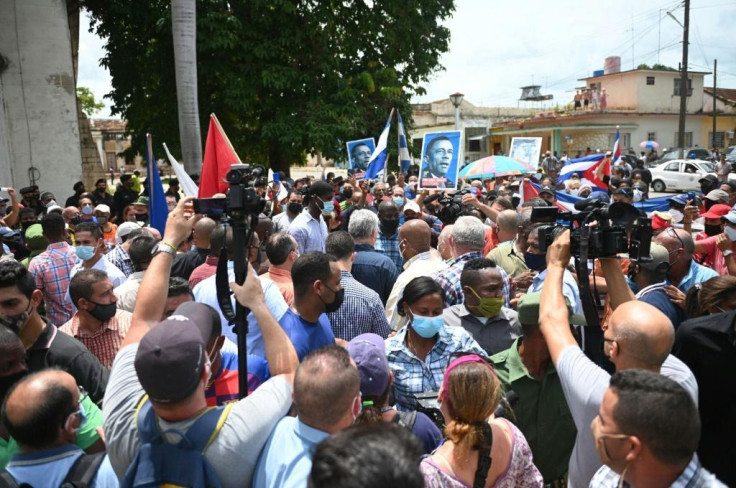
The NBC interview did not happen in isolation. Two days earlier, on 7 April 2026, Diaz-Canel granted an interview to Newsweek in which he warned that Cuba would respond to any military intervention with guerrilla warfare. On that same day, hundreds of Cuban women gathered in Havana at a government-organised rally led by Deputy Prime Minister Ines Maria Chapman and Deputy Foreign Minister Vidal, calling for an end to the US energy blockade. The Associated Press reported that participants waved Cuban flags and carried signs reading 'Down with the Blockade.'
With a full NBC broadcast still to come and talks still at a 'very preliminary' stage, Sunday's unedited 'Meet the Press' interview may tell considerably more about where this confrontation is heading.
© Copyright IBTimes 2026. All rights reserved.
- Recommended For You