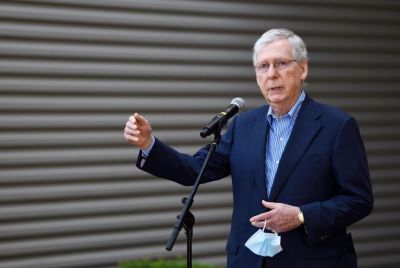
'A Disgraceful, Attention-Seeking W***er': Senator Slams Governor Over Mitch McConnell Health Probe
A bruising fight over Mitch McConnell's health has become a proxy war over how much voters are entitled to know about the frailty of the people who govern them.
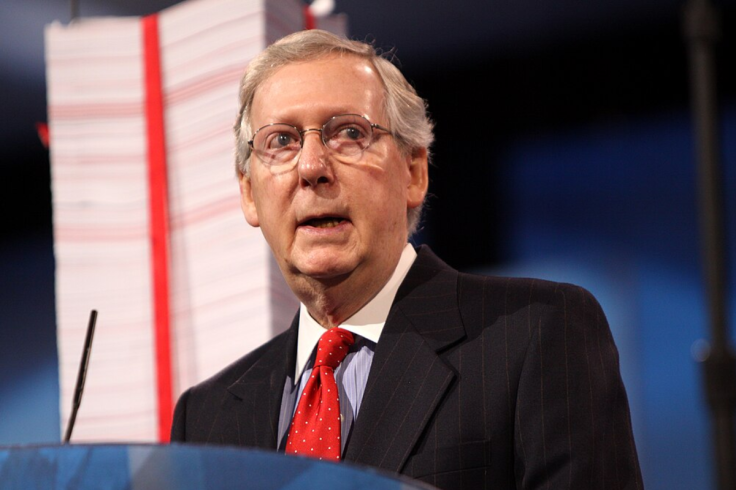
A 73-year-old Republican senator has leapt to Mitch McConnell's defence from nearly 1,000 miles away, condemning demands for more transparency about the Senate leader's health after his weeks-long absence from Washington following a June fall. Speaking to Maine's Susan Collins urged critics to 'extend some grace' to McConnell, as pressure mounts in Kentucky for the veteran lawmaker to prove he is still fit to serve.
A murky period for McConnell, who was hospitalised on 14 June after a fall and has not been seen on Capitol Hill for weeks, prompting a round of anxious questions and political sniping in his home state. With little official detail released, Kentucky's Democratic governor Andy Beshear has tried to force the issue into the open, sending pointed letters to McConnell and Republican leaders in the Senate demanding a formal probe into the 82‑year‑old's condition and capacity.
'Mitch was the longest-serving leader in Senate history. Couldn't we extend some grace to him?' Collins told the Times, framing McConnell not as a fading political boss but as a man fighting his way back from a serious setback. She noted that McConnell is a survivor of childhood polio, arguing that this has slowed his recovery but not dimmed his appetite for the fight. 'He has always been a fighter, and will be back,' she said.
Beshear's Challenge to Mitch McConnell Ignites Fury
Beshear has been unusually blunt in his public and private questioning of McConnell's health, refusing to accept vague assurances from Republican leaders. In a letter to Senate Minority Whip John Thune, the governor wrote that he was acting 'under the assumption that [McConnell] is capable of reading and responding verbally, and not incapacitated by means of consciousness or cognition.' The implication was hard to miss.
Beshear issued a similar message directly to McConnell, telling him to 'provide proof of your capacity to serve, or resign.' For a sitting governor to speak like that about one of the most powerful figures in his own state's political history is remarkable in itself, but it has also lit a fuse under Republicans already sensitive to questions about ageing leaders.
Kentucky's Republican senator Rand Paul dismissed Beshear's intervention as 'a campaign ploy... to look relevant,' casting it as theatrical rather than principled. From neighbouring Ohio, Republican senator Bernie Moreno dispensed with euphemism altogether, reportedly calling Beshear 'a disgraceful, attention-seeking w—e' language that underlined just how personal the row has become.
Collins, usually cast in US media as an institutionalist voice of restraint, has now joined that chorus of critics, though in a more measured register. She accused the governor of using McConnell's health as a political prop. 'This rush led by the governor, who must be running for president, is so unseemly and so unkind to a senator who has been such a leader for so many years,' she said.
Nothing in the public record yet confirms the precise nature or extent of McConnell's current health problems, and there has been no independent medical assessment released to voters.
With that vacuum comes speculation, and much of what is being said on both sides of the partisan aisle rests on inference rather than solid evidence. Until any formal medical documentation or Senate inquiry surfaces, much of the debate should be taken with a degree of caution.
Susan Collins, Mitch McConnell And The Ageing Senate
It can be recalled that Collins herself has faced similar scrutiny over her own health, an awkward symmetry that hangs over her defence of McConnell. Earlier this year, a campaign video posted in February showed the senator trembling almost continuously, prompting a wave of online speculation and armchair diagnosis. The chatter grew loud enough that, months later, she chose to address it directly.
In an interview with News Center Maine, Collins said she has 'an extremely common condition that is called a benign essential tremor.' She stressed that she has had it for the entirety of her Senate career and insisted that 'it has absolutely no impact on my ability to do my job or on how I feel each day.' Coming from someone now urging tolerance for McConnell, the statement reads as both explanation and quiet warning against the political weaponising of visible frailty.
Behind the personal drama sits a harder structural question about who is actually running Congress. An analysis by The Swamp, political newsletter, found that the average age in the US House of Representatives has risen from 54.4 years between 2001 and 2003 to 57.9 years today. In the Senate, the figure has climbed from 59.8 to 63.9 over the same period, making it one of the oldest elected chambers in modern democratic politics.

That creep in average age makes individual health scares more than just personal misfortune: they become tests of a system that often relies on long-serving politicians to hold institutional memory and party discipline together. For Republicans, McConnell is precisely that figure, a leader whose absence is both symbolically unsettling and practically cumbersome.
Beshear's demand for proof of McConnell's capacity touches on a raw but unavoidable dilemma for American politics. Voters are entitled to know whether their representatives are able to perform the job they were elected to do. Yet those same representatives are human beings, reluctant to have every tremor, stumble or hospital visit dissected for partisan advantage.
In that gap between privacy and accountability, Collins has chosen her side. She wants McConnell judged on decades of service and granted time to recover. Beshear, calculating or not, is insisting that the public is owed something more concrete than assurances from colleagues. Until McConnell himself steps back into view, neither argument is likely to settle much.
© Copyright IBTimes 2026. All rights reserved.
- Recommended For You