66-Year-Old Secretly Wired $200,000 to Scammers Chasing $7 Million Promise: 'It's His Pure Greed'
After losing $120,000 to a similar scam 17 years earlier, the man was duped again, now risking his family's entire housing fund
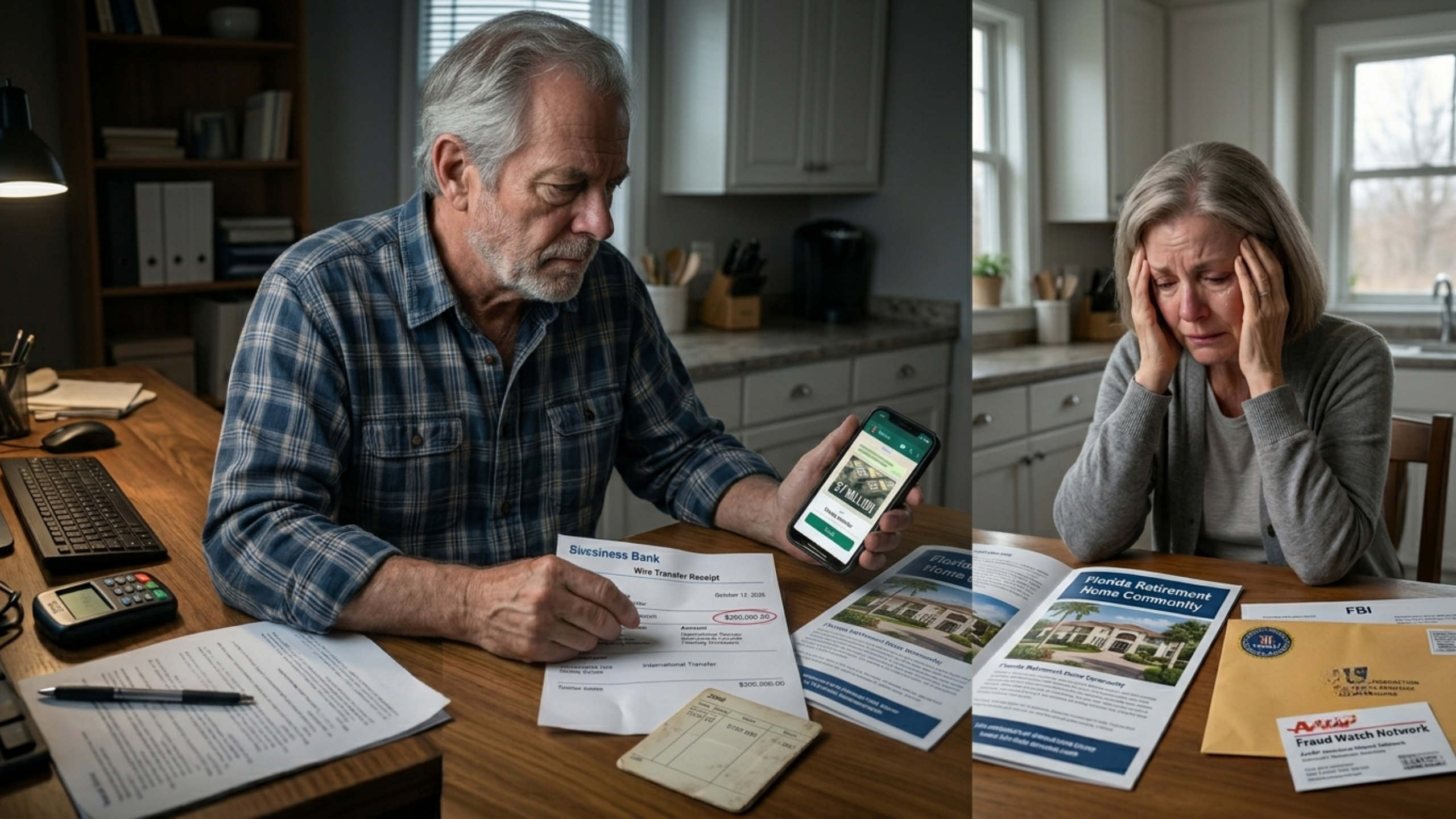
A 66-year-old American man secretly wired $200,000 (£151,000) of his family's retirement savings to scammers who had promised to turn it into $7 million (£5.3 million). He told no one, ran no checks, and tried to send more when his bank froze the payment, and the police arrived at his door.
The case came to light earlier this month on Reddit's r/Scams forum, where the man's adult child set out what had happened under the flair 'Victim of a scam.' The poster wrote that it was 'not dementia' but 'his pure greed'. 'I literally don't know where else to go. I am so devastated,' the post began.
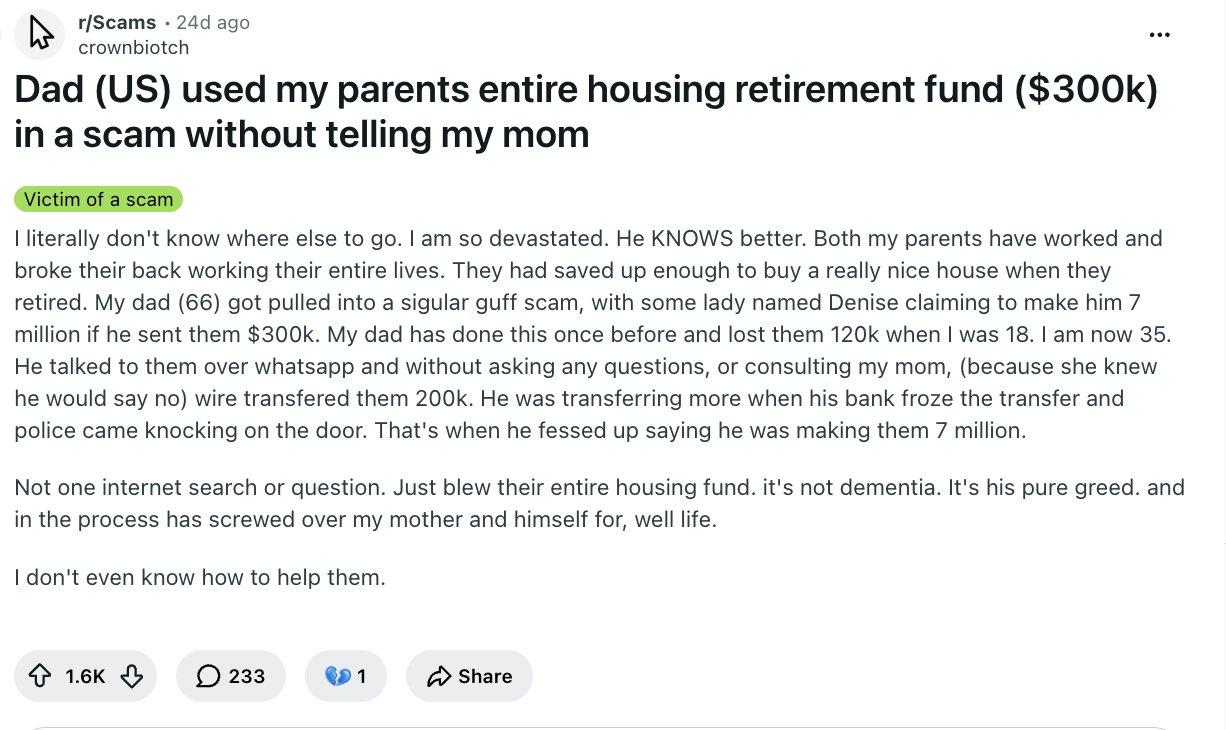
According to the account, the man was drawn in by a woman calling herself Denise, who reached him via WhatsApp and dangled a $7 million payout in exchange for an upfront $300,000 (£226,500). He asked no questions and searched for nothing online. He also kept his wife out of it, the poster said, because he knew she would have refused.
He managed to send $200,000 before his bank blocked a further transfer, and officers turned up at the family home. Only then did he admit what he had been doing. The couple had set aside roughly $300,000 to buy a house for their retirement, and most of it is now gone. 'Just blew their entire housing fund,' the poster wrote, before ending the post: 'I don't even know how to help them.' The thread drew more than 1,600 upvotes and over 230 comments within weeks.
A Near-Identical Scam Had Already Cost Him $120,000 Years Earlier
It was not the first time. About 17 years earlier, the same man had lost $120,000 (£90,600) to a strikingly similar scheme, the post said. He was taken in again, by the same kind of fraud, with the family's entire housing fund now at stake.
That repetition is common. Investigators warn that anyone who pays once tends to be flagged by criminals as a soft target and approached again. Some victims are later contacted by recovery scammers, who pose as agents or lawyers and offer to claw back the lost money for an advance fee, then take more. Advance-fee schemes like this one promise a large windfall in return for an upfront payment that never produces the payout.
Why Older Savers Lost $7.7 Billion to Scams Last Year
The case fits a pattern the FBI tracks at scale. The bureau's 2025 Internet Crime Report logged 1,008,597 complaints and reported losses of about $20.9 billion (£15.8 billion), up 26 per cent on the previous year. The average reported loss was around $20,700 (£15,600), and online fraud accounted for roughly 85 per cent of the money lost.
Americans aged 60 and over were hit hardest, filing 201,266 complaints and reporting $7.7 billion (£5.8 billion) in losses, more than any other age group. Investment fraud caused the single biggest share of the damage, at about $8.6 billion (£6.5 billion). Cryptocurrency featured heavily too, making up roughly $11.3 billion (£8.5 billion) of the total. The bureau also gave artificial intelligence its own line for the first time, logging 22,364 complaints and around $893 million (£674 million) in losses as criminals turned to voice clones and deepfakes.
Retirement accounts are a frequent target because a single instruction can move a lifetime of savings at once, which is what occurred here. Banks and the FBI do sometimes halt a transfer in time. Through its Financial Fraud Kill Chain, the bureau froze more than $679 million (£513 million) of $1.16 billion (£876 million) in attempted thefts last year, a 58 per cent success rate. In this case, the block came only after $200,000 had already left the account.
How Families Can Step In Before the Scam Money Goes
The AARP runs a free Fraud Watch Network helpline on 877-908-3360, staffed by specialists who talk callers through a suspected scam. Its guidance, echoed by the FBI, is to slow down and check any unexpected demand for money before acting on it. No legitimate agency asks to be paid in wire transfers, cryptocurrency, or gift cards.
Families are urged to name a trusted contact on elderly relatives' accounts and to talk about money openly, since investigators say secrecy around large transfers is one of the clearest warning signs. Anyone who believes they or a relative has been targeted can report it at ic3.gov.
© Copyright IBTimes 2026. All rights reserved.
- Recommended For You