iPhones Are Cheapest in These Countries: Türkiye Already Pays More Than What Apple's Foldable Might Cost
The same 256GB handset sells for over twice as much at the top of the table as at the bottom, a gap created by tax, not hardware
Japan, the United States, and South Korea are the cheapest of the 41 markets where Deutsche Bank tracks the 256-gigabyte (GB) iPhone 17 Pro, and Japan's $1,121 (£835) undercuts every rival. Türkiye sits at the other end on $2,592 (£1,930), more than analysts expect Apple to charge for its first folding iPhone, which is forecast to arrive in September.
The figures come from the bank's research arm, the Deutsche Bank Research Institute, whose 2026 'Mapping the World's Prices' survey compares the same handset across 41 markets in US dollars. The UK ranks 23rd at $1,476, in line with the £1,099 on Apple's own UK store. The US benchmark stands at $1,181 (£880), and Apple set the model's American sticker at $1,099, a $100 rise on its predecessor, at the September 2025 launch.
From $1,121 in Japan to $2,592 in Türkiye
Brazil is second dearest at $2,260 (£1,684) and Egypt third at $1,872 (£1,395), while South Korea shares the US price and Hong Kong, at $1,200 (£895), sits just above it. The shape of the ladder, as the chart below shows, owes more to national tax codes than to anything Apple decides in California.
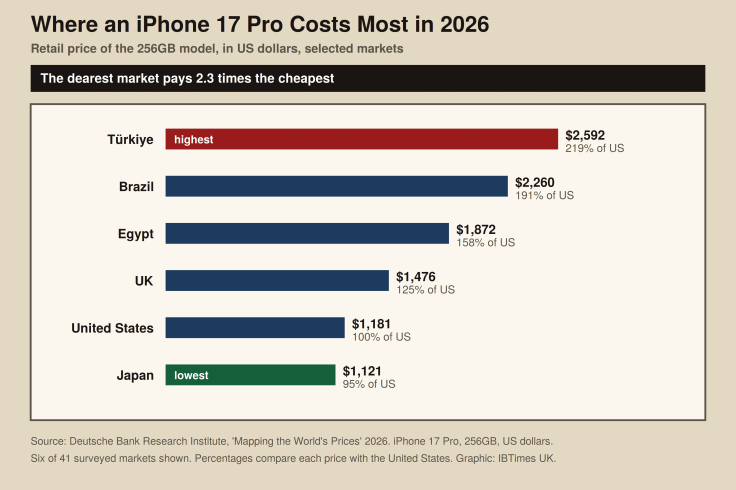
Sixteen of the 20 most expensive markets are European, largely because advertised prices there include value added tax (VAT). Standard rates run from 27% in Hungary, whose $1,826 (£1,360) price is the highest in the European Union, down to just over 8% in Switzerland.
Japan pairs a 10% consumption tax with fierce local competition, which keeps its price below the US level even after Apple lifted some Japanese prices in July following years of yen weakness. South Korea and the US complete the cheap end of the table, and each of those three markets sits at or under $1,200.
The Tax Stack Behind the World's Dearest iPhone
Türkiye layers four separate charges on a handset before it reaches a till. A 1% culture ministry fee and a 12% levy for the state broadcaster, the Turkish Radio and Television Corporation (TRT), come first. A special consumption tax (ÖTV) of 50% then applies to premium models, and 20% VAT lands on the whole stack. A weakening lira compounds the arithmetic, since the currency lost nearly 17% against the dollar in the year to mid-July, while the Turkish Statistical Institute put annual inflation at 32.11% in June.
The Turkish price is striking because it clears even the bolder forecasts for Apple's first folding phone. Fubon Research expects the device to launch near $2,399 (£1,787), and analyst Ming-Chi Kuo of the brokerage TF International Securities projected a $2,000 to $2,500 (£1,490 to £1,862) window. The research firm IDC puts the average selling price at the top of that span, and Apple has confirmed none of these numbers. Every one of them sits below the $2,592 a standard iPhone 17 Pro already commands in Türkiye, as the graphic below shows.
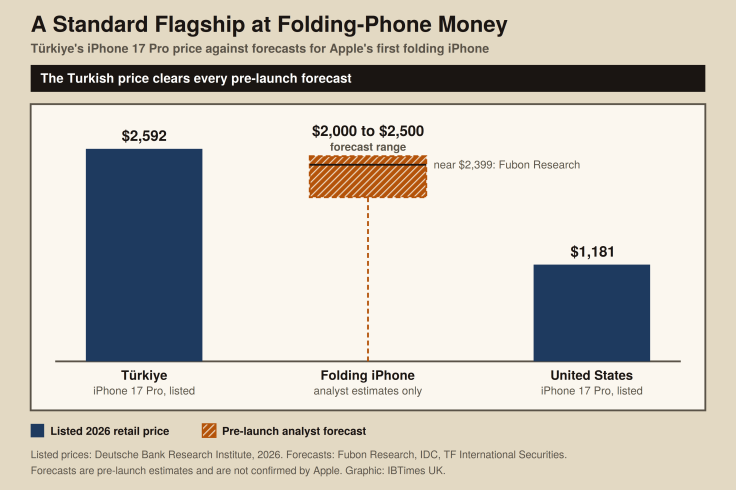
The comparison cuts both ways. Whatever Apple charges for the folding model in the US, Turkish levies will pile onto that figure in the usual order. Buyers there face the prospect of a folding price far beyond anything on the current table.
Importing a cheaper handset is no escape for residents. Registering a foreign phone's International Mobile Equipment Identity (IMEI) number costs 54,258 lira, about $1,263 (£941), under the 2026 fee schedule. An unregistered handset stays usable there for just 120 days.
Price ladders like this one move with currencies and budgets rather than with Apple's September announcements, so today's cheap markets carry no guarantee for next year. For a British buyer, the maths is simpler. The £1,099 list price sits a quarter above what Americans pay and some £830 below the Turkish figure, and the cheap list, in the end, is a map of tax policy.
© Copyright IBTimes 2026. All rights reserved.
- Recommended For You