Why Málaga Has Become One of Europe's Leading Destinations for British International Education
Discover how Málaga's British schools are attracting international families to the Costa del Sol.
For much of the twentieth century, Spain's southern coast was known abroad primarily for its beaches and summer tourism. That perception has shifted considerably over the past decade. Málaga and the wider Costa del Sol are increasingly recognised not as a seasonal getaway, but as a place where international families choose to settle permanently, build careers and raise children.
Behind this shift lies a combination of economic, professional and lifestyle factors, and few reflect it as clearly as the growing presence of British international education along this stretch of coast.
Remote Work And International Mobility
The rise of remote and hybrid working arrangements has loosened the traditional link between where people work and where they live. Professionals who once had to be based near a single employer now have far more freedom to choose a location that suits their family, and southern Spain has benefited directly from this flexibility. Mild weather, direct flight connections to major European cities and a comparatively lower cost of living than much of Northern Europe have all played a role.
For families considering relocating to Málaga with children, the appeal rarely rests on lifestyle alone. Once the initial interest in moving takes hold, practical questions quickly move to the centre of the decision, including healthcare access, housing and, consistently, the availability of reliable schooling. Education is often the factor that determines whether a family follows through with a move or looks elsewhere.
The Global Appeal Of The British Curriculum
Demand for British education in Spain is closely tied to the way the UK system approaches learning. Rather than focusing heavily on rote memorisation, the National Curriculum for England places significant emphasis on independent thinking, problem-solving and continuous assessment alongside examinations. For parents who expect their children to move between countries as their careers evolve, this style of education is often viewed as one that transfers well across different school systems and cultures.
Because British qualifications are recognised by universities around the world, students who complete their education within this framework generally retain a wide range of higher education options, regardless of which country they ultimately choose to study in.
Growing demand has pushed British schools in Spain into a period of expansion, both in terms of facilities and academic offerings. Competition across the Costa del Sol education sector has encouraged continued investment in science, sport and arts facilities. Many of these schools do not simply replicate a UK classroom in a different climate. Instead, they typically incorporate Spanish language teaching into the weekly curriculum, giving pupils valuable bilingual exposure that can benefit them in higher education and later employment.
Málaga As A Regional Hub For International Education
As the administrative and economic centre of the province, Málaga has become the natural focal point for this growth in international schooling. The concentration of international schools in the city reflects both rising demand from relocating families and a broader regional strategy to attract skilled professionals and their households.
Beyond academics, these schools often play a practical role in helping newly arrived families settle in by providing a ready-made community at a time when both parents and children are adjusting to life in a new country. The result is often a genuinely international environment, with pupils from a wide range of nationalities studying alongside one another every day.
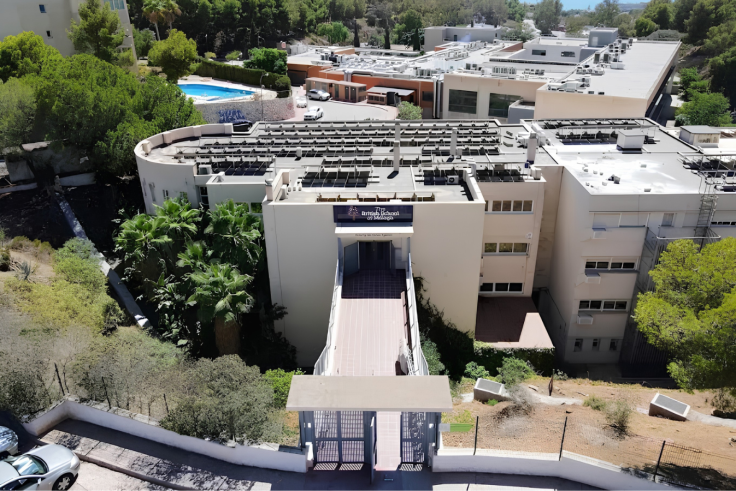
One established institution in this sector is The British School of Málaga, which has more than 25 years of experience since opening in 2000. This has helped establish the school within the city, supported by strong rankings among both national and international universities.
The British School of Málaga delivers the National Curriculum for England across all stages, from Early Years through to Sixth Form. The school is part of International Schools Partnership (ISP), one of the world's largest and fastest-growing groups of private international schools, with more than 100 schools across over 25 countries, educating more than 100,000 students worldwide.
Belonging to a group of this scale carries practical implications for a school's day-to-day operation. ISP schools share access to a common framework of teaching practice, professional development and quality assurance designed to maintain consistent standards across different countries. Teachers at ISP schools, including those at The British School of Málaga, can draw upon group-wide training resources and continuing professional development programmes, rather than relying solely on what a single school could provide independently.
For pupils, membership of the group can provide access to international learning opportunities beyond the local campus, including exchange programmes, collaborative projects with other ISP schools overseas and structured university and careers guidance as students approach the end of secondary education.
For families relocating to the Costa del Sol, this international network can be reassuring. It means a school's educational offering is supported not only by its own resources, but also by a wider international organisation with an established track record across multiple countries.
This combination of delivering the British curriculum and being backed by ISP has translated into external recognition in recent years. The British School of Málaga has featured in El Mundo's national ranking of the best international schools in Spain, placing among the country's leading schools and among the small number of Andalusian schools included. It has appeared in the ranking every year since 2021.
The school has also been recognised as one of the most sought-after international schools in the Málaga-Costa del Sol area, based on the level of interest shown by families researching international education in the region.
A Curriculum Built For Continuity
The consistency of the British curriculum across different countries is one of its most practical advantages for internationally mobile families. Because assessment structures and core content are broadly standardised, a student relocating mid-year from London, Singapore or Dubai can generally integrate into a British school in Spain without the disruption that moving between unrelated education systems might cause.
For families whose relocation plans can change with little notice, often because of a parent's employer, this continuity is an important consideration. It also helps explain why securing a place at a British school in Málaga is frequently one of the first practical steps families take when planning a move.
A Long-Term Bet, Not A Seasonal One
The rise of the Costa del Sol as a destination for British international education reflects broader changes in how and where people choose to live and work. Remote working and greater international mobility have made relocation more achievable for a wider range of families, while the presence of established British schools, including institutions such as The British School of Málaga, has given many the confidence to make that move.
As global mobility continues to shape family and career decisions, education is likely to remain one of the clearest indicators of how firmly Málaga has established itself as a long-term destination for international families, rather than simply a seasonal one.
© Copyright IBTimes 2026. All rights reserved.
- Recommended For You