'We Are at War with an Enemy': Firefighters Describe 'David v Goliath' Battle Against Europe's Mega-Blazes
Firefighters face unprecedented challenges as wildfires rage across France and Spain, forcing mass evacuations amid extreme heat.

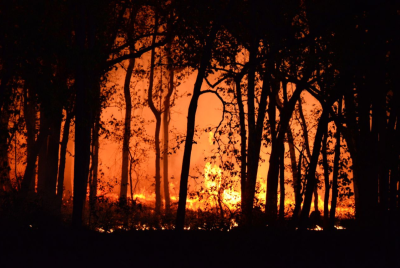
Wildfires are tearing across parts of France and Spain, where firefighters now describe their work as a 'David v Goliath' struggle against some of the biggest blazes either country has seen.
In southwest France, a fire near Bordeaux has already devoured around 42,000 hectares of pine forest and destroyed 240 homes, while in central Spain a 'monster' wildfire west of Madrid has grown to five times the size of Barcelona.
Authorities say more than 360,000 people have been forced to evacuate across both countries as flames advance on towns, campsites and holiday resorts.
Officials warn that a fresh heatwave, with temperatures forecast to exceed 40 degree Celcius in some areas, could make the situation even more volatile.
For those on the fireline, Europe's mega‑blazes are no longer distant climate warnings, they are the enemy right in front of them.
Firefighters Call Gironde Wildfire a 'David V Goliath' Fight
In the Gironde region of southwest France, where the main French wildfire is concentrated, the language from front‑line crews has shifted from professional understatement to something closer to open alarm.
Remi Lassoureille, a captain in the French Fire and Rescue Service who heads forest fire efforts in Gironde, said the blaze has burned roughly 42,000 hectares in five or six days and destroyed 240 homes, with more than 2,000 firefighters deployed, including over 500 from the local service.
Lieutenant Colonel Eric Brocardi, speaking for the National Federation of Firefighters of France, called it an 'exceptional situation' and said crews are facing 'a fire with an exceptional intensity in Gironde.'
He added that the 'one goal' is to save lives, but did not hide the scale of the task, saying: 'The fire is big. It's like David v Goliath... We are little but we have a good strategy.'
Local officials are using similarly stark language. Manuel Martinez, mayor of Marcheprime, one of the hardest‑hit towns, described 'a raging fire that we are learning to understand' and declared: 'We are at war with an enemy.'
Interior Minister Laurent Nunez has warned that the overall situation across France remains 'very unfavourable', even as some fronts stabilise from one night to the next.
Mega‑Blazes Near Bordeaux and Madrid Push Thousands from Their Homes
The headline numbers from France and Spain are sobering. In France, as of this writing, more than 250,000 people have been evacuated, many from villages and resorts dotted around the Cap Ferret peninsula and the Lacanau Ocean area outside Bordeaux.
The Gironde prefecture has ordered fresh evacuations of campsites, holiday villages, tourist residences and leisure parks, affecting about 4,000 people in the latest wave alone.
Bordeaux's western metropolitan fringe is 'frightened' by the approach of the flames, according to Lassoureille, although officials stress that the city's central municipality is 'not really concerned right now.'
Bordeaux's mayor, Thomas Cazenave, has said there are no plans to evacuate the urban area, home to roughly 850,000 people and sheltering thousands already displaced by the fires, while insisting local authorities remain 'vigilant.'
In Spain, the blaze in Avila province, west of Madrid, has been labelled a 'monster' by civil protection chief Virginia Barcones.
She said crews are dealing with a fire perimeter of about 280 kilometres that encompasses 77,000 hectares. Around 75,000 residents have been evacuated from the Madrid region, Avila, Toledo and parts of Castellon in Valencia, while new fires in eastern Spain have forced yet more people to leave.
Spain's interior minister, Fernando Grande‑Marlaska, has said the major fires are still advancing, albeit slowly.
King Felipe VI, visiting an emergency shelter on the outskirts of Madrid, described the damage to Spain's natural heritage as 'incalculable.'
One evacuee, Azucena Paguada, said the Guardia Civil came to her home and ordered the family out, warning they were in danger. Another, a 70‑year‑old woman named Margarita, noted she had been wearing the same stained T‑shirt for four days in the shelter, adding with a sigh that the queen had come to see them when she felt anything but presentable.
Heatwaves, Firestorms and a 'Fire‑Breathing Dragon of Clouds'
Scientists have long warned that climate change is making extreme heat events more frequent and intense, and that hotter, drier summers would feed more severe wildfires. That pattern is visible across this crisis.
Meteorological agencies say parts of western France are already touching 37C, with forecasts of up to 38C in Paris and 40C in some southwestern departments. Spain is bracing for a powerful 'heat dome' that will trap hot air over the peninsula, with temperatures expected to reach 44C in Cordoba and around 42C in cities such as Toledo and Zaragoza.
The French weather service has placed Gironde and Landes, along with more than a dozen other departments, under 'heatwave' alerts.
Spain's meteorological agency expects the latest heatwave to last until at least Sunday, warning that high temperatures and gusty southerly winds will make firefighting harder.
In both countries, the strategy is essentially a race against time, trying to contain existing lines before the next blast of hot, dry air causes fires to surge again.
The Gironde blaze has already spawned one of the most troubling fire phenomena. According to the National Firefighters Federation of France, the major fire near Bordeaux created a 'pyrocumulonimbus', a towering fire cloud that generates its own winds and lightning.
Space agency scientists have nicknamed such systems 'fire‑breathing dragons of clouds' because the lightning they produce can ignite fresh fires far from the original front.
Children, Tourists and Exhausted Crews on the Front Line of Europe's Wildfires
The human impact of Europe's wildfires is rippling far beyond the fire lines. New data from Save the Children estimates that 57 million children, about 63% of the population of Western Europe, have been exposed to extreme heatwaves in the first half of 2026, more than in any year in the past two decades.
The charity says over 10 million children in the UK alone have already experienced extreme heat this year, more than in any full year since 1995. Children have reported struggling to sleep, losing their appetite and withdrawing socially in the prolonged heat.
Holidaymakers are also caught up in the disruption. Travel experts are advising British tourists with trips to Spain and France in the coming weeks to check airline updates and insurance policies closely, as some areas near the fires are under evacuation orders or air‑quality warnings.
In Gironde, the regional prefect has urged tourists to avoid the area altogether and choose 'other destinations.'
On the ground, firefighters continue to describe grinding, dangerous work, often with little sleep.
In Gironde, 93 firefighters have been injured during the current blaze, according to the prefecture, and union representatives have complained that crews lack proper protection against toxic smoke.
France has deployed around 2,500 firefighters, 1,500 military personnel and 1,200 police to the region, and the defence ministry has moved to secure key industrial facilities around Bordeaux.
The main motorway south of the city and some rail services have been cut, choking off normal life to give the men and women in yellow helmets a fighting chance.
Across the border in Spain, Prime Minister Pedro Sanchez has visited fire‑hit areas and warned of 'difficult hours' ahead, while officials in Valencia describe a new blaze there as 'very intense'.
One person has died in a smaller fire near Valencia and two firefighters were killed near Bordeaux earlier in the week.
Pope Leo IV has publicly called the fires 'devastating' and urged people to pray for both victims and first responders.
The current emergency follows months of unusually hot and dry weather across western Europe that has turned forests into ready fuel. Spain's national fire data show that 362 wildfires had already broken out in the country by 22 July, the highest number recorded at this point in the year since 2006.
The European Forest Fire Information System has estimated that at least 204,000 hectares of land have burned in Spain in 2026, almost half of it in just one week between 15 and 22 July.
Regional authorities say major fires near Madrid remain 'active and uncontrolled', and that across Spain and France roughly 360,000 people have been ordered to leave their homes or holiday accommodation as a precaution.
The French government and local prefectures in Gironde have stressed that the situation remains 'highly unpredictable.'
Experts such as Martin Wooster, a professor of earth observation science at King's College London, argue that societies will have to get smarter about managing landscapes in an era of more flammable summers.
He has pointed to techniques like prescribed burning to reduce dead fuel and noted that some vegetation actually depends on intense fire to regenerate, adding that 'vegetation recovers after fire' and 'fire is not the dead end.'
For the crews facing a wall of flame, the more immediate question is simpler and harsher: where on earth do you hit Goliath next.
© Copyright IBTimes 2025. All rights reserved.
- Recommended For You