Why Was Bayeux Tapestry Secretly Delivered to British Museum? Historic Masterpiece Returns After 1,000 Years
The Bayeux Tapestry arrives in Britain for the first time in nearly a millennium, marking a significant cultural exchange between France and the UK.
The Bayeux Tapestry has arrived in Britain for the first time in nearly 1,000 years after a secret overnight journey designed to protect one of Europe's most priceless historical treasures.
The 70-metre medieval artwork was discreetly delivered to the British Museum in London after an 11-hour journey from Bayeux in Normandy. Details of the transfer were kept under wraps for security reasons. The tapestry is fragile, priceless and politically symbolic, making its movement across borders one of the most sensitive museum loans in recent history.
The artwork was reportedly folded accordion-style into a climate-controlled case and placed inside a shock-absorbing cradle before being loaded into a truck. It then travelled through the Channel Tunnel under police escort before arriving at the British Museum in the early hours of Friday.
I can confirm that The Bayeux Tapestry has just arrived safely and securely at the British Museum pic.twitter.com/5FCflDpId1
— George Osborne (@George_Osborne) July 10, 2026
British Museum chair George Osborne confirmed the arrival on X, writing that the tapestry had reached the museum 'safely and securely.'
A Historic Return to English Soil
The arrival marks the first time the Bayeux Tapestry has been in Britain since it was created nearly a millennium ago. Although long housed in France, historians believe the embroidery was probably made in England, possibly by women or nuns, before being taken across the Channel.
The tapestry will be displayed at the British Museum from 10 September until July 2027. Museum director Nicholas Cullinan described the moment as extraordinary, saying it felt remarkable after years of planning, care and negotiations.
Public demand has already been huge. Around 100,000 tickets were reportedly sold on the first day they became available.
What Does the Bayeux Tapestry Show?
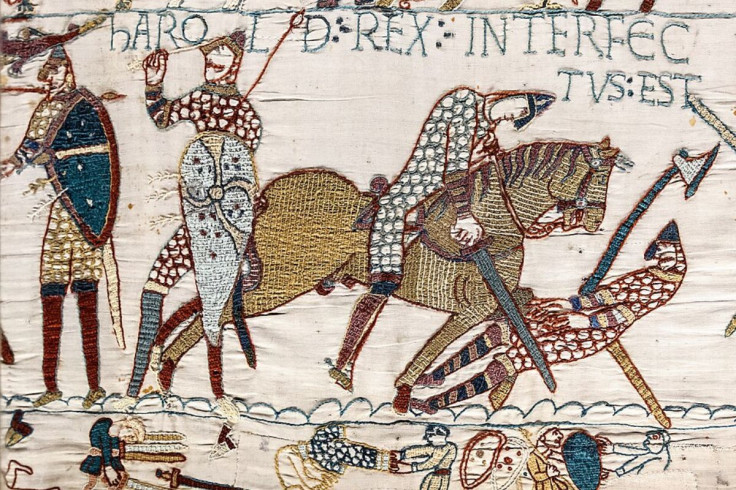
Despite its name, the Bayeux Tapestry is technically an embroidery, made with wool thread stitched onto linen.
Its 58 scenes tell the story of the events leading to the Norman conquest of England in 1066. The artwork shows banquets, ships, soldiers, weapons and brutal battlefield scenes, culminating in the Battle of Hastings, where William, Duke of Normandy, defeated King Harold's Anglo-Saxon army.
The victory ended Saxon rule and made William the Conqueror the first Norman king of England. With more than 600 human figures and hundreds of animals, the tapestry remains one of the most vivid surviving records of 11th-century life, war and power.
Why Did France Loan It to Britain?
The loan was announced by French President Emmanuel Macron and is being viewed as a major gesture of Franco-British friendship. Macron described the transfer as a sign of the long-standing relationship between France and the United Kingdom, as both countries work to strengthen ties after Brexit.
La Tapisserie de Bayeux a pris le chemin de Londres. Ce trésor millénaire qui raconte notre histoire commune traverse la Manche. Merci aux équipes qui ont rendu possible ce geste historique de confiance, de culture et d’amitié.
— Emmanuel Macron (@EmmanuelMacron) July 9, 2026
Vive l’Entente cordiale ! pic.twitter.com/IgaiYtyYOB
The timing also has a practical reason. The museum in Bayeux that normally houses the tapestry is undergoing renovation, allowing the work to travel while its permanent home is updated. In return, the British Museum will loan France treasures from the Sutton Hoo collection, one of England's most important Anglo-Saxon archaeological finds.
Why Some Opposed the Move
Not everyone supported the loan.
Some French cultural figures argued that moving the fragile artwork was too risky, warning that even careful transport could damage a piece that has survived nearly 1,000 years. Museum officials said they took extraordinary precautions, including trial runs, specialist packing and constant environmental controls.
Delighted that after many centuries (and many many months of work and careful planning) the Bayeux Tapestry is now at the @britishmuseum ahead of its display later this year. Thank you to all involved in the meticulous planning and to our French neighbours for allowing the loan. https://t.co/whmHBdN4WK
— Fiona Twycross (@fionatwycross) July 10, 2026
For many people, the successful arrival is both a technical triumph and a symbolic homecoming. After centuries in France, the Bayeux Tapestry is now back on English soil as a shared reminder of the violent history that helped shape both nations.
© Copyright IBTimes 2026. All rights reserved.
- Recommended For You