Top 10 Stunning Moon Images From Artemis II That Humans Have Never Seen Before
During a seven-hour pass over the Moon's far side, the crew documented regions that remain invisible from Earth

NASA has unveiled a remarkable collection of lunar images captured during the Artemis II mission, offering a rare glimpse of the Moon from a human perspective not seen in more than half a century. Taken during the crew's flyby of the far side of the Moon, the photographs showcase landscapes, light patterns, and celestial alignments that even modern satellites struggle to replicate with the same depth of human observation.
The images, released by NASA, highlight what mission officials describe as a defining moment in the return of human space exploration beyond low Earth orbit.
A Historic Return to the Moon's Far Side
The Artemis II mission marks the first crewed journey around the Moon since the Apollo era, with astronauts travelling farther from Earth than any humans in decades. During a seven-hour pass over the Moon's far side, the crew documented regions that remain invisible from Earth.
According to NASA mission updates, the astronauts witnessed 'sights that no human has ever seen', underscoring the unique vantage point.
Unlike robotic probes, the human eye offers an interpretive dimension, capturing contrast, colour, and spatial relationships in ways that automated systems cannot fully replicate.
The Top 10 Images That Captured Global Attention
1. The Far Side in Full Shadow and Light

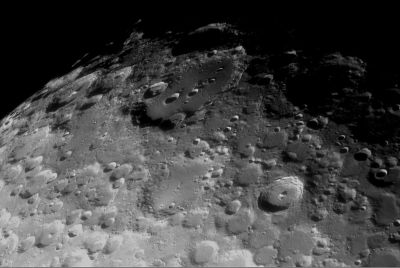
A striking image captures the lunar terminator, the jagged boundary where day meets night, creating a sharp contrast of light and darkness. The low-angle sunlight casts long, dramatic shadows that accentuate the Moon's rugged topography, revealing the intricate depth of craters and ridges. This interplay of light and shadow highlights surface complexities that remain hidden under the flat illumination of a full Moon.
2. Rare Solar Eclipse From Deep Space

During the mission's lunar flyby, the crew witnessed a total solar eclipse from a unique vantage point near the Moon. This extraordinary perspective showcased the Sun, Earth, and Moon in a near-perfect alignment, with the massive lunar disk obscuring the Sun for an unprecedented 54 minutes. From this deep-space position, the Sun's faint corona became visible as a soft halo, a phenomenon typically hidden by the Sun's intense brightness.
3. Newly Observed Crater Formations

Astronauts on the Artemis II mission reported seeing vibrant 'bright patches' scattered across the far side of the Moon, where small, fresh craters reflected sunlight in unexpected shades of brown and blue. These subtle colours, visible even to the naked eye from their close vantage point, indicate varied mineral compositions recently exposed by impacts. This unique perspective provides a rare, natural-colour look at the Moon's rugged, hidden face, highlighting a level of geological detail that is often lost in long-distance photography.
4. Earthrise Beyond the Lunar Horizon

A modern successor to the iconic Apollo-era perspective, this photograph captures the brilliant arc of Earth emerging from the lunar horizon. This Artemis II 'Earthrise' serves as a powerful reminder of humanity's place in the cosmos, framing our home planet against the stark, monochromatic desert of the Moon. From this deep-space vantage point, the fragile blue marble stands in vivid contrast to the rugged lunar limb, bridging the gap between historical exploration and our next giant leap.
5. High-Contrast Terrain Mapping

The Artemis II crew captured the Moon's rugged geology with unprecedented clarity, revealing intricate surface textures and fine-scale details. From sharp crater rims to ancient volcanic flows, these images offer a high-resolution view of the lunar landscape's complex history. This perspective offers a level of geological depth rarely seen, highlighting the battered beauty of a world shaped by eons of cosmic impacts.
6. Lunar Limb Against Deep Space

The sharp curvature of the Moon against the absolute blackness of space creates a striking visual composition that underscores its profound isolation. This stark contrast highlights the Moon's solitary presence in the void, framing the lunar limb as a thin, brilliant arc between the cratered surface and the deep silence of the cosmos.
7. Celestial Alignment During the Eclipse

This rare perspective features the soft glow of Earth's reflection on the lunar disk, while Saturn and Mars shine as bright points in the distance. With the spacecraft's solar array wing in the foreground, the image highlights a stunning celestial alignment during the Artemis II mission.
8. The Return of Light

The Orion spacecraft captures the Sun reemerging from behind the Moon at the end of a total eclipse, displaying brilliant light returning to the lunar limb, showcasing, as detailed in the image, distinct topography and signalling the crew's journey back from the lunar far side.
9. Eclipse Shadows Sweeping the Surface

The soft solar corona and Earth-lit Mare Crisium captured by the Orion during a record 54 minutes of totality. This image highlights the deep-space view of the lunar eclipse compared to its appearance from Earth. The interplay of light during the eclipse creates moving shadows, adding a dynamic element rarely captured in lunar photography.
10. The Far Side's Vast Silence

During the 6 April 2026 lunar flyby, the Artemis II crew captured a photograph of a crescent Earth hanging above the rugged lunar surface, showing swirling clouds over Australia and Oceania. This image highlights the contrast between the dark, crater-marked landscape in the foreground and the luminous planet in the background.
Why Human Observation Still Matters
Despite advances in satellite imaging, scientists emphasise the importance of human presence in space exploration. As one expert noted, while satellites provide data, human observation offers context, interpretation, and immediacy.
NASA scientists have highlighted that astronauts can identify subtle features and adjust their focus in real time, something pre-programmed systems cannot always achieve.
This capability becomes particularly valuable when documenting transient phenomena such as eclipses or unusual light patterns across the lunar surface.
A New Era of Lunar Exploration
The release of these images signals more than just a technological achievement; it marks the beginning of a renewed human connection with the Moon. Artemis II serves as a precursor to future missions that aim to land astronauts on the lunar surface and establish a sustained presence.
Officials at NASA have framed the mission as a stepping stone towards deeper space exploration, including eventual journeys to Mars.
The Emotional Impact of Seeing the Moon Again
Beyond the scientific and strategic implications, the images have resonated on a human level. Astronauts described the experience as overwhelming, with one noting there were 'no adjectives' sufficient to capture the view.
These photographs do not simply document a mission but reconnect humanity with a sense of exploration that defined the Apollo era, now renewed for a new generation.
As Artemis II continues its journey back to Earth, the images captured during its lunar flyby are likely to remain among the mission's most enduring contributions. They offer a rare blend of science, art, and perspective, reminding us not only of where we are going, but of how far we have come.
With future missions already in development, these photographs may soon be joined by even more detailed observations. For now, however, they stand as a powerful testament to the value of human exploration and the timeless allure of the Moon.
© Copyright IBTimes 2026. All rights reserved.
- Recommended For You