

'The Rain Is Black… I Can't Believe It' — Tehran Residents Wake to Oil-Tainted Skies After Israeli Strikes on Fuel Storage Sites
Israeli airstrikes on oil depots cause black rain and toxic fallout in Tehran
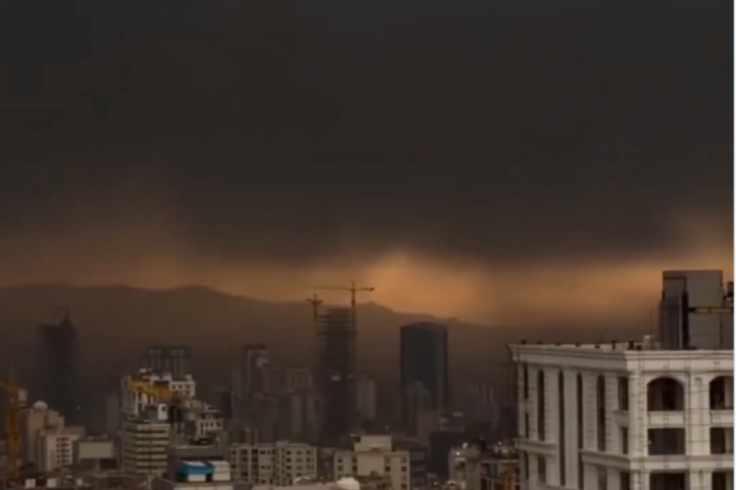
Residents of Tehran woke on Sunday morning to an unsettling and, for many, terrifying scene. Thick black smoke from burning fuel depots blanketed the Iranian capital after Israeli airstrikes hit oil storage sites late on Saturday night, plunging a city of nearly 10 million people into an unnatural darkness that persisted well into the morning hours.
'The rain is black, I can't believe it, I'm seeing black rain,' Kianoosh, a 44-year-old engineer, said. 'It's even in Tajrish, which is miles and miles away from the oil tanks.' His account was far from isolated. Leila, a 27-year-old teacher, described the air as 'unbreathable.' 'Something like a black monster has swallowed the sky over Tehran,' she told the same publication. 'It's as if all the cars and the street pavement have been coated in black paint.'
A City Left in the Dark
With the sun blotted out, disoriented residents had to turn on their lights to see through the gloom. 'I thought my alarm clock was broken,' a driver in his fifties said. By 10:30 am local time, cars still needed their headlights to drive along Valiasr Street, a main thoroughfare running north to south through the capital.
Journalist Frederik Pleitgen, reporting from central Tehran, captured footage showing dark water gathering on every surface. 'You can see that the rain, the rainwater is actually black — also saturated, it appears, with oil,' Pleitgen reported. 'So that's what's coming down this morning, this sort of oil-filled rain that we have right now on the Iranian capital, after the strikes took place.' Residents speaking to BBC Persian described Saturday night as 'the worst night' since the Israeli offensive began a week ago.
What Was Struck — and Why
The Israeli military confirmed it had struck 'a number of fuel storage facilities in Tehran' that were used 'to operate military infrastructure.' Israeli Prime Minister Benjamin Netanyahu said his government would press on with the assault and strike Iran's rulers 'without mercy.' 'We have an organised plan with many surprises to destabilise the regime and enable change,' he said in a video statement. 'We have many more targets.'
According to the IDF, the strikes marked the first time during Operation Roaring Lion that the military targeted Iranian national infrastructure, carried out under instructions from Israel's political leadership. Four oil depots and a petroleum logistics site in and around Tehran were hit, including the Aghdasieh oil warehouse in northeast Tehran, the Tehran refinery in the south, the Shahran oil depot in the west, and a depot in the city of Karaj.
An official from Iran's oil distribution company confirmed that four employees were killed in the strikes, including two oil tanker drivers, adding that the facilities were damaged but that 'fire was brought under control.'
NEW: Black rain pours down on Tehran, Iran following Israeli strikes on oil facilities Saturday night.
— Collin Rugg (@CollinRugg) March 8, 2026
“I want to show you something…” CNN’s @fpleitgenCNN said.
“This is a white car … the rain is actually apparently saturated with oil. You can see on my finger that it's… pic.twitter.com/np6HNDDLcV
Health Warnings and Toxic Fallout
The Iranian Red Crescent Society said the oil depot explosions released 'significant quantities of toxic hydrocarbon compounds, sulfur, and nitrogen oxides' into the air, warning that the contaminated precipitation was 'extremely dangerous.' The organisation advised residents not to turn on air conditioning, to avoid going outside immediately after rainfall, to protect exposed food, and to gargle salt water to clear oily soot particles from the throat, further warning that the rainfall could cause 'chemical burns of the skin and serious damage to the lungs.'
Dozens of kilometres from the fuel depots, residents swept their balconies, covered in a mix of rain and puddles of fuel. Tehran's governor, Mohammad Sadegh Motamedia,n confirmed on Sunday morning that fuel distribution in the capital had been 'temporarily interrupted,' with each vehicle now limited to 20 litres of fuel. Long queues formed quickly at petrol stations across the city.
The black rain over Tehran marks a new and visible dimension to a conflict that has, in just over a week, already killed more than 1,300 people in Iran and around 300 in Lebanon, according to official figures—and the full environmental toll has yet to be assessed.
© Copyright IBTimes 2026. All rights reserved.