

What Is Mitch McConnell's Health Status? Here's How His Absence Let Democrats Force US Troop Withdrawal From Iran
When a single missing senator can flip a war vote, Mitch McConnell's silence on his health has become a problem far bigger than one man's privacy.
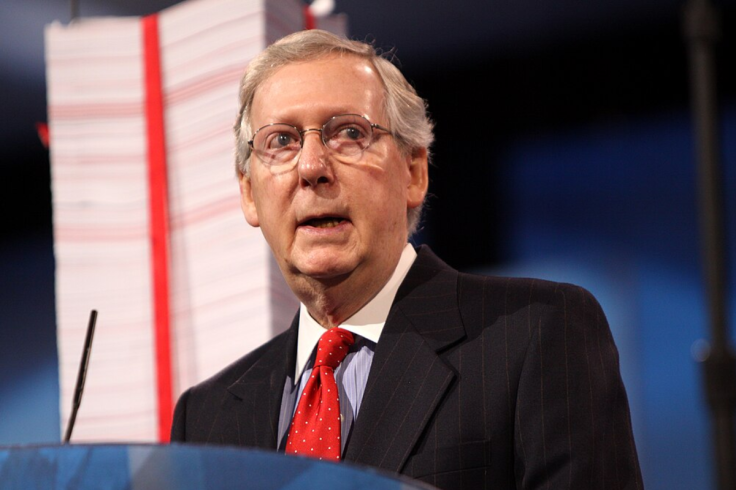
Mitch McConnell's health status is under fresh scrutiny in Washington after emergency audio revealed that paramedics were dispatched to his Capitol Hill home on 14 June for a reported 'cardiac arrest,' raising questions over when or if the 84-year-old Republican senator will return to the Senate and how his absence has already shifted the balance on foreign policy votes, including a resolution ordering US troop withdrawal from Iran.
The news came after weeks of sparse and carefully worded updates from McConnell's office, which has said only that he is in hospital, 'continues to improve,' and is working remotely on Kentucky and Senate matters while the chamber is out of session. No formal medical diagnosis has been released. In the vacuum, a single line from an emergency dispatcher, coupled with McConnell's visible frailty in recent months, has been enough to ignite a round of rumours about his condition and future in office.
Questions Mount Over Mitch McConnell And Transparency
McConnell's staff announced on 14 June that he had been admitted to hospital that morning and was 'receiving excellent care,' but declined to say why. There was no reference to heart trouble, loss of consciousness or any sense of urgency. That picture shifted dramatically last week, when a recorded dispatch call emerged indicating that emergency crews were sent to an address matching McConnell's Washington townhouse, where CPR was reportedly performed on an unconscious patient believed to have suffered cardiac arrest.
Nothing in that recording has been independently confirmed by the senator's team or medical personnel, so all interpretations of what happened should, at this stage, be treated with caution. Even so, the audio has fed speculation on Capitol Hill that McConnell's condition may be considerably more serious than his office has let on, and that his long career in the chamber could be nearing an abrupt end.

Al Cross, widely regarded as Kentucky's most seasoned political observer and someone who has interviewed McConnell at length twice in the past six weeks for a historical project, thinks the silence is backfiring. 'They're causing themselves problems by not saying more about it, but he's always been very private about his health matters,' he said. Cross added that recent whispers about 'worst-case scenarios' are in large part a product of that vacuum.
Those whispers have moved well beyond the Senate. Conservative activist Laura Loomer claimed on X, citing what she called 'a high level source close to the White House', that McConnell's health is far worse than publicly acknowledged and that he is 'not coming back' to the Senate.
Digital journalist Desirée Townsend, one of the first to circulate the dispatcher audio, reposted Loomer's claim and said she had 'heard the same thing' from her own sources over several days. None of those anonymous assertions have been corroborated, and no official source has confirmed that McConnell's return is off the table.
Cross himself is wary of the more dramatic claims. He notes that the 'cardiac arrest' description appears to have been the dispatcher's assumption, rather than the report of someone physically present. 'We have very little news that's reliable,' he said, before adding his own admittedly subjective reading: 'My gut tells me he's coming back.'
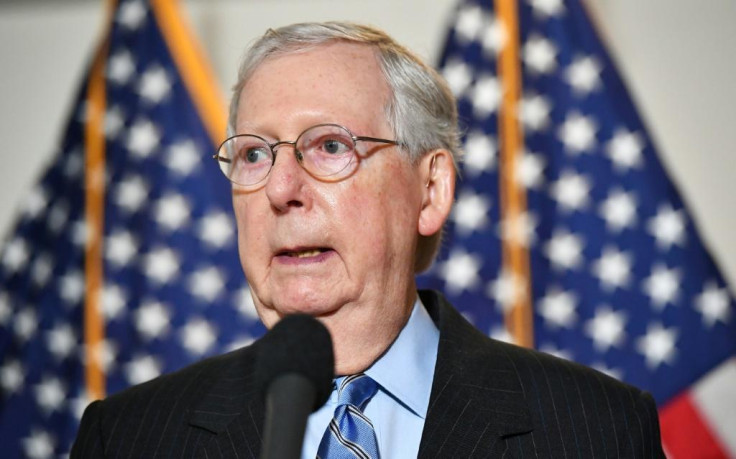
Mitch McConnell's Absence And The Iran Troop Vote
McConnell has not cast a vote since 11 June, and his absence has already had direct policy consequences. On 23 June, four Republican senators joined Democrats to approve a House-passed resolution directing then-President Trump to withdraw US troops from the military conflict with Iran.
The measure passed only because both McConnell and fellow Republican Sen. David McCormick of Pennsylvania missed the vote. Had McConnell been present and opposed the resolution, as he has historically opposed similar efforts to constrain presidential war powers, the outcome could have been very different.
The former GOP leader's continued absence now looms over the Republican agenda. Senate Majority Leader John Thune said on 15 June that he had spoken to McConnell in hospital and that he 'sounded good.' Thune said that McConnell 'wants to be back' but declined to put a date on it, deferring to the senator's staff. Earlier that same day, Thune had sounded 'hopeful' that McConnell would return to the Senate later that week. That did not happen.
Without McConnell physically in the chamber, Thune faces a harder climb in lining up votes for an emergency defence spending package that needs 60 votes and is already facing stiff resistance. He and House Speaker Mike Johnson are also eyeing a third budget reconciliation bill to fund the Pentagon and deliver on other Republican priorities. On both fronts, McConnell's vote would be crucial, not just numerically but symbolically, as several Republicans among them Susan Collins, Lisa Murkowski, Thom Tillis and Bill Cassidy have histories of breaking with Trump and could peel away.
The lack of clarity has sparked a broader debate about how candid senior politicians are about their health. Many Republicans have accused former President Biden's inner circle of concealing the true state of his cognitive abilities, particularly after his faltering debate performance against Trump in June 2024.
More recently, Republican Representative Tom Kean Jr was absent from the House for months before later revealing that he had been battling depression. Against that backdrop, McConnell's tight-lipped operation looks less like an outlier and more like part of a worrying norm.
Cross points out one detail he finds telling. While McConnell's office has talked about 'improvement' and 'recovery,' staff have noticeably avoided saying that he 'looks forward to returning to work.' 'That's the thing I've been looking for, but they haven't said that yet,' Cross observed.
If McConnell were to resign for health reasons, the repercussions would stretch beyond Washington. A 2024 law, House Bill 622, stripped Kentucky's Democratic governor, Andy Beshear, of the power to appoint a replacement senator. Any vacancy in McConnell's seat before the end of his term in 2026 would now trigger a special election, controlled by the Republican-dominated state legislature, to decide who finishes out the term.
© Copyright IBTimes 2026. All rights reserved.