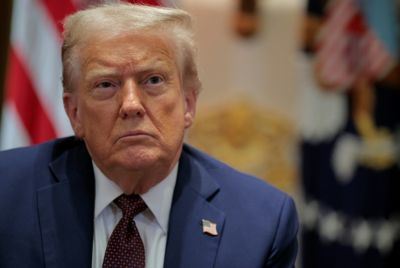
'Weak' Trump G7 Greeting With Emmanuel Macron Fuels Health Panic Over Discoloured Hands and Exhaustion
President Trump's health under scrutiny as his subdued demeanour at the G7 summit contrasts with past encounters.
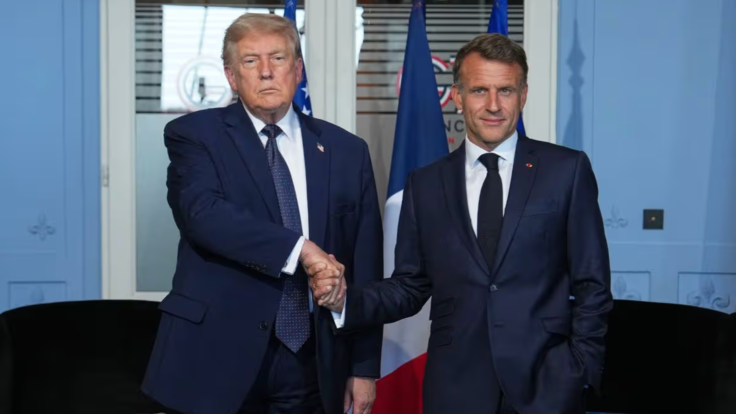
A president long associated with bone-crushing handshakes arrived at the G7 summit in France looking anything but dominant, and the world is watching closely to see what that might mean.
Donald Trump, who turned 80 on 14 June, landed at Geneva airport on 15 June before travelling to Évian-les-Bains for the 52nd G7 summit, hosted by French President Emmanuel Macron. Footage of the pair's bilateral meeting that day prompted immediate commentary online and across media. Where previous Trump–Macron encounters had been defined by white-knuckled, marathon grips, each man visibly refusing to yield, observers this time described Trump's demeanour as noticeably subdued. The interaction arrived against a backdrop of months of accumulating concern over the president's physical condition, concerns that a White House physician's memo released just days before the summit has done little to fully extinguish.
A Handshake That Tells Its Own Story
The history of Trump and Macron's physical greetings is, by any measure, unusual. Their first meeting in May 2017 produced a near-30-second grip that left both men's knuckles white. The following year, at the 2018 G7, Macron's handshake was so forceful it left a visible imprint of his thumb on Trump's hand. In December 2024, at Notre Dame's reopening, the two exchanged a 10-second embrace-turned-grip that television personality Piers Morgan described on X as an 'arm-wrestle' he had 'missed.' As recently as February 2025, during a White House bilateral, the pair were photographed in a six-second tug-of-war that left observers debating who came out ahead.
The bilateral in Évian on 15 June stood apart. Macron opened proceedings warmly, congratulating Trump on the newly announced US–Iran ceasefire framework. 'It's a very important step for peace of the whole world,' Macron said, according to an AFP pool report from the meeting. Trump, seated, received the praise without the charged physical theatrics that have characterised nearly every previous encounter.
🚨WTF! Donald Trump seems to LACK the strength in his right arm today to do his signature pulling handshake with French President Emmanuel Macron.
— CALL TO ACTIVISM (@CalltoActivism) June 15, 2026
He also looks GRUMPY as hell today. What’s going on? pic.twitter.com/RLyv2S8Wyh
Health Record Deepens Questions Over Discolouration
The health backdrop to Trump's G7 appearance has been building for over a year. In July 2025, White House Press Secretary Karoline Leavitt confirmed that Trump had been diagnosed with chronic venous insufficiency following vascular testing prompted by widely circulated photographs of his visibly swollen ankles at a FIFA Club World Cup event. 'The president underwent a comprehensive examination... which revealed chronic venous insufficiency, a benign common condition, particularly in individuals over the age of 70,' Leavitt told reporters at the time, adding that there was no evidence of deep vein thrombosis.
Hand bruising has been a separate, persistent concern. Photographs taken at the White House during Macron's February 2025 visit showed a pronounced grey-yellow discolouration across the back of Trump's right hand. The image was confirmed as authentic by Getty Images and verified by fact-checkers. The White House attributed it to 'minor soft tissue irritation related to frequent handshaking in the setting of aspirin use for cardiovascular prevention,' in the words of the president's physician, US Navy Captain Sean Barbabella. By 11 June 2026, fresh photographs circulating on social media showed that the discolouration had migrated: 'Now it's his left hand that's torn up,' one widely shared post noted.
Trump himself addressed the scrutiny directly in an interview with The Wall Street Journal, stating 'my health is perfect' and attributing the bruising to aspirin. He also revised an earlier claim that he had received an MRI scan in October 2025, clarifying it had in fact been a CT scan.
Latest Physical Leaves Key Issues Unresolved
On 27 May 2026, Trump visited Walter Reed National Military Medical Center for the third time in 13 months, a frequency that itself drew scrutiny. The White House released a memo from Barbabella three days later, at 22:44 on a Friday evening, concluding that the president 'remains in excellent health, demonstrating strong cardiac, pulmonary, neurological, and overall physical function.' Trump scored a perfect 30 out of 30 on the Montreal Cognitive Assessment. The memo noted 'slight lower leg swelling with improvement from last year' and reiterated the handshaking-and-aspirin explanation for the bruising.
What the memo did not address was equally noted. Axios reported that it left 'persistent questions about apparent bruising on Trump's hands, swollen ankles and his alertness during some public events' unresolved. The neck skin treatment Trump underwent in March 2026 received no mention. Nor did the question of why, on 4 June 2026, Trump appeared to lose consciousness briefly during an Oval Office briefing on 'Beautiful, Clean Coal,' leaning back and to the side in his seat while officials spoke around him.
check out how swollen and discolored Trump's right hand is pic.twitter.com/jU6QNgIJpa
— Aaron Rupar (@atrupar) June 15, 2026
High-Stakes Diplomacy Under A Physical Microscope
The summit itself carries significant stakes. According to ABC News, this is the first G7 gathering since the start of the US–Iran conflict, now in its 15th week, with oil and gas prices elevated globally as a direct consequence. A senior White House official told reporters in a background briefing ahead of the trip that Trump's agenda includes 'economic growth and development, supply chain resilience, illegal immigration and artificial intelligence.' Trump is also expected to press European allies on demining the Strait of Hormuz; both France and Britain have signalled interest in assisting.
France did considerable work to engineer conditions favourable to a full Trump attendance. The Council on Foreign Relations noted that the summit dates were shifted specifically to allow Trump to host a UFC championship fight at the White House for his birthday. Macron has invited Trump to a dinner at the Palace of Versailles on the summit's final evening, an appeal, French officials have said, deliberately calibrated to Trump's well-documented affinity for gilded interiors. Last year, Trump left the Kananaskis summit in Canada a day early; whether he completes the three days in Évian remains, as The Guardian observed, 'touch and go.'
The physical optics, in this context, are not incidental. Trump built his political identity on projected vitality, and the handshake battles with Macron were, in their own way, a performance of dominance staged for the cameras. That the cameras now capture something different, including a more restrained greeting and renewed focus on his discoloured hands and apparent fatigue, is not lost on those watching from allied capitals or from Washington.
© Copyright IBTimes 2026. All rights reserved.
- Recommended For You