

3I/ATLAS May Be Older Than the Sun as Scientists Uncover New Clues To Interstellar Comet's Ancient Origins
Astronomers have discovered that the interstellar comet 3I/ATLAS may be over twice as old as the Sun, giving them rare insights into ancient star systems.
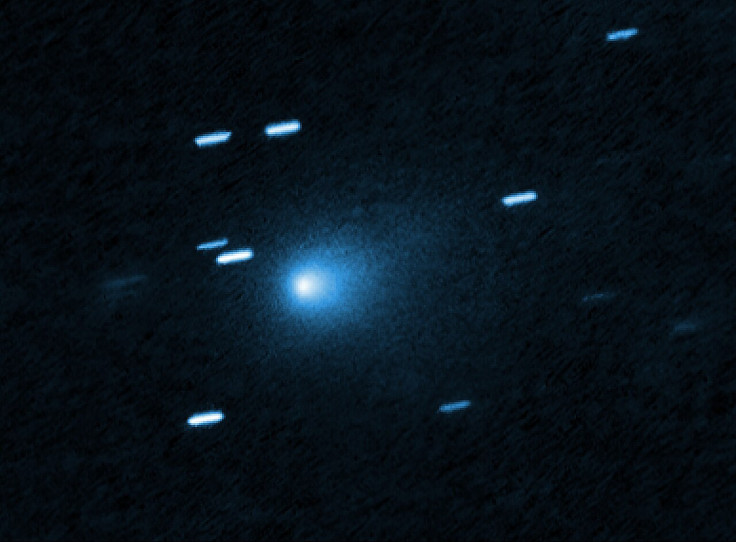
Astronomers studying the interstellar comet 3I/ATLAS have found fresh evidence suggesting the object may be more than twice as old as the Sun, after analysing its chemical composition using the European Southern Observatory's Very Large Telescope in Chile.
The findings, published in Nature Astronomy, indicate that the comet likely formed around an ancient star system long before our own Solar System came into existence.
3I/ATLAS is only the third confirmed interstellar object ever detected passing through the Solar System, following 1I/ʻOumuamua in 2017 and 2I/Borisov in 2019. Unlike its predecessors, however, 3I/ATLAS has remained bright enough for astronomers to examine its chemical makeup in unprecedented detail, allowing researchers to investigate where it formed and how old it might be.
3I/ATLAS Has Chemical Fingerprints From an Ancient Star System
Interstellar comets are icy bodies that originate around stars other than the Sun before drifting through interstellar space. Scientists regard them as natural time capsules because their composition preserves evidence of the planetary systems where they were born.
'They are sort of fossils from a planetary formation process that happened very far away, but that we get the chance to study from much closer,' said Cyrielle Opitom, an astronomer at the University of Edinburgh and lead author of the study.
Using the UVES instrument on ESO's Very Large Telescope, Opitom and her colleagues measured the relative amounts of different forms of carbon and nitrogen inside cyanide molecules surrounding the comet. These isotopic ratios are considered valuable clues because they remain largely unchanged as a comet travels through space, making them reliable indicators of the conditions in which it originally formed.
The researchers discovered that 3I/ATLAS contains unusually high ratios of carbon and nitrogen isotopes compared with comets native to the Solar System.
'Unlike comets from our Solar System, this interstellar visitor carries unusually high carbon and nitrogen isotopic ratios,' said co-author Aravind Krishnakumar of the University of Liège.
Those chemical signatures suggest the comet formed in the distant outer regions of a low-metallicity star system. Such stars contain relatively few elements heavier than helium and are believed to have formed when the Universe was much younger and chemically less enriched than it is today.
The research therefore points to 3I/ATLAS originating around a star significantly older than the Sun.
A Rare Window Into the Universe's Early History
The new findings also align with an independent study led by NASA Goddard Space Flight Center researcher Martin Cordiner using observations from the James Webb Space Telescope.
That research identified a similarly unusual carbon isotope ratio while also detecting elevated levels of deuterium, often referred to as heavy hydrogen. Together, the separate studies strengthen the idea that 3I/ATLAS formed in a very different environment from the one that produced the Solar System.
Overall, the available evidence suggests the comet could be more than twice the age of the Sun.
'3I/ATLAS is a really exciting opportunity to probe the composition of another planetary system, one that formed long before our Sun and Solar System even existed,' said co-author Rosemary Dorsey of the University of Helsinki.
Scientists say opportunities like this are exceptionally rare. While thousands of comets orbit within the Solar System, confirmed visitors from beyond it remain extremely uncommon. Their brief journeys through our cosmic neighbourhood offer astronomers a chance to examine material that has travelled across the galaxy for billions of years.
Observations of 3I/ATLAS are expected to wind down as the comet continues moving away from the Sun, becoming progressively fainter and more difficult to study.
Researchers are already looking ahead to the European Southern Observatory's upcoming Extremely Large Telescope, which should allow scientists to carry out similar measurements on much dimmer interstellar objects in the future.
'The field of interstellar objects is still very new, and we do not really know what to expect,' Opitom said. 'Every time a new one is discovered, we have new surprises.'
Those surprises may become increasingly common as next-generation observatories begin scanning the skies with greater sensitivity, offering astronomers more opportunities to study ancient visitors that have spent billions of years travelling between the stars before briefly crossing paths with our Solar System.
© Copyright IBTimes 2026. All rights reserved.