Is Earth in Danger? '4 Empire State Buildings Wide' Asteroid Makes Closest Approach This Weekend
Asteroid 1997 NC1 is set to closely approach Earth this weekend.
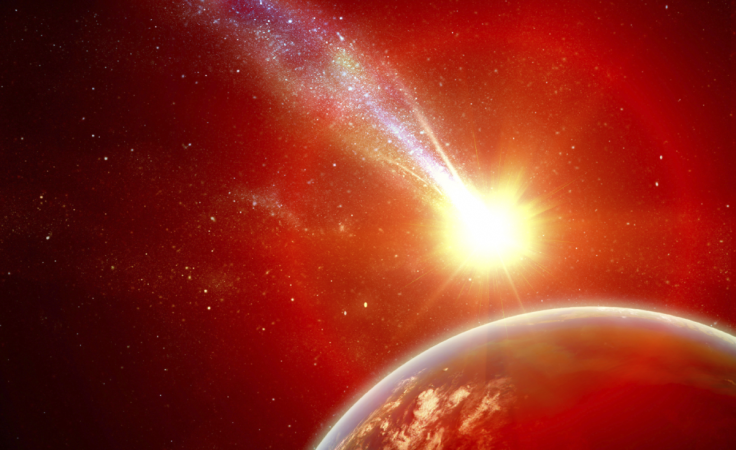
A massive asteroid described as roughly a '4 Empire State Buildings wide' object will make its closest approach to Earth this weekend, passing safely by on Saturday morning at a distance of about 1.6 million miles, according to the European Space Agency. The object, known as 1997 NC1, has drawn attention online as it moves past Earth, but space agencies say there is no threat to the planet.
The asteroid was first detected nearly three decades ago by a tracking system in Hawaii, and its orbit has been closely monitored ever since. Its path is well understood, and scientists have long known about this weekend's approach.
Asteroid Closest Approach to Earth This Weekend
At its nearest point, the asteroid will still be about 2.6 million kilometres away. That may sound close in cosmic terms, and yes, it is, but it remains a comfortable distance by planetary defence standards.
The object's size is what has captured public imagination. Estimates place it between 0.75 kilometres and 1.65 kilometres wide, roughly equivalent to two to four Empire State Buildings laid side by side. That scale tends to trigger alarmist headlines, but size alone does not determine risk. Trajectory is everything, and in this case, the trajectory simply does not intersect with Earth.

Astronomers say skywatchers with binoculars or small telescopes may catch a glimpse of the asteroid as a faint point of light moving across the sky. It will not be visible to the naked eye, and there will be no dramatic celestial display, just a quiet, technical flyby.
NASA and the European Space Agency routinely track objects like 1997 NC1 as part of ongoing planetary defence efforts. Their systems calculate orbits years, even decades, in advance, reducing the likelihood of surprises. One official line repeated by agencies is straightforward, there is no chance of impact during this pass.
Why This 4 Empire State Building Size Asteroid Is Alarming
The surge in attention is not coming from scientists so much as social media. Posts on X and short-form video platforms have amplified the asteroid's size, often without the accompanying context about distance or risk. Some users have questioned whether information is being downplayed, while others have treated the flyby as a casual stargazing event.
Large near-Earth objects tend to trigger a cycle of fascination and anxiety, particularly when scale is framed in recognisable terms like skyscrapers. It is easier to picture four Empire State Buildings than 1.65 kilometres of rock moving through space.
Agencies tracking near-Earth objects rely on continuous observation and updated modelling. If there were any measurable risk, it would not be buried. Programmes designed to detect and assess asteroid threats are built specifically to flag danger early.
The last comparable event came in 2022, when an asteroid named 1994 PC1 passed even closer to Earth without incident. That flyby was also widely discussed, briefly, before fading from public attention once it became clear nothing would happen.
According to NASA, 1997 NC1 will not pass this close to Earth again until 2133. That makes this weekend's event relatively rare on a human timescale, even if it is routine in astronomical terms. And yet, the question lingers every time something like this comes up. How close is too close?
Asteroid (152637) 1997 NC1 flies past Earth on Saturday – great advertising for this weekend’s Asteroid Day festival! After a Friday evening astronomy session, Saturday's event includes astronauts, asteroid experts and engineers. Watch it live here:https://t.co/tdEXL02iso
— ESA Operations (@esaoperations) June 25, 2026
Scientists tend to answer that with numbers, margins, and probabilities. The public, understandably, answers it with instinct. A rock the size of multiple skyscrapers passing 'near' Earth sounds like serious stuff. It is serious in one sense, it is precisely why tracking systems exist, but in this case, it is not dangerous.
What remains is a moment of observation rather than alarm. A large object, carefully watched, passing exactly where it was predicted to pass. For those looking up this weekend, the experience may feel underwhelming. A faint dot, barely visible, crossing a vast sky. No roar, no spectacle, just motion.
© Copyright IBTimes 2026. All rights reserved.
- Recommended For You