Alien Probes Could Be Hiding In Solar System Beyond Our Sight, NASA Study Suggests
We keep asking whether anyone is out there, while barely checking whether they might already be here.

Alien probes could already be hiding somewhere in our Solar System – and our current surveys are nowhere near good enough to rule them out, according to a NASA‑linked study presented this month by astronomer T. Joseph W. Lazio.
The work, outlined at the Proceedings of the IAU Centenary Symposium in the United States, argues that even if an advanced civilisation had sent robotic scouts into our cosmic backyard, today's instruments would almost certainly miss them. Lazio, a senior scientist at NASA's Jet Propulsion Laboratory, sets out where such probes might lurk and why they would be so hard to spot.
The idea that an advanced civilisation might send robotic scouts between the stars is no longer confined to science fiction. Humanity has already done a crude version of it. Five human‑made probes – Pioneer 10 and 11, Voyager 1 and 2 and New Horizons – are on escape trajectories that will eventually carry them out of the Solar System. They will be long dead by then, but they prove a basic point: once a species can build rockets, it can end up seeding the galaxy with hardware more or less by accident.
Lazio pushes the logic one step further. If we can do this, why could another civilisation not have done it earlier, and targeted our system on purpose?
How A NASA Framework Reimagines Alien Probes
To move beyond hand‑waving, Lazio borrows a framework first set out in a W. M. Keck Institute for Space Studies report. It sorts potential extraterrestrial artefacts into four types, based on where they are and whether they are still working.
In space, there are 'passive probes' – dead or inert objects drifting through the Solar System on hyperbolic paths – and 'active probes', still powered, able to manoeuvre, measure and transmit data.

On planetary surfaces, the same split holds. 'Passive surface artefacts' are impact debris or abandoned hardware sitting quietly on the Moon, Mars or some distant moon. 'Active surface artefacts' are the heavy‑duty kit: operating machines on a planet or asteroid, from a mining rig to an automated monitoring station ticking away for aeons.
Within that grid, Lazio poses a simple question: are 'one or more physical extraterrestrial technosignatures present in the Solar System today', and can our current technology disprove that?
His conclusion is blunt. Not even close.
Why We Would Struggle To Spot An Alien Visitor
The irony is that the 'easiest' alien probes to find might be the ones drifting in deep space, and even there we are fumbling.
Astronomers have already tracked a few interstellar interlopers, including the object labelled 3I/ATLAS. Each time an odd trajectory or strange light curve crops up, the script is familiar. Social media lights up, and a few serious scientists entertain the idea that we might be looking at an alien craft.
The hard bit is not seeing the object, but proving it is anything more than another lump of rock or ice.
Lazio highlights a very human case study. In 2020, astronomers spotted an object on a bizarre orbit, tagged 2020 SO and initially logged as an asteroid. Its path was so strange that researchers dug deeper. Near‑infrared data showed a spectrum matching stainless steel and polyvinyl fluoride. It was not a rock at all, but a Centaur rocket booster from NASA's 1966 Surveyor 2 mission.
If our own space junk can convincingly impersonate a natural object for half a century, unpicking a genuinely alien probe from the background clutter would be at least as tricky. That is with hardware built from materials we already know.
On planetary surfaces, things look worse. We have managed to spot parachutes, crashed landers and even rover tracks on Mars and the Moon, but those are carefully targeted shots over tiny patches of ground.
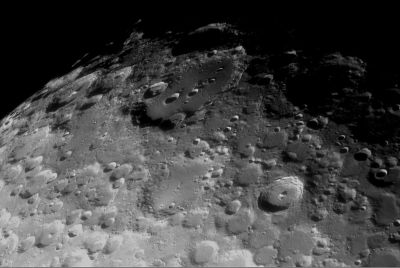
Across most of the Solar System, our imaging is far cruder. Lazio notes that typical views of Saturn's moons have a resolution of roughly one kilometre per pixel, which means anything smaller simply vanishes into the blur. Even the Moon, where orbiters can achieve about 0.5 metres per pixel, has only had a small slice of its surface mapped at that level.
The upshot is clear. An alien lander the size of NASA's Perseverance rover could be parked on the far side of a small moon and, in our best pictures, it would be one bright pixel – or nothing at all.
Time, Weather And The Slow Erasure Of Evidence
Then there is the problem of time. Even if an alien artefact did touch down in our cosmic backyard, it would have to survive the elements.
Jupiter's atmosphere would shred almost anything. But even the supposedly benign surface of Mars does not play nice over geological stretches. Micrometeorite strikes, solar radiation and relentless dust storms can abrade, bury and chemically weather exposed hardware in a few million years.
A few million years, in Solar System terms, is effectively yesterday. For a civilisation capable of interstellar travel, it might be a single experiment run and forgotten. If they were here in the deep past, much of what they left could already be sand.
The Heat‑Signature Hunt For Active Alien Probes
If passive probes are hard to distinguish from rocks, active alien probes at least have to obey one rule we are pretty sure is universal: thermodynamics. Any working machine has to dump waste heat.
In principle, that should make active probes stand out in infrared surveys as objects running hotter than their surroundings allow.
NASA's WISE telescope has already swept the sky for such oddities and found small bodies whose thermal properties do not quite match expectations for a simple rock or comet. The problem is that predicting how much heat a space object should emit, given its spin, shape and composition, is messy. There is still no clean way to say: this one is so strange it must be artificial. And there are far too many borderline cases to chase each with painstaking follow‑up observations.
Lazio argues that the next generation of all‑sky surveys could shift the balance. The Vera C. Rubin Observatory's Legacy Survey of Space and Time, NASA's SPHEREx mission and the planned Near‑Earth Object Surveyor will together generate millions of high‑precision profiles of small bodies.
Buried in those catalogues could be objects whose heat signatures or trajectories are so far off the norm that they demand a closer look. That is where the long‑sidelined Search for Extraterrestrial Artefacts, SETA, the hardware‑focused cousin of SETI, might finally have something to chew on.
Whether anyone will fund a dedicated mission to go and check is another matter. If Lazio is right, though, the real scandal is not that alien probes are missing from our Solar System, but that we have barely started to look.
© Copyright IBTimes 2026. All rights reserved.
- Recommended For You