

Airport Radar Leakage Could Reveal Humanity to Aliens Detecting Earth From Up to 200 Lightyears Away
New research suggests airport radar systems could be detectable by extraterrestrial observers up to 200 lightyears away.

Airport radar systems used daily at major hubs including London Heathrow and New York's JFK could be unintentionally broadcasting humanity's presence to aliens up to 200 lightyears away, according to new research that models how these signals leak into space and remain detectable across interstellar distances.
Scientists have long searched for life beyond Earth by scanning exoplanet atmospheres for chemical biosignatures or by listening for 'technosignatures,' signals produced by advanced civilisations. The same logic, the new study suggests, applies in reverse. Earth is not a silent observer. It is, in its own way, transmitting.
Radar Signals and Humanity's Interstellar Footprint
The research focuses on what scientists describe as 'hidden electromagnetic leakage,' the faint but persistent radio signals produced by systems we rely on every day. Civilian and military airport radars are a key culprit. They sweep the skies constantly, tracking aircraft, managing traffic, keeping everything moving.
By simulating how these signals propagate over time, researchers found that major aviation hubs effectively act as beacons. Heathrow, Gatwick and JFK were among those modelled, their combined emissions spreading outward in expanding shells.
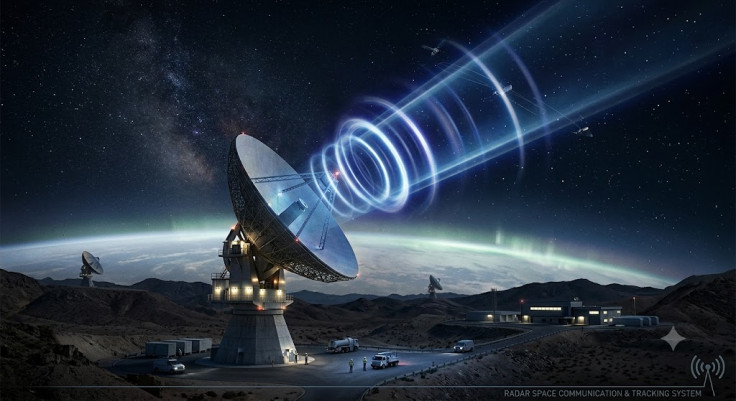
Airport radar systems collectively emit radio signals estimated at 2 x10¹⁵ watts. According to the study, that is strong enough to be detected from as far as 200 lightyears away, provided an observing civilisation has radio telescopes comparable to the Green Bank Telescope in West Virginia.
Barnard's Star, one of the nearest stars to Earth at roughly six lightyears away, hosts a known rocky exoplanet, Barnard b. AU Microscopii, another nearby system examined in the study, also sits well within that detection range. From those vantage points, Earth would not appear quiet. It would flicker with structured, repeating signals.
How Airport Radar Could Appear to Aliens
Unlike natural radio emissions, radar transmissions are highly directional and patterned. To an external observer, they would not blend into cosmic background noise. Lead researcher Ramiro Caisse Saide of the University of Manchester said the emissions would stand out. 'This would look clearly artificial to anyone watching from interstellar distances with powerful radio telescopes,' he explained.
Military radar systems, though less discussed publicly, add another layer. Their peak emissions reach around 1×10¹⁴ watts. While lower in total output than civilian systems, their focused beams can appear significantly brighter depending on where an observer is positioned in space. In some scenarios, they could seem up to 100 times stronger from certain angles.
It raises an uncomfortable, if slightly sci-fi, question. If we are actively searching for extraterrestrial intelligence by looking for these kinds of signals, what happens if someone else is doing the same and spots us first?
Detection does not equal visitation. The distances remain vast, and any response would take decades or centuries to arrive, assuming it comes at all. Still, the idea that our everyday infrastructure is effectively announcing our presence is, at the very least, a little wild.
What the Findings Mean Beyond Alien Contact
The researchers are careful not to frame this as a warning about imminent discovery, but rather as a tool for understanding both astronomy and our own technological footprint.
Professor Michael Garrett, a co-author also at the University of Manchester, said the modelling has practical applications closer to home. 'By learning how our signals travel through space, we gain valuable insights into how to protect the radio spectrum for communications and design future radar systems,' he said.
There are also implications for planetary defence and space monitoring. The same techniques used to trace faint radar leakage could help astronomers detect weak signals from distant objects or assess how human-made emissions interfere with observations.
Caisse Saide framed it more broadly. 'Our findings suggest that radar signals, produced unintentionally by any planet with advanced technology and complex aviation system, could act as a universal sign of intelligent life.'
If radar leakage is a marker of civilisation, then scanning for similar patterns elsewhere becomes a more concrete strategy in the search for life. At the same time, it sharpens the picture of how visible we already are.
The nearest potentially habitable exoplanet, Proxima Centauri b, sits just four lightyears away. On a cosmic scale, that is next door. If there is anyone there with the right instruments, Earth's signal has already arrived, or will soon. Whether it registers as background noise or something more deliberate is another matter entirely.
IBTimes UK could not independently verify how detectable these signals would be to hypothetical extraterrestrial observers, so the findings should be taken cautiously, grounded in current human technology assumptions.
© Copyright IBTimes 2026. All rights reserved.