The Alien Signals We're Missing: Why Stellar Plasma Is 'Smearing' Extraterrestrial Broadside Transmissions
New research suggests violent space weather around distant stars may be scrambling alien radio signals beyond recognition, forcing SETI scientists to rethink how they search for technosignatures.
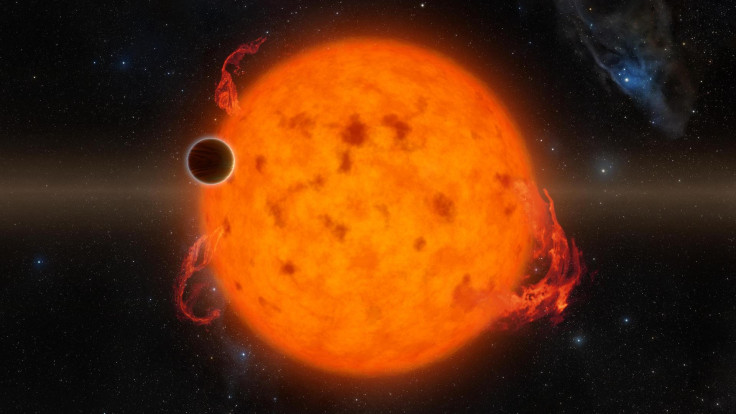
Astronomers hunting alien signals say turbulent stellar plasma around distant worlds may be scrambling extraterrestrial transmissions before they ever reach Earth, according to a new study published on 5 March in The Astrophysical Journal.
For context, scientists involved in the search for extraterrestrial intelligence, or SETI, have spent decades scanning the skies for so‑called technosignatures, especially ultra‑narrow radio spikes that do not occur naturally. The absence of any confirmed non‑human signal has long fed the Fermi paradox, the nagging question posed in 1950 by physicist Enrico Fermi: if the universe is so vast and full of potentizzally habitable planets, where is everybody?
The new work, led by Vishal Gajjar of the SETI Institute in California, argues we may have been looking for the wrong thing in the wrong way. The team suggests that 'space weather' around alien planets, driven by their parent stars, could be widening and weakening any artificial radio signals, pushing them below the sensitivity limits of even our best radio telescopes.
How Stellar Plasma Warps Alien Signals
In case you missed it, most SETI programmes prioritise very narrowband radio signals, essentially razor‑thin spikes just a few hertz wide. As astronomer Evan Keane of Trinity College Dublin, who was not part of the research, told Live Science, such signals do not arise from known natural processes, so if you see one, you pay attention.
The catch is that these clean, narrow spikes assume a relatively calm journey through space. Gajjar and his SETI colleague Grayce Brown decided to test how realistic that assumption really is. They turned to a surprisingly down‑to‑Earth source of data: historic radio links between Earth and old spacecraft.
Drawing on decades of tracking records from missions like Mariner IV, which flew past Mars in the 1960s, and the Viking probes launched in 1977, they built what they describe as one of the largest collections yet of real‑world examples of 'signal broadening'. In simple terms, they looked at how human‑made radio transmissions were distorted as they passed through the Sun's own plasma‑filled environment.
Space weather refers to changes in the near‑space environment caused by charged particles, radiation and eruptions of hot plasma known as coronal mass ejections. Our Sun does all this routinely. Other stars do too, sometimes much more violently. As radio waves move through this roiling material, their sharp frequency profile can spread out, diluting the signal's strength across a wider band.
Using the spacecraft data as a benchmark, Gajjar and Brown modelled how similar processes would play out around stars like our Sun that host exoplanets. They then asked a simple but unsettling question: what would happen to a hypothetical alien narrowband transmission trying to punch its way out of that kind of stellar weather?
M Dwarf Stars and the 'Smearing' of Technosignatures
The alien signals question gets more interesting, and more awkward, when you look at M dwarf stars. These small, cool red stars make up roughly three‑quarters of the Milky Way's stellar population, and some have been shining since the early universe. On paper, that gives any life on their planets an absurd amount of time to become technologically advanced.
The problem is that M dwarfs are also notorious for intense, frequent flaring. We do not yet have direct measurements of the space weather conditions around individual M dwarf systems, so Gajjar and Brown turned to simulations. They modelled how a narrowband technosignature, emerging from a planet orbiting such a star, would fare as it travelled through the local interplanetary plasma.

Their conclusion, laid out in the paper, is that these signals are especially likely to be 'smeared' by the surrounding environment. The narrow spike we expect to see on our radio telescopes could be stretched and blurred until it looks like nothing more than low‑level background fuzz.
To move this beyond hand‑waving, the authors propose a framework that lets researchers estimate how much broadening a signal might suffer, based on its frequency and the type of star it originates from. In other words, a tool to predict just how much the cosmos might be messing with our potential alien post.
'If a signal gets broadened by its own star's environment, it can slip below our detection thresholds, even if it's there, potentially helping explain some of the radio silence we've seen in technosignature searches,' Gajjar said in a statement.
The paper is careful not to overclaim. It does not solve the Fermi paradox, and it does not assert that aliens are out there chatting away on scrambled channels. Instead, the authors argue that Fermi's question is not simply evidence that transmitters do not exist, but also a mirror of our own technological and methodological limits, including a 'mismatch between the assumed signal morphology' and what might actually survive the journey to Earth.
What This Means for the Next Phase of SETI
The study has drawn interest from other leading figures in the field. Michael Garrett, an astrophysicist at the University of Manchester who was not involved, told Live Science he sees it as 'a solid contribution that SETI researchers and signal‑processing teams should pay attention to.' He noted that one of its strengths is being firmly rooted in real spacecraft measurements rather than purely theoretical speculation.
Garrett also pointed out a limitation. The work focuses on the classic SETI target, narrowband radio transmissions. His own research looks at broader 'radio leakage' from a technological civilisation, spread across a wide frequency range, like the unintentional radio clutter Earth has been throwing into space for decades. If aliens are doing the same, signal broadening may play out differently in that context.
Another outside expert, Andrew Siemion, director of the Breakthrough Listen Oxford Hub, said this is the first paper to explicitly explore the impact of the environment around exoplanets on the detectability of technosignatures.
He suggested the framework could even help validate future candidate signals as likely coming from a distant planetary system rather than some mundane interference closer to home.
Looking ahead, Gajjar and Brown urge that upcoming, ultra‑sensitive facilities such as the SKA‑Low telescope in Australia factor in signal broadening when designing search strategies. That may mean scanning a wider range of signal shapes, or re‑analysing existing data with different assumptions about what an alien broadcast would actually look like after battling through a star's plasma.
None of this guarantees we will suddenly tune in to a galactic chatroom. It does, however, raise an uncomfortable possibility for anyone who likes tidy answers: the universe might be noisy with technology, and our current search methods could still be missing most of it.
© Copyright IBTimes 2026. All rights reserved.
- Recommended For You