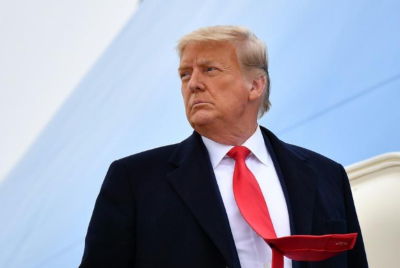
Donald Trump Lambasted: 'Anti-Christ' Row Erupts as POTUS Likens Himself to Jesus at Easter Lunch
Donald Trump's Easter comments comparing himself to Jesus have sharpened the clash between his Christian supporters and critics who call the rhetoric blasphemous.

Donald Trump likened himself to a 'king' and invoked the suffering of Jesus during an Easter lunch speech in Washington on Wednesday, 1 April, prompting accusations on social media that the US president had crossed a line and engaged in 'anti-Christ' rhetoric.
The news came after months of tension between Donald Trump and critics who accuse him of courting Christian voters with ever more extravagant religious language. The Wednesday event, held in the run-up to Easter and framed around Palm Sunday, offered the latest glimpse of how explicitly he now weaves theology and political grievance together in public.
It also laid bare the split between supporters who see him as a persecuted leader and detractors who regard the comparisons to Jesus as blasphemous.
During prepared remarks at the lunch, Trump, 79, opened by recalling the biblical account of Palm Sunday, when Jesus entered Jerusalem to crowds hailing him as king. 'On Palm Sunday, Jesus entered Jerusalem as crowds welcomed him with praise, honouring him as a king,' he said, before pivoting abruptly to himself. 'They call me king now. Do you believe it?'
He went on to riff on the idea with a characteristic mix of complaint and bravado. 'No kings. I'm such a king, I can't get a ballroom approved. It's pretty amazing, right? I'm a king,' Trump said, apparently alluding to nationwide 'No Kings' protests against him. 'If I was a king, we'd be doing a lot more.'
“On Palm Sunday, Jesus entered Jerusalem as crowds welcomed him with praise honoring him as king. They call me king now. Can you believe it?”
— The Intellectualist (@highbrow_nobrow) April 1, 2026
- President Trump compares himself to Jesus Christ, the Christian Messiah, days before the Easter holiday. (2026) pic.twitter.com/3wke4sXlov
Those 'No Kings' demonstrations have become a shorthand among opponents who worry that another Trump term would test the limits of US democratic norms. Trump's insistence that he is powerless, even as he toys with monarchical language, is the kind of contradiction his critics seize on and his base tends to enjoy.
From there, the speech returned briefly to the Gospel narrative. Trump spoke of Jesus not coming 'to take a throne, but to carry a cross, not only to reign but to save,' and referenced Judas' betrayal and the crucifixion. Then he folded that story back into his own. 'We know the feeling,' he told the room. 'Many of the people in this room know the feeling. Many of the people went through h---.'
The remark underlined a familiar Trump theme, that he and his allies are victims of historic injustice. To some Christian listeners, that kind of parallel between a criminally tried politician and the central figure of their faith is at best clumsy, at worst offensive.
Pastor's Donald Trump Comparison Deepens Easter Backlash
If Trump's own wording blurred the line between reverence and self-pity, his spiritual adviser Paula White-Cain erased it almost entirely.
White-Cain, a televangelist who has long been part of Donald Trump's inner religious circle, delivered an emotionally charged tribute tying the Easter story directly to his political fortunes. 'Jesus taught so many lessons through his death, burial and resurrection. He showed us great leadership, great transformation, requires great sacrifice,' she said.
'And Mr. President, no one has paid the price like you have paid the price,' she continued. 'It almost cost you your life.'
She went further still, casting Trump's legal and political woes as a re-enactment of the Passion. 'You were betrayed and arrested and falsely accused. It's a familiar pattern that our Lord and Saviour showed us. But it didn't end there for him, and it didn't end there for you.'
Paula White compares Trump to Jesus during event with faith leaders: "You were betrayed and arrested and falsely accused. It's a familiar pattern that our Lord and Savior showed us. Because of His resurrection, you rose up." pic.twitter.com/Ddc8hflU34
— Aaron Rupar (@atrupar) April 1, 2026
According to White-Cain, God had a plan for both. 'On the third day, he rose, he defeated evil, he conquered death, h--- and the grave. And because he rose, we all know that we can rise. And sir, because of his resurrection, you rose up.'
'Because he was victorious, you are victorious,' she added. 'And I believe that the Lord said to tell you this, because of his victory, you will be victorious in all you put your hands to.'
Online Critics Call Donald Trump Remarks 'Blasphemy'
Clips and quotes from the Easter lunch quickly spread across X, where users lined up to denounce both Donald Trump and the pastor's framing.
'What a disgrace to the human race,' one person wrote, responding directly to the 'They call me king now' line.
Disrespectful, blasphemous moron! No wonder your so certain you're going to hell!
— Dana Duggins (@danaduggins60) April 2, 2026
Another user rejected the whole premise that anyone was crowning him. 'Idiot doesn't even know that we are trying to PREVENT him from BECOMING a king, he isn't one, and we're not calling him one, other than maybe the king of liars and ignoramuses,' they said.
A third branded the comments spiritually offensive. 'This is the most anti-christ thing anyone could say. It's blasphemy. how are Christians even supporting him?' they wrote, reflecting a deep frustration among believers who see the language of martyrdom being attached to a partisan figure.
Comparing Trump to our Lord is a blasphemy and disrespectful to our Lord Jesus and our faith
— CELEBRITI HOME (@UbahNdife) April 2, 2026
Others turned their fire on those around him. 'Trump has gone insane and his cabinet is evil. Nothing good can come of this,' another critic insisted.
There was no immediate official response from Trump's team addressing the charge that his remarks were sacrilegious, nor any clarification from White-Cain about her repeated suggestion that his experiences mirror those of Jesus.
Supporters would likely argue that both were speaking metaphorically about hardship and redemption. Opponents, reading the same words, see a deliberate sacralising of political power.
© Copyright IBTimes 2026. All rights reserved.
- Recommended For You