Nancy Guthrie DNA Deficit Exposed: FBI Analyses Mystery Hair as Experts Warn Forensics 'May Take a Year'
In the search for Nancy Guthrie, science is moving at its own unforgiving pace while a family waits for a single piece of evidence to speak clearly.

The FBI is analysing a single unidentified strand of hair recovered from the bedroom of missing Arizona mum Nancy Guthrie, as experts warn that the digital and DNA work now at the heart of the 84‑year‑old's case in Pima County could take months, and potentially up to a year, to complete.
For context, Nancy Guthrie, mother of Today show co-host Savannah Guthrie, vanished from her Tucson-area home on 1 February. Blood later confirmed as Nancy's was found on the front porch, and investigators have treated the disappearance as a suspected abduction. More than 100 days on, there is still no confirmed sighting of the matriarch, no named suspect and, crucially, no clear forensic breakthrough that ties the scene to an offender.
DNA Bottlenecks Deepen the Nancy Guthrie Mystery
The latest focus in the Nancy Guthrie inquiry is a rootless hair, discovered in her bedroom and now at the FBI Laboratory in Quantico for advanced testing. Rootless hair is notoriously difficult to work with, and investigators are hoping newer, highly sensitive techniques can extract a usable genetic profile.
Nothing about that analysis is confirmed yet, so any expectations around rapid answers should be treated with a grain of salt.
Forensic expert Robert Fried told NewsNation that the science behind the Nancy Guthrie case is likely to move more slowly than the public appetite for answers.
'It is a very time‑intensive, resource‑intensive type of process,' Fried said, describing both the DNA and digital work underway. In mixed samples, where more than one person's DNA is present, he said lab teams can be tied up for 'anywhere from a few weeks to a full year.' Those are not comforting numbers for a family already three months into an ordeal with no closure in sight.
Alongside the hair, investigators are trying to unravel other 'mixed' DNA profiles collected from inside the house. These samples may hold the key to whether a stranger entered the home or whether the genetic traces belong only to Nancy and people known to her.
Officials have been careful to stress that DNA and digital traces are context tools, not instant verdicts. A sample can place someone in a location, but it does not automatically explain why they were there or what they did.
Digital Evidence Pile-Up Slows Nancy Guthrie's Search
If the DNA work is slow, the digital forensics facing detectives in the Nancy Guthrie case is scarcely any faster. The Pima County Sheriff's Department has been combing through thousands of neighbourhood security clips, dashcam recordings, and traffic camera feeds, looking for any frame that might show Nancy, a vehicle of interest, or an unknown figure near the home around the time she disappeared.
Fried described that digital trawl as every bit as painstaking as the lab work. Analysts, he explained, must hunt for 'unique identifiers' in often poor-quality imagery, anything from a particular gait to a distinctive facial feature that can reliably link a fuzzy silhouette to a known person of interest.
'You have to have unique identifiers within those videos, those facial expressions, those unique characteristics that can help you positively or without a doubt say that that is that person,' he said. That search for certainty, he added, is why image analysis tends to be 'very time‑intensive.'
There is an additional problem baked into the geography. Tucson's dark-sky ordinances, designed to curb light pollution, combine with rural-style residential layouts to leave large pockets of darkness at night and streets with limited CCTV coverage. Detectives are, in effect, sifting for a needle in a haystack where much of the haystack is unlit.
Sheriff, FBI, and Family Drift Apart Over Communication
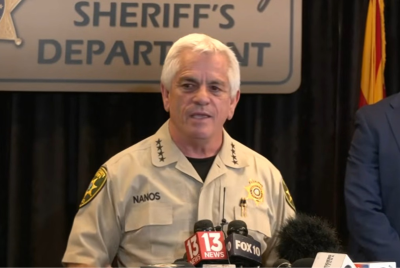
As the technical work grinds on, the human relationships around the Nancy Guthrie investigation appear to have grown more strained. Recent reporting from NewsNation suggests that Pima County Sheriff Chris Nanos and the Guthrie family are no longer in direct contact, with observers noting that relatives seem to be engaging more closely with the FBI than with the local sheriff's office.
Sheriff Nanos has pushed back at public criticism and speculation that the case is at risk of going cold. He has insisted that investigators are sitting on certain 'breakthrough' details deliberately, in order to 'protect the integrity of the case.' According to Nanos, the investigation remains active, and he maintains 'absolute confidence' that there will eventually be an arrest.
That insistence is echoed, in different language, by high-profile true crime commentator Nancy Grace. Speaking about the Nancy Guthrie disappearance, she argued there is already 'so much evidence' in play and singled out the FBI's DNA and digital forensics as the route to answers.
'I have great confidence we will get an answer in the Nancy Guthrie case,' Grace said, suggesting the abduction was highly targeted and not random. Her assessment is still just that, an analysis from outside the official investigation rather than a statement of fact, and should be read accordingly.
What can be said with certainty is that experts are now central to whatever happens next. Somewhere in a Quantico lab, that single rootless hair and a series of mixed DNA samples are being pushed to the limits of current technology, while thousands of video frames are scrutinised for a telling face, a car, a shadow in the wrong place at the wrong time.
Whether those fragments will finally explain what happened to Nancy Guthrie is, for now, one more question the evidence has yet to answer.
© Copyright IBTimes 2026. All rights reserved.
- Recommended For You