Ford Patent Details System That Could Scan Faces and Compare Them to Law Enforcement Databases
Ford's patent for a biometric system in vehicles raises privacy alarms despite its intended use for security personnel.

A post is causing a stir on X, claiming that automobile manufacturer Ford has patented a technology that will allow its cars to scan the faces of their passengers, and send personal information to police databases.
Posted 25 June 2026 by @Traceix, an account owned by the non-profit Perkins Fund, the user posted a diagram from a Ford patent application, with the caption:
'Patent number US20250104469A1.
'This is a biometric system that scans people, compares against law enforcement/security databases, and alerts authorized personnel when a match is found.'
Patent number US20250104469A1.
— Traceix (@usetraceix) June 24, 2026
This is a biometric system that scans people, compares against law enforcement/security databases, and alerts authorized personnel when a match is found.
Patent: https://t.co/HxokSZcSrx
By @Ford pic.twitter.com/rXt2ctJSYD
The attached image is a flowchart from the said patent application, detailing the proposed process of collecting and processing biometric information. The post garnered a host of comments expressing disapproval of newer car models and what has come to be understood as car manufacturers' collection of personal data.

One user who re-shared the tweet compared it with the alarm over Chinese espionage, posting the caption: 'Chinese cars are filled with spyware and will drive American car companies bankrupt! Meanwhile at Ford:
"Chinese cars are filled with spyware and will drive American car companies bankrupt!"
— Joshua Bailey (@JoshuaBailey184) June 25, 2026
Meanwhile at Ford: https://t.co/FV0ka12t2S
What The Patent Meant for Ford Cars
Patent number US20250104469A1 is for an advanced biometric identification system that, as the original post claimed, scans personal identifiers and compares them to an external database. Some of the details that the patent proposes to scan are fingerprints, iris patterns, and facial geometry, through technology such as internal and external cameras, and cabin sensors.
Besides the biometric scanner, the patent also includes a database to store relevant biometric data, as well as the necessary circuitry to compare new data with what has already been stored.
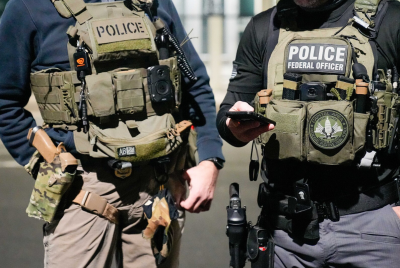
Contrary to claims on social media, however, the technology is not meant for civilian vehicles, but for those used by security personnel. In fact, the patent also states the possibility of including a body-mounted camera to augment the devices already on the vehicle.
Some of the monitoring devices, such as a fingerprint scanner on the door handle, are meant to make it easier for security personnel to use the vehicle during high-stress situations. Others are meant to scan passengers or detainees, and match them with entries in the database. These will include individuals with active warrants, individuals on parole or on probation, missing persons, etc.
Distrust Remains
The above-mentioned scanning technology likely does not yet exist. Furthermore, Ford has repeatedly stated that 'submitting patent applications is a normal part of any strong business as the process protects new ideas and helps us build a robust portfolio of intellectual property.' Despite that, many are still distrustful of the automobile giant.
Some have pointed out that, although meant for security personnel, the technology can be easily used on the general public, while others maintain that all cars will have similar scanning devices by 2027.
Earlier this year, similar alarms were sounded over another Ford 'surveillance truck' patent for sensors that would 'read' the driver's lips. Some have claimed that this would allow the company to eavesdrop on its customers. Tech experts, however, explained that numerous cars already use mics for voice commands, and the 'lip-reading' sensors were only meant to supplement microphones in convertibles, where environmental noise drowns out the driver's voice.
The application for Patent number US20250104469A1 was submitted in September 2023 and is still in the process of approval.
© Copyright IBTimes 2026. All rights reserved.
- Recommended For You