

LOOK: This Giant Shark 'Rolled Its Eyes' in Bizarre Deep-Sea Video
A 2019 OceanX video of a giant sixgill shark approaching a research submersible has gone viral, captivating viewers with a rare close-up
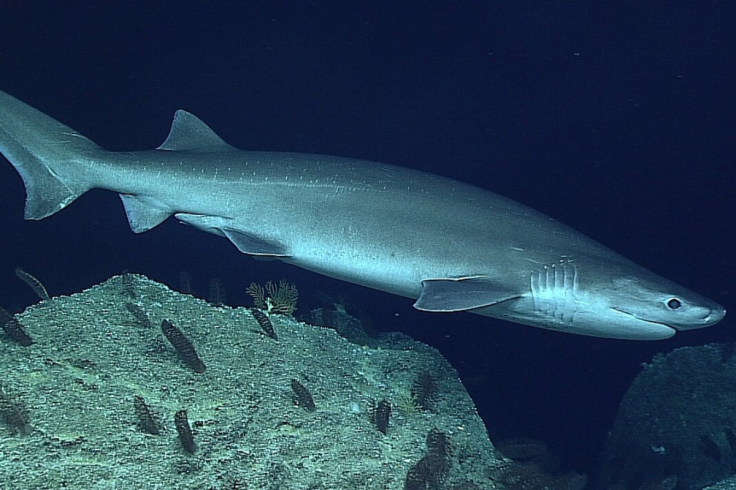
A giant deep-sea shark has caught the internet's attention after footage showed the enormous animal approaching a research submersible and seemingly rolling its eyes at the people inside. The unusual encounter has prompted amused reactions online, with viewers joking about the shark's apparent response to the humans observing it.
The footage shows a bluntnose sixgill shark approaching the submersible's viewing window, offering researchers an unusually close look at its face and distinctive eyes.
Giant Shark Approaches Submarine in Extraordinary Deep-Sea Footage
The video shows the enormous shark swimming towards OceanX's Nadir submersible before moving close to its viewing window. Its large eye is clearly visible as it appears to look towards the vessel, providing a rare close-up view of the deep-sea predator.
A massive deep-sea shark was filmed approaching a submarine during an expedition deep beneath the ocean's surface pic.twitter.com/UrZbUAIp3L
— Nature Unedited (@NatureUnedited) November 21, 2026
The footage attracted millions of views after it was shared on X on 22 November. Other users joined the conversation, with one writing, 'When nature looks back at you' while another marvelled at the close-up of the shark's eye.
When nature looks back at you… pic.twitter.com/v7G2P5CsKf
— Slim Pickens (@EODstu) November 22, 2026
However, this was not a recent sighting. The encounter dates back to June 2019, when researchers aboard the Nadir submersible encountered the female shark during an expedition near the Bahamas. OceanX originally published footage of the encounter in July 2019.
He just rolled his eyes 👀 HUMANS 🙄 pic.twitter.com/rmmxH1GQQP
— Zeen (@nimisha91526512) November 23, 2026
Why Scientists Risked a Deep-Sea Dive to Study the Giant Shark
The encounter was part of a research mission involving OceanX, Florida State University, the Florida Museum of Natural History and the Cape Eleuthera Institute. The researchers aimed to develop a method for attaching satellite tracking devices to bluntnose sixgill sharks without having to bring them to the ocean surface.
Previously, researchers had to capture the sharks and bring them into shallower waters to attach tracking equipment. This could increase stress and recovery time, making it important to develop a method that allowed scientists to study them in their natural habitat.
The team used specially designed tagging equipment operated from the three-person Nadir submersible. After several unsuccessful attempts, marine biologist Gavin Naylor successfully attached a satellite tag to a male sixgill shark at more than 1,700 feet below the surface on 29 June 2019.
The tag was designed to record the shark's depth, ambient light levels and water temperature before detaching and transmitting its stored data. The female featured in the viral footage was a separate shark encountered during the expedition and was not the individual that received the satellite tag.
What Makes the Bluntnose Sixgill Shark So Unusual?
The bluntnose sixgill shark, scientifically known as Hexanchus griseus, is one of the largest sharks inhabiting deep ocean waters. It can grow up to 20 feet long and has a distinctive appearance that sets it apart from most other shark species.
Unlike most sharks, which have five pairs of gill slits, the bluntnose sixgill has six. It also has large green eyes and unusual teeth. Its lower jaw features broad, saw-like teeth, while its upper jaw has smaller, serrated teeth that help it feed on various marine animals.
The species belongs to an evolutionary lineage dating back more than 180 million years, predating many dinosaurs. It typically inhabits depths between 650 and 3,300 feet, although researchers have recorded individuals much deeper.
Despite its intimidating size, the Florida Museum of Natural History says the species is not considered a threat to humans unless provoked.
What Have Scientists Recently Learned About Sixgill Sharks?
Despite their ancient evolutionary lineage, bluntnose sixgill sharks remain poorly understood because of their deep-sea habitat and elusive behaviour. However, research published in 2026 has provided new insights into their reproduction and movements.
In September, NOAA Fisheries reported findings from genetic research involving 274 sixgill shark tissue samples collected over 16 years in the Salish Sea, which includes Puget Sound in the United States.
The researchers found genetic evidence that female sixgill sharks can mate with multiple males. Their findings also suggested that related sharks return to the region across successive years and decades, supporting its importance as a breeding and nursery habitat.
The research further suggested that young sharks may spend around four to six years growing in the Salish Sea before moving into deeper waters. This remains an estimate rather than an established age determination, as scientists have yet to develop a reliable way to determine the species' age.
The findings offer another glimpse into the lives of a species that continues to fascinate researchers.
© Copyright IBTimes 2026. All rights reserved.