Secret Service Fires Near White House: Man with Gun Shoots at Officers Near National Mall; 'We Will Find Out'
Incident near Washington Monument leaves teenage bystander injured, prompts lockdown.

Gunfire erupted just south of the White House on Monday afternoon after Secret Service agents confronted an armed man near the Washington Monument, an incident that left a teenage bystander injured and forced one of the capital's most heavily visited districts into lockdown. The exchange unfolded in seconds, but its shockwaves moved through a city already tense over recent security breaches.
The confrontation took place in an area usually defined by slow-moving tourists and open lawns. Instead, it became a scene of sirens, cordons and armed response teams converging around the National Mall while Vice President JD Vance's motorcade had passed through only moments earlier.
A Confrontation In The Shadow Of National Icons
According to news outlets, plainclothes Secret Service officers first approached a man they believed was carrying a firearm near the intersection of 15th Street Southwest and Independence Avenue at around 3.30 pm. What happened next was rapid and fragmented, the kind of incident that leaves investigators reconstructing intent long after the noise has faded.
The man fled, and shots were fired. Agents returned fire and moved to detain him.
U.S. Secret Service personnel are on the scene of an officer-involved shooting at 15th Street and Independence Avenue in Washington, D.C. One individual was shot by law enforcement; their condition is currently unknown. Please avoid the area as emergency crews are responding. pic.twitter.com/LNUTL2F3gM
— U.S. Secret Service Office of Communications (@SecretSvcSpox) May 4, 2026
A firearm was recovered at the scene, and both the suspect and a 15-year-old boy were taken to the hospital. The teenager's injuries were described as non-life-threatening. Deputy Director of the Secret Service Matt Quinn said investigators believe the child was hit by the gunman, though he later appeared less certain when pressed by reporters, saying doctors would determine the exact trajectory of the wound.
The Washington Monument sits at the centre of one of the most symbolically loaded spaces in the US, a place designed for civic gathering, not armed confrontation. Yet Monday's shooting unfolded in full view of pedestrians, tourists and uniformed personnel, turning a postcard scene into a security incident within moments.
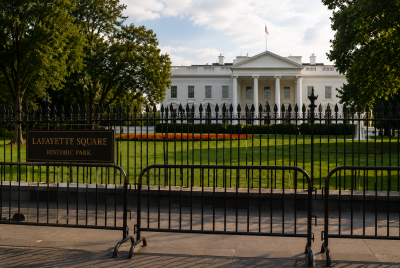
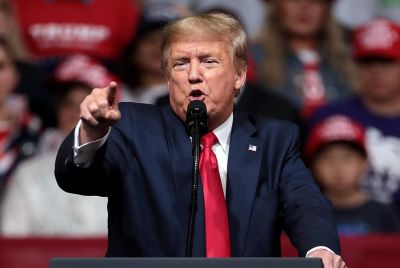
Officials were quick to say there was no indication the White House itself was targeted. A congressional briefing email from the Secret Service stressed that President Donald Trump was not in danger and that no link to the executive complex had been identified. Still, the proximity alone was enough to trigger an immediate security response across the area.
A City Already Bracing For Political Violence
Only days earlier, a separate gunman had attempted to breach security at a White House Correspondents' Association dinner, injuring a Secret Service agent in what authorities described as an apparent targeted attack on political figures.
Monday's incident, though different in scale, added another layer to a growing pattern of disruption around high-profile federal sites in Washington. The city has lived with heightened security for years, but the clustering of events has begun to test assumptions about what constitutes routine protection.
Vice President Vance's motorcade had travelled through the same corridor shortly before the shooting. That detail, confirmed by officials, underscored how quickly the calculus of risk can shift in a city where motorcades, protests and tourism intersect daily.
The White House itself briefly tightened operations during the response. Reporters on the North Lawn were moved indoors as law enforcement flooded the surrounding streets, a precaution that has become increasingly familiar during security alerts.
The National Mall And The Illusion Of Stability
The National Mall is often described as one of the safest stretches of urban space in Washington, a broad civic landscape framed by museums, monuments and federal buildings. Crime statistics generally reflect that reputation. Ward 2, which includes the Mall, records some of the lowest violent crime levels in the city.
Yet history complicates the picture. The Mall has witnessed political violence stretching back more than a century, from the assassination of President James A. Garfield in 1881 to more recent isolated shootings near museums and transit hubs. Monday's incident joins that uneasy chronology.
Within minutes of the gunfire, dozens of law enforcement officers and National Guard personnel were deployed across the area, blocking streets and directing confused tourists away from cordoned zones. The presence of uniformed troops around the Washington Monument has become increasingly common since their deployment following a federal takeover of city policing, a move that continues to shape the capital's public spaces in visible ways.
The Metropolitan Police Department is leading the investigation into the use of force, while the Secret Service continues to examine the sequence of events that led to the exchange of fire. Officials have not confirmed the identity of the armed man, nor have they outlined a possible motive.
That absence of detail is typical in the immediate aftermath of such incidents, but it leaves a gap that will eventually need to be filled if authorities are to explain how an armed confrontation unfolded so close to the centre of federal power.
© Copyright IBTimes 2026. All rights reserved.
- Recommended For You