

'Propaganda' Is Over: Hungary Takes Down Orbán's State Media Empire, Promising Independent News Instead
Prime Minister Péter Magyar initiates sweeping reforms to rebuild independent public broadcasting.
Hungary's new government has suspended broadcasts on key state media channels as Prime Minister Péter Magyar presses ahead with sweeping reforms aimed at dismantling what he describes as Viktor Orbán's long-standing propaganda machine.
Announced on Tuesday, Kossuth Radio and the M1 television news channel temporarily went off the air as the administration pledged to rebuild public broadcasting as an independent and trustworthy news service.
The move came after Magyar's Tisza party secured a landslide election victory in April, ending Orbán's 16-year rule with a two-thirds parliamentary majority built on promises of 'regime change' and institutional reform. During the campaign, Magyar repeatedly accused Hungary's public broadcasters of functioning as government propaganda outlets and vowed to overhaul the country's media landscape if elected.
Hungary's State Media Falls Silent After Orbán Era Ends
By Tuesday afternoon, viewers tuning into M1 no longer found rolling news coverage. Instead, the channel displayed a black screen carrying an apology that read, 'Public media should not lie. We are sorry for doing it for so long.'
Hungarian public media outlets Kossuth and M1 suspend their broadcasts; M1's message reads, "Public media should not lie. We are sorry for doing it for so long" (@doberah / The Guardian)
— Mediagazer (@mediagazer) July 7, 2026
(Visit Mediagazer dot com for the link and full context!)
The statement continued, 'Public media now will be reformed so it will be independent and trustworthy. Our news programme is currently suspended. Stay tuned!'
Kossuth Radio also suspended its usual programming, replacing news broadcasts with classical music by Hungarian composer Béla Bartók. At the same time, the websites for both M1 and Kossuth became unavailable.
According to Hungary's state media umbrella organisation, MTVA, M1 would resume broadcasting later in the day without its news programmes, while other public service content would continue as scheduled.
Magyar welcomed the disruption as a symbolic break from the previous administration.
'A historic day. Today marks the end of propaganda broadcasts on public media platforms,' he wrote on Facebook.
'They lied at night, they lied during the day, they lied on every wavelength. That is now over.'
His government had already ordered a comprehensive review of Hungary's public service media and its financing shortly after taking office. The temporary suspension followed the replacement of senior management at the country's state television and radio networks.
A Break With Orbán's Legacy
Control of the media was widely regarded as one of the defining features of Orbán's government after he returned to power in 2010. During his 16 years in office, public broadcasters increasingly promoted government policies while directing criticism at political opponents and figures portrayed as adversaries, including philanthropist George Soros and Ukrainian President Volodymyr Zelenskyy.
Hungary's international standing on media freedom also declined during that period. According to Reporters Without Borders, the country dropped from 23rd place in its global press freedom index in 2010 to 74th in 2026, reflecting long-running concerns over political influence in the media sector.
Magyar himself was frequently targeted during the recent election campaign. State media portrayed him as a puppet of Brussels, an absentee father and a traitor, allegations he rejected while accusing public broadcasters of operating as a 'factory of lies'. He also compared their editorial approach to propaganda associated with North Korea and Nazi-era Germany.
The changes are extending beyond state broadcasters. Since taking office, Magyar's administration has also moved against private media organisations owned by business figures aligned with Orbán. At TV2, one of Hungary's largest commercial broadcasters, leading news presenters have been replaced, and the channel's news director has left following the election.
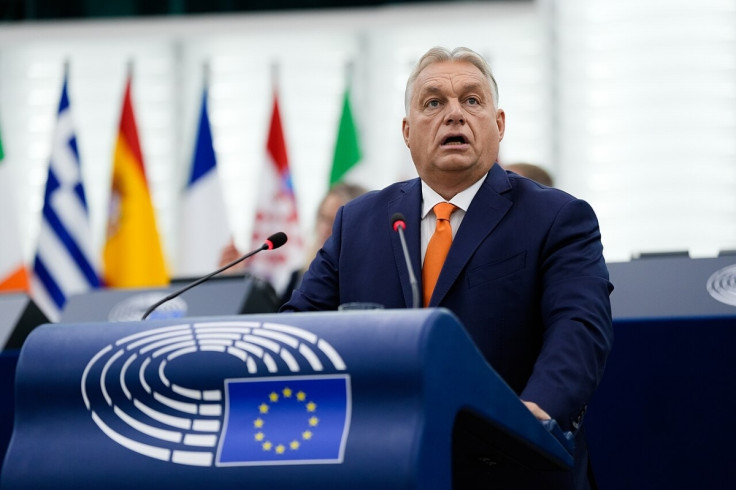
Orbán condemned the suspension of state broadcasts, describing the move on social media as 'another example of Tisza tyranny.' He encouraged viewers seeking what he called 'the truth' to watch Hír TV, a broadcaster closely linked to his Fidesz party.
Although analysts expect several privately owned media companies associated with Orbán's allies to remain influential because of their established audiences, they say the political transition could introduce greater competition and reshape editorial priorities across Hungary's media industry.
For now, the temporary silence on Hungary's principal state news channels marks one of the clearest signs yet of how quickly the country's new leadership intends to dismantle institutions that had become closely identified with the Orbán era.
© Copyright IBTimes 2026. All rights reserved.