Horror as Man Brings Sister's Skeletal Remains to Bank to Prove Her Death and Access Her Account
Jeetu Munda was forced to exhume his sister to prove her death after failing to navigate complex banking laws in Eastern India

A horrific incident in Eastern India has exposed the tragic consequences of rigid rural banking rules and systemic failures in documentation within marginalised communities.
Jeetu Munda, a resident of the Keonjhar district in Odisha, stunned staff and customers at a local rural bank this week when he arrived carrying the exhumed skeletal remains of his sister, Kalra Munda.
The Odisha bank skeletal remains spectacle was a last resort for Munda, who had spent months attempting to access the ₹19,300 (approximately £183) left in his sister's account following her death earlier this year.
Driven to a state of 'grave desperation' after his requests were repeatedly denied due to a lack of paperwork, Munda believed the physical remains were the only 'undeniable proof' left to offer.
The Jeetu Munda case has since gone viral, sparking an international conversation about financial literacy in Odisha and the lack of a humanitarian banking approach for the illiterate and vulnerable.
A Shocking Scene That Left Staff And Locals Stunned
Jeetu Munda reportedly arrived at a local branch of the bank carrying the skeletal remains of his sister, Kalra, wrapped in cloth. Witnesses described scenes of panic among staff and customers as the remains were brought to the premises.
The incident followed repeated failed attempts by Jeetu to withdraw money from his sister's account after her death earlier in the year. Without official documentation such as a death certificate or a legal heir certificate, his requests were denied.
Frustrated and unable to navigate the system, he resorted to an extreme measure, digging up her remains to present what he believed would be undeniable proof of her death.
'Out of frustration, I dug the grave and brought her remains as proof of death,' Jeetu Munda said, explaining his actions.
Bureaucratic Barriers And Miscommunication
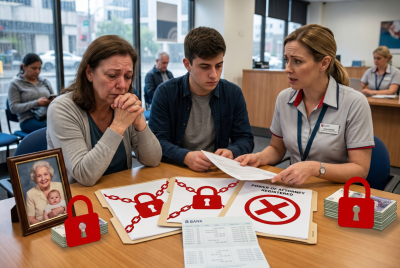
At the heart of the incident lies a breakdown in communication between the bank and a vulnerable customer.
Officials maintain that the bank followed standard procedure, requiring documentation to release funds from a deceased person's account. However, local authorities and observers have pointed to a failure to adequately explain those requirements.
Jeetu Munda, described as an illiterate tribal man, reportedly did not understand concepts such as 'legal heir' or 'nominee', leaving him unable to comply with the process.
In some accounts, he believed bank staff were insisting that the account holder be physically present, an impossibility that ultimately drove his drastic actions.
Critics have argued that the episode reflects a lack of a humanitarian approach to individuals who lack formal education or access to administrative support.
A Journey Marked By Desperation
Reports indicate that Jeetu Munda carried the remains over a significant distance in the heat before arriving at the bank, underscoring the level of desperation involved.
The amount he was attempting to withdraw, around ₹19,300, was relatively modest.
Yet for individuals in economically marginalised communities, such sums can represent critical financial support.
The stark contrast between the modest amount involved and the extreme nature of the act has further fuelled public debate about inequality and access to financial systems.
Authorities Intervene To Resolve The Situation
Following the incident, police and local officials stepped in to restore order and address the situation.
Authorities facilitated the issuance of the necessary documents, including a death certificate and legal heir certification, enabling Munda to finally access the funds.
The remains of his sister were subsequently reburied under supervision, bringing a tragic episode to a close.
No charges are expected to be brought against him, with officials acknowledging that his actions stemmed from confusion rather than criminal intent.
Public Reaction and Systemic Concerns
The incident has triggered widespread outrage and debate across India and beyond.
Many commentators have criticised what they see as rigid bureaucracy and a lack of empathy in handling vulnerable individuals. Others have pointed to deeper structural issues, including limited access to documentation in rural areas and low levels of financial literacy.
Social workers and community leaders have described the episode as 'heartbreaking', emphasising the struggles marginalised groups face when interacting with formal institutions.
The case has also prompted calls for reforms to simplify banking procedures and improve communication with customers who may not fully understand legal or administrative requirements.
A Disturbing Parallel In Brazil
While the Odisha case appears to have been driven by confusion and desperation, a similarly shocking incident in 2024 highlighted a darker dimension of such behaviour.
In Brazil, a woman was arrested after bringing the body of her deceased relative to a bank in an attempt to secure a loan. Authorities alleged that the act was part of a fraudulent scheme, with the deceased man being used to sign documents.
The case, widely reported at the time, was treated as a criminal investigation rather than a misunderstanding, drawing international attention and condemnation.
The contrast between the two incidents is striking: one rooted in alleged deception, the other in systemic failure and lack of awareness.
The Human Cost Of Red Tape
At its core, the Odisha case underscores the human consequences of bureaucratic rigidity.
For individuals without access to education, documentation, or guidance, navigating formal systems can be overwhelming. What may seem like a routine administrative requirement can become an insurmountable barrier.
In this instance, the inability to obtain or understand basic paperwork escalated into a shocking public spectacle that could have been avoided with clearer communication and support.
The image of a man carrying his sister's skeletal remains to a bank is as haunting as it is revealing.
While the immediate issue has been resolved, the incident raises broader questions about access, empathy, and the role of institutions in serving vulnerable communities. Ultimately, it is not just a story of shock, but one of systemic gaps that, left unaddressed, risk repeating themselves in equally disturbing ways.
As the Odisha bank skeletal remains story continues to circulate, it serves as a haunting indictment of 'red tape' and its human cost. For the institutions involved, the lesson is clear: rules without empathy are not just ineffective, they are dangerous.
© Copyright IBTimes 2026. All rights reserved.
- Recommended For You