Iran's 'Game Changer' Missile Strike On Diego Garcia Puts Europe In Range
Western officials are now reassessing the scale of Iran's missile ambitions, from Indian Ocean test shots to eventual intercontinental systems.

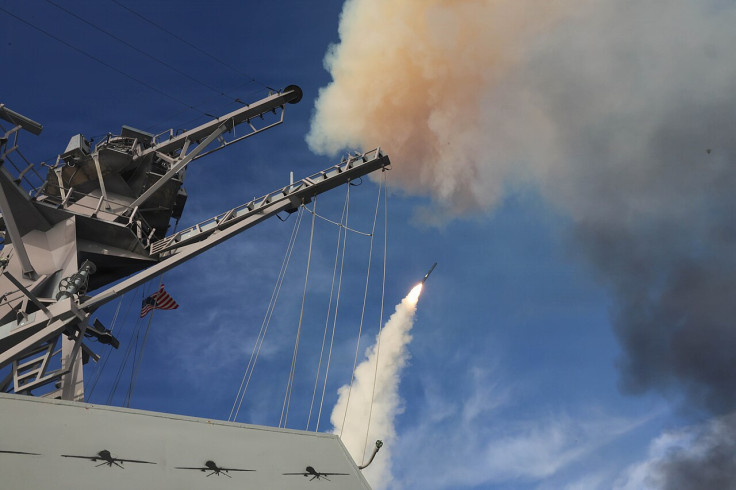
Iran's decision to fire two ballistic missiles towards the US–UK base at Diego Garcia in the Indian Ocean on 20 March has jolted defence planners in Europe, who are being warned that much of the continent now lies within range of Tehran's evolving arsenal, according to Western and Israeli assessments. Although one missile fell into the sea and the other was intercepted, analysts say the attempted strike suggests Iran has quietly crossed a threshold that could reshape how NATO thinks about its own security.
For context, Iran has long insisted that its missiles are capped at a self‑imposed range limit of about 1,240 miles. Western governments treated that ceiling with suspicion but, for years, it provided a kind of diplomatic fig leaf. The Diego Garcia incident, directed at a remote atoll roughly 2,360 miles from Iran and capable of hosting US long‑range bombers, is now being cited as evidence that the range 'fiction,' as one expert put it, has effectively collapsed.
Iran's Diego Garcia Shot And The End Of 'Strategic Ambiguity'
Iran has officially denied firing the munitions. Israeli military assessments, however, say Tehran used a two‑stage intermediate‑range ballistic missile with an operational reach of around 2,500 miles.
NATO secretary‑general Mark Rutte told CBS's Face the Nation that the alliance 'cannot confirm' Israel's claim that Iran pulled the trigger. He added that, if verified, the launch would underline why degrading Iran's missile and nuclear capacity remains central to Western strategy.
Security specialists argue that, even as a failed strike, Diego Garcia is a watershed. Behnam Ben Taleblu, senior director of the Foundation for Defense of Democracies' Iran programme, said the event effectively revealed "an entirely new missile" and called it a 'game changer.'
Nicholas Carl, a fellow with the American Enterprise Institute's Critical Threats Project, reached a similar conclusion in a recent interview. He said policymakers 'now need to rethink some of the underlying assumptions people have long had about the Iranian missile threat and where Iran could plausibly reach.'
Hudson Institute senior fellow Can Kasapoğlu was even more blunt. He wrote that Iran has for years sustained a 'convenient fiction' about the 1,240‑mile cap, using it to serve diplomatic interests while 'masking the true pace of its development.' The Diego Garcia profile, he argued, shows not just extended reach but a deliberate abandonment of 'strategic ambiguity.'
What Iran's Missile Test Means For Europe And NATO
Kasapoğlu warned that the implications for NATO are 'immediate and structural.' With the limited exception of the Iberian Peninsula, he wrote, alliance territory now appears to fall inside Iran's 'evolving missile engagement envelope,' including systems derived from its space‑launch vehicle programme. The suggestion is that rockets developed to loft satellites may double as the backbone for longer‑range military missiles.
🚨 BREAKING: 🚀🇮🇷
— IranDefenceForce (@IranDefenceForc) March 21, 2026
Iran fired missiles toward Diego Garcia 4,000 km away one failed, one intercepted.
pic.twitter.com/TzMQQgLaim
The technical details are still contested. Carl notes that analysts do not yet know whether Iran unveiled an entirely new system at Diego Garcia or fired a modified version of an existing missile fitted with a lighter warhead to squeeze out more distance. That ambiguity has fuelled debate over whether the projectile stemmed from Iran's known Khorramshahr medium‑range missile, first tested in 2017, or from solid‑fuel space‑launch vehicles reworked to carry a re‑entry vehicle.
🚨🇺🇸🇮🇷 Iran doubled its missile range from 2,000km to 4,000km, launching 2 missiles at the U.S-UK base in Diego Garcia.
— Mario Nawfal (@MarioNawfal) March 21, 2026
They didn't hit, but they sent a warning that its strike range can now reach Europe.pic.twitter.com/7FpoWO3JIM https://t.co/VbrOSe9sS3
Taleblu said both options would require significant modification and raised an additional question: if Iran used an SLV‑derived design, 'what kind of foreign support, if any at all, did the regime receive?' Kasapoğlu, citing Israeli assessments, leans towards that SLV route. He pointed to systems such as Zoljanah, Qased and, 'likeliest of all,' Ghaem‑100 as close analogues, combining multistage architecture, advances in solid propellant and range characteristics consistent with the Diego Garcia profile.
Those judgements are not universally confirmed and much of the underlying data remains classified. NATO has not publicly endorsed any specific missile designation, and Iran's denial further muddies the picture. In the absence of open technical evidence, any precise claim about the exact model used should be treated with a degree of caution.
Fox News is absolutely panicking. They just realized Iran has long-range missiles capable of hitting Europe, and they fired two of them at the US base in Diego Garcia. The US severely underestimated Iran's reach and now they are terrified. pic.twitter.com/mPZIwmC6Hh
— Furkan Gözükara (@FurkanGozukara) March 24, 2026
What is clearer is the direction of travel. At a US Senate Armed Services Committee hearing, Senator Tom Cotton asked General Stephen N Whiting, commander of US Space Command, whether Iran's SLV work was simply 'flimsy cover' for building an intercontinental missile. Whiting replied that he believed Tehran was indeed developing an ICBM. A 2023 Defence Intelligence Agency report had already concluded that Iran's space vehicles could be repurposed for such weapons, estimating that up to 60 ICBMs might be fielded by around 2035.
CIA director John Ratcliffe told senators that Iran was gaining experience with missiles reaching roughly 3,000 kilometres. Left 'untouched,' he said, Tehran 'would have the ability to range missiles' to the continental United States. He linked that warning directly to ongoing US strikes under Operation Epic Fury, framed as an effort to degrade Iran's missile production capacity.
BREAKING: Iran likely used the Khorramshahr-4 missile in the attempted strike on Diego Garcia, suggesting a range exceeding 4,000 km.
— Brian Krassenstein (@krassenstein) March 21, 2026
If confirmed, this means Iran could strike nearly all of Europe, including France and the UK, with missiles capable of carrying cluster or… pic.twitter.com/rgt1yifEQf
Western officials are also grappling with intent as well as capability. UK defence secretary John Healey, speaking to Sky News, did not rule out that Iran could reach Britain but stressed that military assessments see no current plan to strike London. Nicholas Carl has pointed out that accuracy remains a weakness, saying Iran has 'really struggled' with precision at long distances, particularly against targets as far away as Israel. That limitation does not, however, mitigate the political shock of watching a projectile arcing toward Diego Garcia.
For Taleblu, the lesson is stark. He argues that the United States 'must succeed" in efforts to 'handicap, meaningfully set back, if not destroy' Iran's missile systems, warning that simply knocking out launchers will not change the underlying trajectory. Kasapoğlu goes further, writing that a demonstrated range of 2,500 miles is 'not an endpoint, but a developmental midpoint' for the Islamic Republic, and that for the West, the attempted Diego Garcia strike should be read as a marker of Iran's deliberate march toward intercontinental capability.
© Copyright IBTimes 2026. All rights reserved.
- MOST POPULAR IN Trending