Could Trump Really Use Nuclear Weapons Against Iran? Vance's Ominous Warning Forced the White House to Respond
Vance's 'Toolkit' remark sparked a global panic — then the White House stepped In
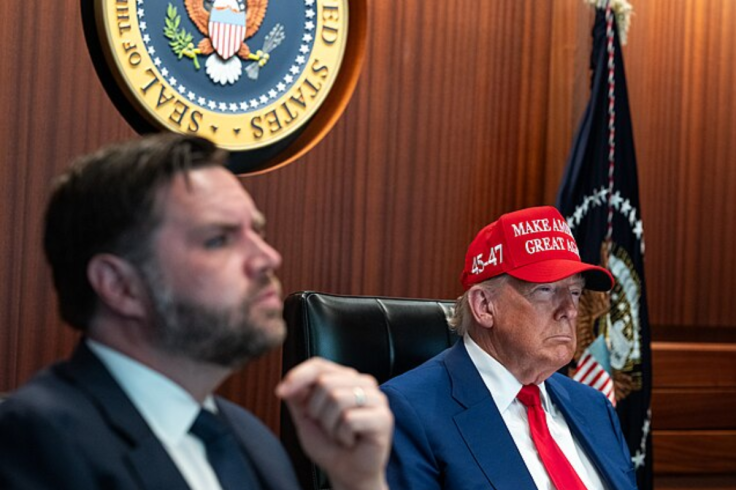
As tensions between Washington and Tehran reached a peak on Tuesday, a single phrase from US Vice President JD Vance prompted global concern—and a rare public clarification from the White House. Speaking at a press conference in Budapest, Hungary, Vance warned that the United States has 'tools in our toolkit that we so far haven't decided to use' against Iran, adding that 'the president of the United States can decide to use them, and he will decide to use them if the Iranians don't change their course of conduct'. The remarks, delivered hours before President Donald Trump's self-imposed 8 pm ET deadline for Iran to reopen the Strait of Hormuz, raised fears that the administration was contemplating a nuclear strike on the Islamic Republic.
The alarm grew against the backdrop of Trump's own Truth Social post earlier that day. 'A whole civilisation will die tonight, never to be brought back again. I don't want that to happen, but it probably will,' Trump wrote, while leaving open the possibility of an off-ramp, saying that 'maybe something revolutionarily wonderful can happen'. The combination of Trump's apocalyptic language and Vance's reference to unused capabilities prompted international speculation—and a swift rebuttal from the White House.
'Absolute Buffoons'
The White House denied that Vance's remarks suggested a nuclear strike against Iran, posting on X: 'Literally nothing @VP said here implies this, you absolute buffoons'. The post targeted an account associated with former Vice President Kamala Harris, which had claimed Vance implied Trump 'might use nuclear weapons'. In a later statement, the White House said that 'only the president knows' what he will do regarding Iran.
The administration's position on nuclear weapons has remained consistent. From the opening hours of Operation Epic Fury, the White House stated that one of the campaign's core objectives was to 'ensure the world's leading state sponsor of terrorism will never acquire a nuclear weapon,' with no indication that the US would deploy one. Trump's statements have repeatedly framed nuclear weapons as something Iran must never possess—not a tool Washington intends to wield.
Literally nothing @VP said here "implies" this, you absolute buffoons https://t.co/7JU3wXMaWX
— Rapid Response 47 (@RapidResponse47) April 7, 2026
Tehran Fires Back
Iran responded defiantly to Trump's ultimatum. In a social media post, the Iranian Embassy in Thailand responded to Trump's 'whole civilisation will die' threat, saying: 'Civilisations don't die by bombing'. The Iranian Revolutionary Guard Corps (IRGC) was similarly unyielding. IRGC spokesperson Ebrahim Zolfaqari called Trump's threats 'baseless,' warning: 'If attacks on non-civilian targets are repeated, our retaliatory response will be carried out far more forcefully and on a much wider scale'.
On the ground, the situation deteriorated rapidly. Airstrikes hit two bridges and a train station in Iran on Tuesday, while Iranian officials urged young people to form human chains around power plants to deter further strikes. Iran also retaliated militarily, firing missiles into central Israel, Saudi Arabia and Bahrain, forcing the closure of the King Fahd bridge between the two Gulf countries. Saudi Arabia's Ministry of Defence reported damage to an energy facility caused by falling debris from ballistic missiles and drones intercepted by its air defence systems.
Diplomacy Hanging by a Thread
Even as the deadline loomed, diplomatic channels remained technically open — if barely. The New York Times, citing three senior Iranian officials, reported that Iran had stopped direct negotiation efforts with the US and told Pakistan, which had been acting as a mediator, that it would end ceasefire talks. However, Iran's state-run Tehran Times said in an X post that 'diplomatic and indirect channels of talks with the US are not closed.'
BREAKING: President Trump provides an update on his 8 PM ET deadline for Iran tonight.
— The Kobeissi Letter (@KobeissiLetter) April 7, 2026
President Trump says:
1. The US is preparing to carry out "heavy strikes" against Iran if his 8 PM deadline is not met tonight
2. If negotiations with Iran make progress today and something…
The Arms Control Association, which has closely tracked the Iran nuclear file throughout the conflict, noted that despite Trump's envoy Steve Witkoff claiming Iran was 'probably a week away from having industrial-grade bomb-making material,' the US intelligence community's own 2026 Worldwide Threat Assessment did not indicate that Iran had made a decision to weaponise its nuclear programme. The discrepancy between the administration's public rhetoric and its own intelligence assessments has drawn scrutiny from arms control experts.
The Vance episode cuts to the heart of a central anxiety in the current conflict — that ambiguous language from senior US officials, left unclarified, can accelerate the very crisis the administration claims it wants to resolve. Human rights expert Kenneth Roth, former executive director of Human Rights Watch, warned that Trump was 'openly threatening collective punishment, targeting not the Iranian military but the Iranian people,' adding that 'attacking civilians is a war crime' and that even making such threats 'with the aim of terrorising the civilian population' may itself constitute a violation under international humanitarian law. With more than 3,400 people already reported killed across the wider conflict, according to NBC News, the stakes of miscalculation — deliberate or otherwise — have never been higher.
© Copyright IBTimes 2026. All rights reserved.
- Recommended For You