Iran War Update: Trump Unveils 3-Week Exit Plan, Slams NATO Allies as Oil Remains Over $100
Tehran denies Trump's ceasefire claim, while UK PM Starmer leads a 35-nation summit to restore Strait passage without escalation

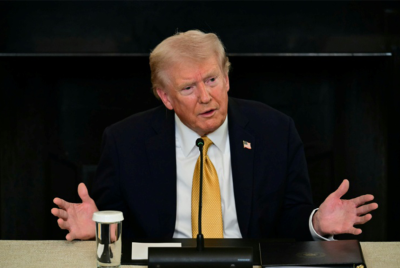
President Donald Trump declared the US war on Iran 'nearing completion' in a primetime White House address on Wednesday, projecting a two-to-three-week exit, but his speech capped a day in which he threatened to rip the United States out of the North Atlantic Treaty Organisation (NATO) and branded the alliance a 'paper tiger'.
The address, delivered at 9 p.m. ET on 1 April (2 a.m. BST on 2 April), was billed as an update on Operation Epic Fury. It became something else entirely.
In a pre-speech interview with Reuters, Trump said he is 'absolutely' considering a formal US withdrawal from NATO because allied nations refused to help unblock the Strait of Hormuz. 'They haven't been friends when we needed them,' he said. 'It's a one-way street.'
Trump Frames Victory to Justify Breaking With Allies
The day carried a dual message. For Tehran, it was a final warning. For Europe, it may be a goodbye.
Trump told Britain's The Telegraph that NATO membership is now 'beyond reconsideration', and singled out UK Prime Minister Keir Starmer for refusing to join the US-Israeli offensive. 'You don't even have a navy,' he said of Britain.
Secretary of State Marco Rubio reinforced the threat on Fox News, saying the US would 're-examine' whether NATO still serves its purpose or has become an arrangement where 'America is simply in a position to defend Europe.'
In the speech itself, Trump didn't mention NATO by name, but his demand that allies 'go get your own oil' made the message clear.
Tehran Denies Ceasefire Claim
Hours before the speech, Trump posted on Truth Social that Iran's president had requested a ceasefire. Iran's Foreign Ministry spokesperson, Esmail Baghaei, dismissed the assertion as 'false and baseless,' according to Iranian state television.

The Islamic Revolutionary Guard Corps (IRGC) went further, declaring the Strait of Hormuz 'firmly and decisively' under its control. Iranian Foreign Minister Abbas Araghchi told Al Jazeera that 'you cannot speak to the people of Iran in the language of threats and deadlines.'
In the speech, Trump warned he would hit Iran's power grid if no deal is reached, vowing to bring the country 'back to the stone ages.'
Oil Stays Above $100 as Supply Buffers Run Dry
Both Brent crude and US benchmark West Texas Intermediate (WTI) are trading above $100 (£76) a barrel, up from roughly $70 (£53) before the war began on 28 February. US petrol prices hit $4.06 (£3.07) a gallon on Wednesday, a 36% jump in one month, according to AAA.
International Energy Agency (IEA) Executive Director Fatih Birol warned that the oil crisis will worsen sharply in April as pre-war shipments and strategic reserves run dry. 'The next month, April, will be much worse than March,' he said, calling the disruption 'the biggest in history.'
Starmer Charts a Separate Course
Starmer responded from Downing Street with a firm line. 'This is not our war, and we are not going to get dragged into it,' he said, while defending NATO as 'the single most effective military alliance the world has ever seen.'
🚨 WATCH: Keir Starmer's full address to the nation
— Politics UK (@PolitlcsUK) April 1, 2026
"It is now clear the impact of this war will affect the future of our country. So today I want to reassure the British people: no matter how fierce this storm, we are well placed to weather it" pic.twitter.com/VQWdTr1vKT
The UK will host a 35-nation diplomatic summit this week, led by Foreign Secretary Yvette Cooper, to explore how to restore safe passage through the Strait without military escalation.
Democratic Senator Mark Warner called Trump's NATO threat 'reckless.' Poland's Defence Minister Władysław Kosiniak-Kamysz wrote on X that 'there is no NATO without the USA, but there is no strong United States without allies either.'
The war has killed 13 US service members and left 348 seriously wounded, US Central Command confirmed. With no plan to reopen the Strait and allies now openly charting their own course, the question is no longer just when the war ends. It's what comes after.
© Copyright IBTimes 2026. All rights reserved.
- Recommended For You