'Our President Is NOT a Christian': Marjorie Taylor Greene Says Trump Allies Should 'Beg for Forgiveness'
Greene's Critique Sparks Debate Over Trump's Religious Image

Marjorie Taylor Greene's extraordinary declaration that Donald Trump is 'not a Christian' has blown open one of the most volatile fault lines in Trumpworld: whether loyalty to the President now matters more than the religious values many of his closest allies claim to defend, or even live by. What had long been an uneasy bargain between faith and politics is suddenly being tested in public by one of Trump's own former champions.
The former Georgia congresswoman, once one of Trump's fiercest loyalists, launched the attack after the President used Easter Sunday to post an inflammatory threat aimed at Iran, complete with profanity and a closing phrase in Arabic. Greene did not merely criticise the language. She accused the President's Christian supporters inside government of moral cowardice and urged them to 'fall on their knees and beg forgiveness from God'.
The rupture is striking not only because of Greene's history as a hard-line MAGA standard-bearer, but because it goes to the heart of Trump's political identity: his claim to be a champion of Christian America, even as his rhetoric and conduct increasingly test the patience of some of the movement's most religious voices.
The Easter Post That Triggered The Break
The immediate flashpoint was a Truth Social post Trump published on Easter Sunday, 5 Apr 2026, as the US–Iran crisis intensified. In the message, Trump warned Iran to 'open the f---in' Strait [of Hormuz]' and threatened to strike civilian infrastructure, including power plants and bridges, before signing off with the phrase 'Praise be to Allah.'
Greene responded publicly on X the same day, and her language was unusually absolute even by the standards of Trump-era Republican infighting. 'Everyone in his administration that claims to be a Christian needs to fall on their knees and beg forgiveness from God and stop worshipping the President and intervene in Trump's madness,' she wrote. She then added: 'Our President is not a Christian and his words and actions should not be supported by Christians.'
That was not a passing rebuke. It was a direct challenge to one of the core bargains that has long sustained Trump's coalition: that conservative Christians would continue to overlook his rhetoric, personal conduct and confrontational politics in exchange for policy wins and cultural combat on their behalf.
On Easter morning, this is what President Trump posted.
— Former Congresswoman Marjorie Taylor Greene🇺🇸 (@FmrRepMTG) April 5, 2026
Everyone in his administration that claims to be a Christian needs to fall on their knees and beg forgiveness from God and stop worshipping the President and intervene in Trump’s madness.
I know all of you and him and he… pic.twitter.com/DgR74YjPQf
Why Greene's Attack Matters
Greene is not an ordinary Republican dissenter. For years, she served as one of Trump's most aggressive public defenders, often speaking in explicitly religious terms about politics, nationalism and the moral direction of the United States. Her condemnation therefore carries weight precisely because it comes from inside the movement, not from one of Trump's longstanding institutional critics.
Her argument was not primarily about tone. It was theological and political at once. Greene framed Trump's Easter rhetoric as a betrayal of Christian ethics, writing that 'Jesus commanded us to love one another and forgive one another. Even our enemies.' In doing so, she placed Trump's Iran posture inside a much larger dispute over whether the religious language increasingly used by his administration reflects faith or merely instrumental politics.
That tension has become more visible in recent days. The White House has simultaneously issued overtly Christian Easter messaging, including a formal presidential Easter statement centred on the Resurrection and redemption, while also promoting Trump as a 'fierce defender of the Christian faith'. Yet that official imagery now sits uneasily alongside Trump's own wartime rhetoric and Greene's claim that many of his supporters are effectively 'worshipping the President'.
This Easter Sunday, Christians across our nation and around the world celebrate the Resurrection of Jesus Christ—His triumph over sin and death brings redemption, hope, and eternal life.
— The White House (@WhiteHouse) April 5, 2026
He is risen. Happy Easter! pic.twitter.com/RtZumk5BCS
Religion, War And The New MAGA Fracture
Greene's criticism also lands at a moment when parts of the American right are splitting over foreign policy, particularly over Iran and the broader US role in the Middle East. Trump has increasingly wrapped military messaging in religious language, prompting unease not only among opponents but among some figures on the populist right who had expected a more restrained foreign policy after the 2024 election.
That matters because Trump's political coalition is no longer held together by a single ideology. It includes evangelical conservatives, economic nationalists, anti-interventionists, culture-war maximalists and traditional Republicans, all of whom can tolerate different kinds of contradiction until a moral breaking point is reached. Greene's Easter intervention suggests that for at least some former insiders, the combination of war rhetoric and religious posturing may be approaching that threshold.
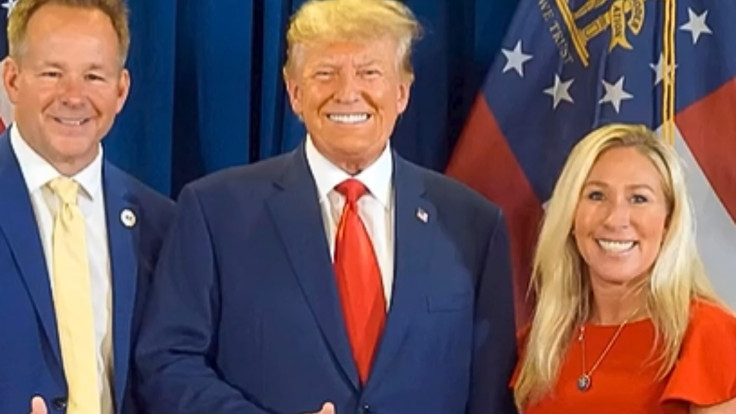
Her choice of words was especially revealing. She did not say Trump had merely said the wrong thing. She said what many in his administration are doing is spiritually disordered. That kind of language is familiar in revivalist and evangelical settings, where public repentance is treated not as symbolism but as a test of sincerity. By telling Trump's Christian allies to 'beg forgiveness', Greene was not just criticising them politically; she was accusing them of moral complicity.
A Public Rebuke With Political Consequences
Whether Greene's broadside marks a durable break or another episodic MAGA feud remains to be seen. Trump has survived, and often benefited from, repeated clashes with former allies who later found themselves pushed to the margins of the movement. But Greene's criticism is different in one important respect: it strikes at the moral legitimacy of the religious brand that has become central to Trump's second-term political image.
The White House has gone out of its way to cast Trump as a protector of Christianity, including through Easter messaging that explicitly links the nation's identity to the Gospel and Christian liberty. Greene's intervention now forces a more uncomfortable question into the open: whether a political movement built around Christian symbolism can sustain itself when one of its own most recognisable former champions says its leader's conduct is fundamentally un-Christian.
For now, Trump's base may absorb the shock as it has so many others. But Greene's rebuke ensures that this is no longer simply a dispute over foreign policy or social media excess. It is now a battle over who gets to define faith, loyalty and moral authority inside Trump's America.
And when a former MAGA loyalist starts calling the movement's central figure 'not a Christian', the fallout rarely stays confined to one Easter weekend post.
© Copyright IBTimes 2026. All rights reserved.
- Recommended For You