US Troops Could Refuse 'Illegal Orders' From Trump, Retired General Warns As Iran Tensions Explode
Military Experts Highlight Legal Boundaries Amid Escalating Tensions
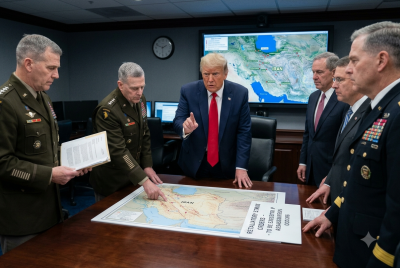
A deepening war of words over Iran has triggered warnings from military experts that US troops could face the extraordinary prospect of refusing 'unlawful orders', as Donald Trump's escalating rhetoric begins to fracture his own political base. What started as another pointed broadside against Tehran has quickly morphed into a wider argument over the limits of presidential power, the duties of those in uniform, and how far campaign-style threats can go before colliding with constitutional red lines.
The president's warning that Iranian actions could lead to the destruction of 'civilisation' has not only escalated tensions abroad but ignited fierce debate at home. Some legal scholars and former military officials now caution that extreme directives, if issued, would raise serious constitutional and legal questions. The controversy has also exposed growing divisions within Trump's MAGA coalition, with prominent allies breaking ranks.
Legal Boundaries Of Military Obedience Under Scrutiny
Under US law, service members are required to follow lawful orders but are equally obligated to refuse those deemed illegal. This principle is codified in the Uniform Code of Military Justice (UCMJ) and reinforced through Department of Defense training.
The US Army's own guidance states that soldiers must disobey orders that are 'patently illegal', including those that would violate the law of armed conflict.
Retired Lieutenant General Mark Hertling has warned that US commanders may be forced to consider defying orders if they are deemed unlawful, underscoring the military's obligation to uphold the law of armed conflict over political directives. His remarks reflect long-standing doctrine that places legal responsibility on individual service members, even within the chain of command.
The Law of War Manual issued by the US Department of Defense similarly outlines constraints on targeting and proportionality in armed conflict.
Experts caution that any directive calling for indiscriminate destruction or targeting of civilians would fall outside these legal boundaries. While no such order has been issued, the rhetoric has prompted renewed discussion of these safeguards.
A prominent retired US General drops a truth bomb on MS Now. Mark Hertling confirms military commanders are actively preparing to defy Donald Trump. They are bound by the Constitution to disobey unlawful orders to bomb Iranian civilians. A military revolt is brewing. pic.twitter.com/FzDwHEPqwn
— Furkan Gözükara (@FurkanGozukara) April 6, 2026
Trump's Iran Rhetoric And Strategic Context
Trump's recent comments have centred on Iran's regional activities and nuclear programme, framing the country as a global threat. His language marks a continuation of his long-standing hardline stance, including the 2018 withdrawal from the Joint Comprehensive Plan of Action (JCPOA).
Since then, tensions have remained high. The International Atomic Energy Agency (IAEA) has reported increased uranium enrichment levels by Iran, raising concerns among Western governments.
Iran maintains that its nuclear programme is peaceful. However, the absence of a revived agreement has heightened the risk of miscalculation, particularly as rhetoric intensifies.
Analysts warn that language suggesting existential or civilisational stakes can complicate diplomatic pathways. Such framing may also influence military planning assumptions, even in the absence of formal policy shifts.
MAGA Divisions Reflect Broader Political Strain
The domestic political fallout has been swift. Several figures associated with Trump's political movement have publicly criticised his remarks, marking a rare break within a typically unified base.
Among them is conspiracy theorist and broadcaster Alex Jones, a long-time Trump supporter, who has expressed alarm at the implications of escalating rhetoric. His criticism underscores a broader unease among some right-wing commentators who fear that confrontation with Iran could lead to a wider conflict.
This internal dissent reflects a more complex political landscape as the United States approaches another election cycle. While many Republican leaders continue to support a hardline approach, others have urged caution, particularly given the risks of military escalation.
The debate has also drawn in legal scholars and former officials, who emphasise that constitutional constraints remain paramount regardless of political pressures.
🚨🚨WAR CRIME ALERT!!🚨🚨- Trump on Iran: "A whole civilization will die tonight, never to be brought back again.
— Alex Jones (@RealAlexJones) April 7, 2026
The definition of genocide is destroying an entire civilization/people!
Trump literally sounds like an unhinged super villain from a Marvel comic movie.
This IS… pic.twitter.com/rE0RUesZt4
Experts Warn Of Real-World Consequences
Military analysts stress that the discussion is not merely theoretical. The chain of command relies on clarity, discipline and adherence to lawful authority, particularly in high-stakes scenarios.
Retired officers and defence experts have warned that ambiguous or extreme directives could create confusion within the ranks. In such circumstances, the burden may fall on individual service members to interpret legality under pressure.
The US Department of Defense emphasises that adherence to the law of armed conflict is a cornerstone of military professionalism. Training materials and official doctrine consistently reinforce this obligation.
At the same time, experts caution against overstating the likelihood of widespread defiance. The US military operates within a robust legal framework, and mechanisms exist to review and challenge questionable orders through established channels.
Nevertheless, the convergence of heightened rhetoric, geopolitical tension and domestic political division has created an unusually charged environment. Analysts note that even the perception of potential conflict can influence strategic calculations on all sides.
The unfolding dispute illustrates how political language can reverberate far beyond the campaign trail, raising profound questions about law, loyalty and the limits of military power.
© Copyright IBTimes 2026. All rights reserved.
- Recommended For You