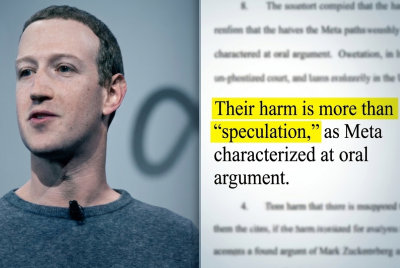
Mark Zuckerberg Orders Surviving Meta Staff to Have Fun Following Brutal Job Cuts
Zuckerberg's call for fun clashes with employee discontent post-layoffs

Mark Zuckerberg asked his remaining Meta staff to start having fun again, just weeks after axing 8,000 of their colleagues, urging them to throw themselves into a new artificial intelligence project even as the company pushes deeper into an era of 'efficiency'.
The Meta chief executive sent an internal memo on Friday urging employees to take part in a companywide artificial intelligence hackathon planned for July. The proposal landed badly with a workforce still reeling from the company's largest round of job cuts since 2023, and internal messages show staff openly rejecting the idea. Meta has not disputed the authenticity of the memo or the employee responses, which were first reported by Wired.
Hackathon Push Meets A Cool Reception
Meta has run companywide hackathons for years as a way to encourage experimentation and camaraderie among engineers. This time, employees pushed back hard, with one writing internally that they were 'literally preoccupied with keeping the lights on' for their team and had 'no incentive to participate, let alone have the time to do so', according to messages reported by Wired.
Another employee questioned the entire premise of the event, writing 'I'm not sure that this company supports a hackathon culture anymore' and pointing out that 'people are being asked to cover more work with less support while their colleagues get laid off'. A third worker noted they had taken part in previous hackathons but said the event 'no longer feels like an option alongside pod sprints' in their corner of the company.
Zuckerberg also offered staff access to permanent desks as part of the same memo, a gesture that drew attention to Meta's wider use of so-called 'hot desks', where multiple employees share the same workspace on a rotating basis.
META IS AN ABSOLUTE MESS INSIDE RIGHT NOW
— LayoffHedge (@LayoffAI) June 13, 2026
Wired just dropped an exclusive, and the details are wild.
This week someone interrupted a livestreamed Meta meeting, open to thousands of employees, with an expletive-filled rant about "being the company's bitch." They told the… pic.twitter.com/BnBDzhTD0P
The Layoffs Behind The Backlash
The hackathon proposal followed a restructuring that began on 20 May 2026, when Meta started cutting roughly 8,000 jobs, equivalent to ten per cent of its workforce. The company simultaneously brought its total headcount reductions since 2022 to roughly 25,000 positions, driven by a reallocation towards AI infrastructure projected to cost between £91.6bn and £107.6bn ($115bn-$135bn) in 2026.
Meta's Chief People Officer, Janelle Gale, told staff in a companywide memo that the changes formed part of the company's continued effort to run more efficiently and to help offset the other investments it was making. Roughly 7,000 employees were simultaneously redirected into newly created AI-focused teams, including Applied AI Engineering, the Agent Transformation Accelerator, and Central Analytics, while Meta also cancelled some 6,000 open job requisitions.
The cuts came despite, rather than because of, financial weakness. Meta reported record quarterly revenue of £44.4bn ($56.31bn) in the same period it announced the layoffs, while raising its 2026 AI infrastructure spending forecast to as much as £114.4bn ($145bn).
Meta acknowledged making mistakes while restructuring its workforce around AI.
— Wes Roth (@WesRoth) June 15, 2026
The company laid off 10% of its global workforce in May and reassigned around 7,000 employees to initiatives focused on AI workflows. It now plans to find new roles for some workers who were moved… pic.twitter.com/Spa841ibkv
A Pattern Of Cuts Under An AI Mandate
The May reductions were not an isolated event but the latest escalation in a yearlong restructuring drive. Meta had already cut between ten and fifteen per cent of its Reality Labs division in January 2026, shut down several virtual reality game studios, and eliminated roughly 700 positions across at least five divisions in March.
Zuckerberg has consistently framed the cuts as a function of AI efficiency rather than financial distress, telling investors during the company's Q1 2026 earnings call that Meta was seeing more and more examples of one or two people building in a week what would previously have taken dozens of people months. Meta's Chief Financial Officer, Susan Li, told investors on the same call that the leaner operating model would help offset the substantial investments the company was making in AI infrastructure.
In his Friday memo, Zuckerberg reportedly acknowledged the turbulence directly, admitting that 'given the complexity of these changes, we've made mistakes and will almost certainly make more', while predicting further difficult periods ahead even as he pledged to avoid additional companywide layoffs for the remainder of 2026.
For a workforce already absorbing record layoffs alongside record profits, Zuckerberg's call to have fun has, for now, found few takers.
© Copyright IBTimes 2026. All rights reserved.
- Recommended For You