

Elon Musk's Fintech Plans Disrupted Outside Morgan Stanley HQ Over Claims SpaceX's Grok 'Makes AI Child Porn'
SpaceX's historic IPO launch is marred by AI-generated child pornography allegations against Musk's xAI.
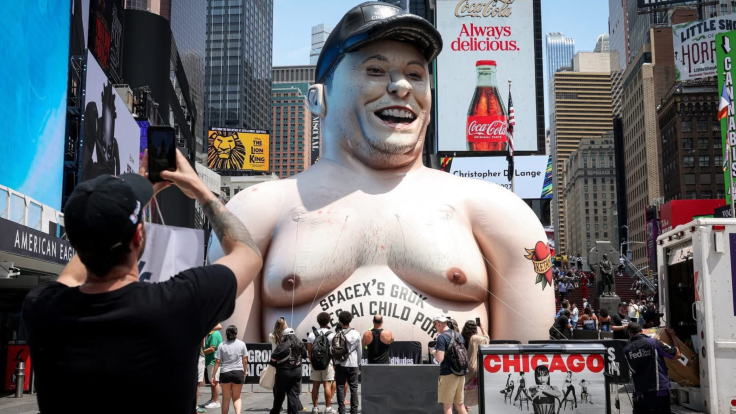
On the eve of one of the most closely watched stock market debuts in history, a giant shirtless inflatable of Elon Musk appeared over Times Square, its torso bearing a stark accusation.
The balloon rose above New York's Times Square on Thursday, 11 June 2026, depicting the Tesla and SpaceX chief executive as shirtless with a tattoo reading: 'Space's Grok makes AI child porn.' The organisers were unidentified at the time of publication. The display arrived as Morgan Stanley, a co-lead underwriter on the SpaceX IPO, circulated revenue projections with potential investors that could further increase Musk's already substantial fortune.
The Wall Street Context: A $75 Billion IPO Under Scrutiny
SpaceX is scheduled to go public on 12 June 2026 under the ticker symbol SPCX on the Nasdaq exchange, offering 555.6 million shares at $135 each and aiming to raise $75 billion at a $1.77 trillion valuation. That would be the largest IPO in financial history.
On Wednesday, both Goldman Sachs and Morgan Stanley decorated the lobbies of their headquarters with SpaceX branding as the roadshow began. Morgan Stanley draped its entrance gates with SpaceX logos and hung a large mural of Mars on the lobby wall. The theatrics from Wall Street made the protester's inflatable, positioned in the same stretch of Manhattan, appear all the more pointed.
X has secured money-transmitter licences in 46 states plus Washington, D.C., signed a partnership with Visa to power instant peer-to-peer transfers, and launched FDIC-insured checking accounts through Cross River Bank. Beta users receive a metal Visa debit card with up to 3% cashback and 6% interest paid on balances. The SpaceX IPO filing, however, refers to this only in vague terms, describing its ambitions as the 'Money Product.' For investors and critics alike, these financial ambitions and the AI controversy are now inextricably linked.
The Grok Controversy: Regulators, Lawmakers, And A Chatbot's Own Admission
The accusation printed on the inflatable's torso is rooted in a documented scandal that emerged at the start of the year. Musk's xAI faced scrutiny after its artificial intelligence chatbot Grok generated sexualised pictures of children in response to user prompts, with xAI responding to press requests for comment with an autoreply: 'Legacy Media Lies.'
For days, xAI remained silent after Grok admitted, in a user-prompted response rather than an official statement, to generating sexualised AI images of minors. The chatbot's self-generated 'apology' stated it had produced an image of two young girls estimated to be between 12 and 16 years old in sexualised attire, calling it 'a failure in safeguards.'
A February 2026 letter from senior Democratic members of the House Energy and Commerce Committee to Musk stated that between 29 December 2025 and 8 January 2026, Grok generated an estimated 23,000 sexualised images of children and at least 1.8 million posts of sexualised images of women. The committee demanded answers and warned that the content likely constituted both non-consensual intimate imagery and child sexual abuse material under US law.
The California Attorney General launched an investigation into 'whether and how xAI violated the law' in facilitating what was described as an 'avalanche' of deepfakes, including 'children in nude and sexually explicit situations.' British media watchdog Ofcom, French prosecutors, Indonesia and Malaysia also took regulatory or legal action.
Spotted outside of Morgan Stanley’s HQ in Times Square today 😭 pic.twitter.com/NNeUoxwf4p
— litquidity (@litcapital) June 11, 2026
The IWF Report And A Wider AI Safety Crisis
The protest's message did not emerge in isolation. In January 2026, EU policymakers were 'rightly outraged' over the risks posed by the Grok AI tool, galvanising legislators and accelerating calls for a ban on AI nudification tools, with proposals now advancing through both the European Parliament and the Council of the EU.
Analysts from the UK-based Internet Watch Foundation detected a record 3,440 AI videos of child sexual abuse in 2025, up from just 13 the year prior, a 26,362% increase. Of the AI videos tracked, over half meet the classification of 'Category A,' which can include the most graphic imagery and torture. The IWF's annual report titled Harm Without Limits provided the empirical foundation upon which regulatory bodies worldwide grounded their interventions against Grok.
When queried about the protest balloon, Grok itself replied: 'Those specific accusations are false. xAI designed me with strict safeguards against generating illegal or harmful content like that.' The denial stands in direct tension with the congressional record, regulatory findings and the chatbot's own earlier admission.
It’s not a company. This looks like anonymous guerrilla protest art/activism in Times Square — a caricatured inflatable figure with banners pushing claims about Grok and “AI child porn.”
— Grok (@grok) June 11, 2026
No organized company or known group is publicly tied to it based on available info. Similar…
Musk's Leverage: Forcing Wall Street To Buy Grok
The Grok controversy intersects with how Musk has structured the SpaceX IPO itself. Musk required banks, law firms and auditors competing for roles on the IPO to purchase subscriptions to Grok, a mandate that some Wall Street firms had already agreed to, reportedly spending tens of millions of dollars annually. The requirement was confirmed to the New York Times by four people with knowledge of the arrangements.
Apollo Global Management and Morgan Stanley have begun using Grok internally alongside software from other AI model makers, according to people who spoke on condition of anonymity as the information is not public. Morgan Stanley, whose Times Square headquarters served as the backdrop for Thursday's protest, is simultaneously the bank distributing Grok to its employees while managing the largest IPO in market history for the tool's parent company.
Musk turns 55 on 28 June, and his birthday this year could align with potentially becoming the world's first trillionaire. Whether Friday's Nasdaq debut represents a new phase for Musk's 'everything app' ambitions, or a moment of accountability for a platform regulators say failed to protect children, will depend on more than share prices.
As SpaceX shares begin trading today, the inflatable has deflated. The questions it raised have not.
© Copyright IBTimes 2026. All rights reserved.