Supreme Court Moves To Dismiss Steve Bannon Contempt Case In Major Blow To Jan 6 Committee
A contempt case born in the heat of the Capitol riot inquiry is quietly unravelling in the cool, procedural language of the Supreme Court.

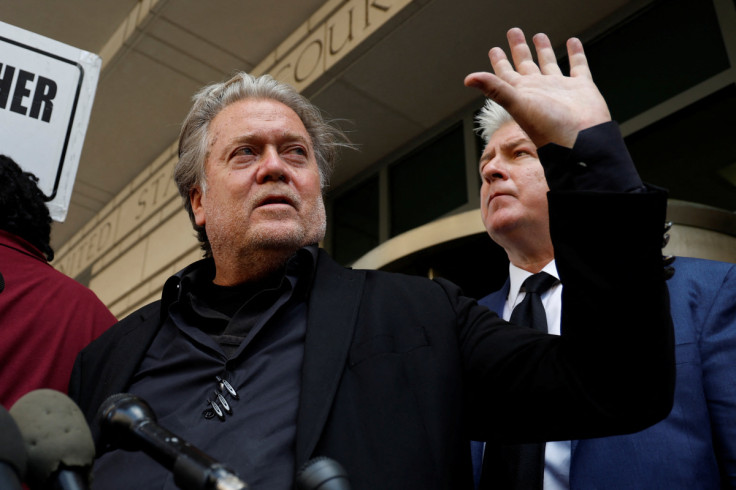
Steve Bannon's contempt of Congress conviction is now on course to be wiped away, after the US Supreme Court in Washington on Monday sent his case back to a lower court where a judge is expected to dismiss it at the Justice Department's request.
The news came after a two–year legal saga that grew out of the House of Representatives' investigation into the 6 January 2021 attack on the US Capitol. Bannon, a former White House strategist and one of Donald Trump's most vocal allies, was convicted in 2022 of refusing to comply with a subpoena from the now‑defunct House select committee, which had demanded his testimony and documents about efforts to overturn the 2020 election.
Supreme Court Shifts Course On Steve Bannon Contempt Case
On Monday, the justices declined to hear Steve Bannon's full appeal, which had challenged his conviction on constitutional and procedural grounds. Instead, they granted a narrower request, vacating a previous ruling against him and returning the case to the US Court of Appeals and then, effectively, to the trial court in Washington DC.
Ordinarily, such a move would set the stage for another round of arguments. Here, it has a very different effect. In February, the Justice Department itself asked for the two‑count indictment against Bannon to be dismissed, signalling that prosecutors no longer wished to defend the case they had brought nearly five years ago.
'The government has determined in its prosecutorial discretion that dismissal of this criminal case is in the interests of justice,' Solicitor General D. John Sauer told the court last month. With that position on the record, the Supreme Court's procedural step all but guarantees that US District Judge Carl Nichols, who presided over the original trial, will now formally erase the conviction.
How Steve Bannon Was Convicted Over Jan 6 Subpoena
For context, Bannon was indicted after he refused to appear for a deposition ordered by the January 6 panel and failed to turn over documents it had subpoenaed. Prosecutors argued he had simply defied Congress. A federal jury in Washington agreed, finding him guilty on two counts of contempt of Congress.
Judge Nichols sentenced Steve Bannon to four months in prison. He initially allowed Bannon to delay reporting to jail while his appeal moved through the courts. That reprieve lasted roughly two years, until 2024, when Bannon ultimately served the four‑month term.
Bannon's defence centred on the advice he said he received from his lawyers at the time. According to filings, he was told to hold off on complying with the committee's demands while questions around executive privilege — the doctrine that protects some presidential communications from disclosure — were resolved. The House committee and prosecutors contended that claim was a smokescreen, noting that Bannon had not been a government official at the time of the 6 January attack and that no formal privilege assertion covered his testimony.
In their latest submissions to the Supreme Court, Bannon's team did not hide their view of the prosecution. 'The government acknowledges that Petitioner's criminal prosecution was unjust,' his lawyer Michael Buschbacher told the justices, seizing on the Justice Department's own language about the 'interests of justice.'
There is no independent confirmation in the court's order that the justices themselves consider the case unjust, and nothing in Monday's decision amounts to a declaration of innocence. Technically, the Supreme Court has simply cleared a procedural path. The substantive decision to abandon the conviction belongs to the executive branch, and should still be treated with a degree of caution until Judge Nichols issues the formal dismissal.
Wider Fallout For Jan 6 Investigations And Allies Of Trump
Steve Bannon was not the only Trump adviser to be swept up in contempt cases linked to the 6 January probe. Peter Navarro, who served as a White House trade adviser, was also convicted on the same two counts for refusing to comply with a subpoena from the committee. Navarro has already served a four‑month sentence, mirroring Bannon's term.
Unlike Bannon, however, Navarro's appeal is still live. The Justice Department has dropped its defence of that conviction as well, according to filings, yet the underlying judgment remains in place while the appeal winds on. That leaves Navarro in an odd legal limbo. He has completed his punishment, but the government is now, in effect, walking away from the very victory it secured at trial.
Key points in the case now are that Bannon's 2022 jury conviction is set to be vacated, the Justice Department has formally declared that dismissal serves 'the interests of justice,' and the Supreme Court has chosen not to examine the underlying constitutional questions. Until the lower court signs off, nothing is absolutely final, but the direction of travel could hardly be clearer.
© Copyright IBTimes 2026. All rights reserved.
- Recommended For You